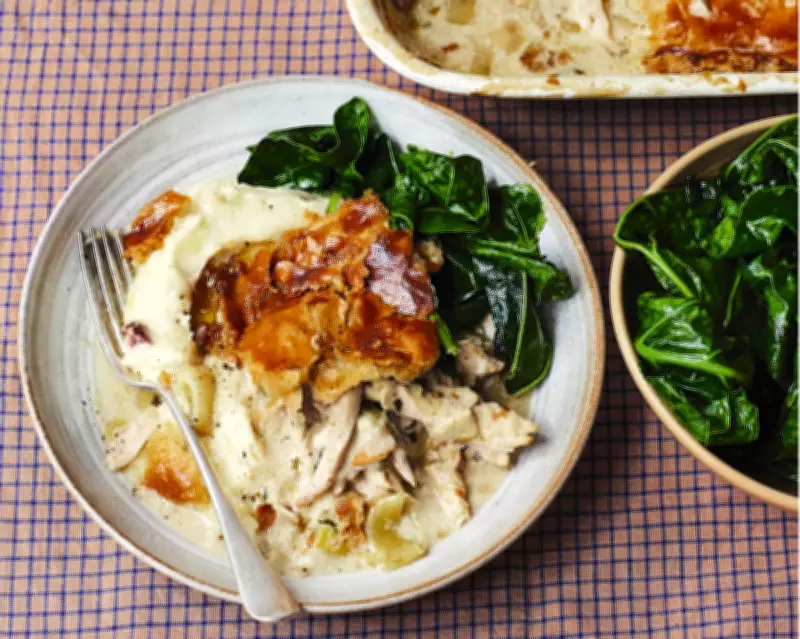
Seeking perfection … Felicity Cloake’s chicken pie. Photograph: Lizzie Mayson/The Guardian
Why we care so much about preserving family recipes. What we inherit in the kitchen isn’t only a list of ingredients, but a living tradition – one that shifts with our lives, our fridges and the people we feed.
The Unwritten Recipe
“Chicken, leek, flour, a few more ingredients.” That was it: my grandma’s WhatsApp response to me earnestly asking if she’d mind sharing her time-honoured chicken pie recipe. She wasn’t being obtuse – well, not deliberately. She had simply never before committed a dish that was second nature to paper, let alone an iPhone screen. It wasn’t how she’d learned it and it wasn’t how I’d go on to learn it, either. I knew I’d have to make her chicken pie many times to get it even close to her standard, that I’d have to learn by watching as well as by asking, and that even then there’d be elements I’d miss. Such is the nature of a family dish – indeed, of any dish that has taken time, repetition and love to master, and for which, even then, perfection remains ephemeral. There is more to their method, meaning and flavour than can ever be confined to and conveyed by a recipe.

The Role of the Gods
“Mum calls them the jollof gods,” food writer Jimi Famurewa says of those occasions when his mum’s jollof rice, which is always excellent, is truly exceptional. “You’ll say, Mum, that was great – and she’ll talk about it as if the jollof gods were smiling down. She’s very accepting of the fact jollof rice won’t be perfect every time; that that’s part of the specialness of the dish.” Indeed, his own attempts to master his mum’s rice have proved somewhat frustrating. “Hers is like ‘hard difficulty mode’ jollof. Her ‘recipe’ is well intentioned but slightly useless. I can follow the method, but I never get the depth of flavour,” he continues.
That’s the thing with family recipes, says Felicity Cloake, who is no stranger to cooking the same dish repeatedly for her ‘How to cook the perfect …’ series. “It’s not until you come to make it yourself that you see what’s not written down; that there are a few things not disclosed by grandma or whoever.”
Adapting the Classics
Sophie Wyburd, author of cookbook Tucking In and a regular Feast contributor, says there is; and her familial, comfort-food style recipes, are testament to this. “It can feel like a betrayal, tweaking something mum has always cooked,” she says, but the nature of these sorts of recipes is such that they “naturally update over time, according to what’s there or needs using”. A ragu is a good example, she says. “It’s only in the last year that I’ve dared to deviate from my mum’s spag bol. I asked her for an incredibly detailed breakdown when I first cooked it.” Yet with time and repetition, her confidence has grown. “Maybe there is pork leftover as well as beef. Maybe I don’t have pancetta so put some chorizo in there.” Like Felicity, she’s found the key is to identify those core traits that make the recipe what it is – incorporating a finely chopped red pepper into the ragu, in the case of the bolognese – and what can withstand or even welcome some adapting.
“We talk about old recipes remaining unchanged – but that’s not true,” says Feast contributor Rachel Roddy. “They are changed every time you make them.” Rachel has devoted most of her career to the sorts of dishes that are handed down by Italian nonnas, and says one of the things she likes about the Italian approach to recipe writing is that “they outline the key principles and offer some troubleshooting”. “This is often more useful than perfect, detailed guidelines,” she continues, and it’s worth bearing in mind if you’re asking a friend or relative for a treasured recipe of theirs.
The Joy of the Journey
Jimi suggests it’s worth “asking that friend or relative how they made that incredible curry or tomato sauce, writing it down, and making a note when you take it in other directions.” He adds: “There’s something to be said for building your own repertoire to pass on” – even if it ends up being as arcane to the next generation as his mum’s and my grandma’s.

The ingredients of these dishes will change, the methods may slightly evolve, but the meaning and memories are not lost. They build with repetition and love. I’m excited to make chicken pie for my daughter (when she’s old enough to chew), but I’m even more excited to tell her about the woman I first learned chicken pie from: to teach her how to bring together the flour and fat, handling it gently, and to say: “I learned this from your great-grandma.”