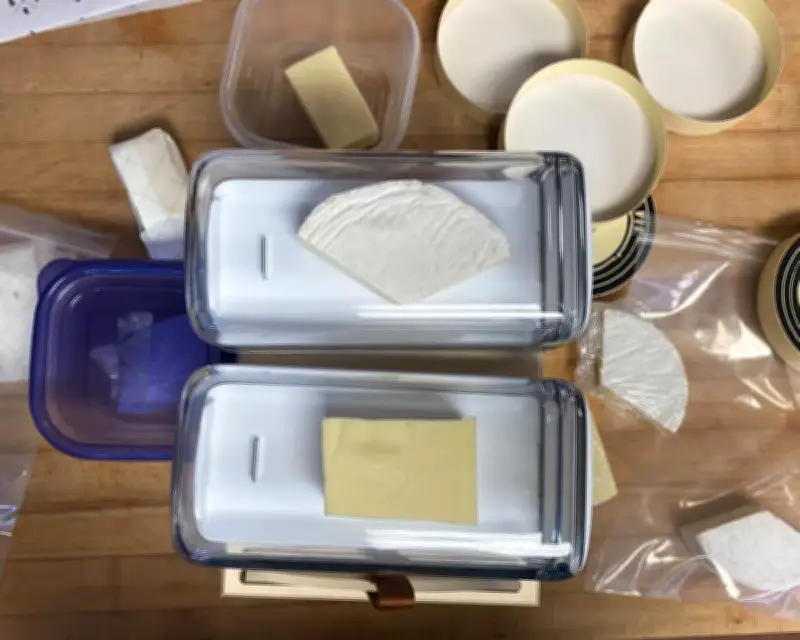
The Drexel Food Lab tested nine cheese storage methods over two months, and Formaticum's Two-Ply Cheese Storage Paper performed best, keeping cheddar fresh for almost two months and allowing brie's natural rind to regrow on cut faces. The tests, conducted with brie and cheddar from the same wheel and block, showed significant differences in appearance, texture, and time to spoilage, though water activity, pH, and taste showed little variation.
Why Cheese Storage Matters
Proper storage can preserve cheese for weeks and even encourage good mold to regrow, according to experts. Emilia D'Albero, ACS CCP, a member of Guilde Internationale des Fromagers and Meilleure Fromagère du Monde 2025, emphasized that "the two key elements are breathability and humidity." She explained that cheese needs oxygen because "cheese is a living product," and proper storage "allows the cheese to breathe but also maintains the right amount of humidity in the package."
Michael Tunick, PhD, adjunct professor of food science at Drexel University and author of The Science of Cheese, noted that cheese stored in plastic will eventually have microbes die out, limiting flavor development. He said, "If you are going to keep it for a while … then it ages better when there is some sort of ventilation." Tunick also warned that green or pink mold on hard cheese can be cut off, but on soft cheeses like camembert, it can grow deep inside, so it's safer to discard.
Top Performers in the Lab Test
Formaticum's flagship cheese paper, made of polyethylene, created the ideal humid but oxygenated environment. The brie saw regrowth of its natural rind, and cheddar had no unwanted growth for nearly two months. The paper was slightly awkward to fold at first but became easy after a few tries. The product costs $18.50 for 15 sheets.
The Zero by Formaticum, a plastic-free reusable alternative, also performed well but dried out more over longer storage. It did not form mold at the eight-week mark, but the cheese dried more than most other options. This may be acceptable for households that consume cheese quickly.
Budget and Specialty Options
For daily consumption, the Cheese Grotto Fresco ($250) offers a cave-like storage environment with a porous clay brick that maintains humidity. The brick needs re-soaking every few days, and the unit holds two to three blocks of cheese. Tunick explained that caves traditionally maintained constant temperature and humidity, and the Grotto works by "keeping it at particular temperatures and humidities that you want."
The cheapest effective method was wrapping cheese in a paper towel and placing it in a resealable plastic bag. The paper towel absorbs excess moisture, keeping the cheese humid but not wet. However, a completely sealed bag without the towel led to condensation and faster spoilage. The bag should be large enough to hold air, and regular opening provides necessary circulation.
Other Methods Tested
Formaticum Reusable Cheese Storage Bags worked as well as the flagship paper but were stiffer and harder to wrap. The Chef'n Cheese Storage Slice'n Store ($19.99) had a built-in slicer that worked for cheddar but not brie, and it saw condensation but still lasted three weeks longer than other plastic methods.
Resealable plastic bags without paper towel produced the most extreme condensation, causing surface spoilage and faster mold. Plastic storage containers also had moisture buildup but kept water off the cheese, delaying spoilage slightly. Plastic wrap prevented molding but lost stickiness with repeated use, drying the cheese; D'Albero advised against plastic wrap because it can impart a chemical flavor.
The Drexel Food Lab, housed in Drexel University's culinary arts and food science program, conducted the tests in its Dietz & Watson Food Technology Lab using a consumer-grade KitchenAid refrigerator, regularly opened to simulate household use.