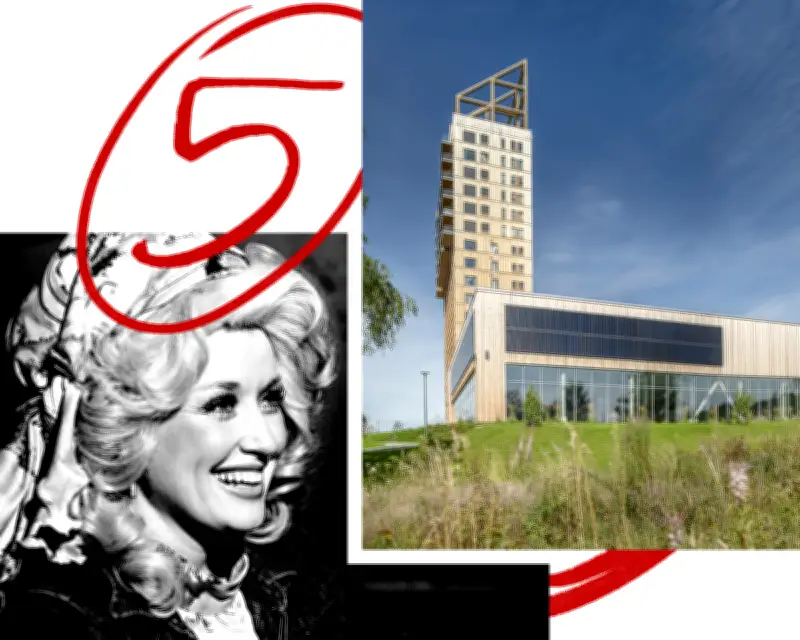
The Guardian's weekend digest, Five Great Reads, curates essential stories from the past seven days, selected by Jacqui Housden. This week's selection includes tributes to Dolly Parton, a report on threats to ancient rock art, a personal essay on grief, literary gossip involving Rachel Cusk and Natalie Portman, and a feature on building cities from wood.
Remembering Dolly Parton's Legacy
As tributes to Dolly Parton flowed in, so did her quotations. From her wisdom: “Don’t get so busy making a living that you forget to make a life,” to her best interviews and sharp wit. The country star will be remembered for her lyrics, her philanthropy, and for pioneering a new vision of femininity.
Parton often said she modelled her look on a woman others called the “town tramp” but who held a glamorous appeal for her. She never failed to poke fun at her own appearance. Her hair was a “fire hazard”, she would say, or “I’m not a fashion icon; I’m an eyesore” – but her look was highly deliberate. Notable quote: “People always ask me how long it takes to do my hair. I don’t know, I’m never there.”
Trump's Border Wall Threatens Ancient Rock Art
Thousands of years ago, Indigenous hunter-gatherers in a west Texas valley spent weeks pulverising gypsum, hematite, limonite and manganese to make paint. Using teamwork and precision, they painted tall figures on a rock wall. But Donald Trump’s administration is now dealing these rare treasures a potentially fatal blow.
Last year, Republicans in the US Congress heaped a whopping $46.5bn for border wall expansion into Trump’s “big, beautiful” spending bill. Now the longest remaining unwalled stretch of the US-Mexico border in west Texas, a remote region that includes some of the state’s most-visited public lands, is under threat. With so much money behind it, Customs and Border Protection is moving ahead at speed, despite almost universal opposition from locals, business leaders and a growing number of political leaders from both parties.
Author Hannah Richell on Grief
For author Hannah Richell, one crashing wave on one single day more than 10 years ago changed everything for her and her family, when her husband Matt died at Sydney’s Tamarama beach. Here, she describes beautifully, but heart-wrenchingly, how she kept going.
From their beginnings at a London publishing company, to travel, marriage and babies, Richell gives a moving account of the life she and Matt built before it was horribly cut short, and then her moving and profound journey through grief and acceptance. Notable quote: “The waves still come, yet we carry on, living lives illuminated by wonder and grief, the duet of both.”
Rachel Cusk's Novel and the Natalie Portman Speculation
Critically acclaimed author of metafiction Rachel Cusk’s new book is alleged to be a thinly veiled portrait of Natalie Portman. Real-life movie star Portman is reportedly not happy about unwillingly being the author’s conduit for interrogating “fame, power, beauty and truth”. While not named, identifying details jump off the page. Cusk’s movie-star main character M is identifiable as Portman in all but name.
It is still unclear whether Portman was involved. But it is known that Cusk and Portman are friends, and both live in Paris, leading to speculation that all this literary drama playing out in the press is a marketing ploy crafted by Cusk and Portman together. Whatever the truth is, Elle Hunt writes that “it’s worked”. The novel in question comes in at 192 pages.
Wood as a Building Material for Future Cities
Our modern towns and cities are not environmentally friendly. They are, sadly, monuments to extraction and emissions, formed out of materials that have been extracted, smelted, superheated or synthesised through the intensive use of fossil energy. But what would happen if our town planners and builders aimed to replace these structures with wood?
“About 10 years ago I had to wake up a little bit myself,” the Norwegian developer Arthur Buchardt says. “About the importance of the environment, about what we are doing to it.” It was in 2015, in the wake of the Paris climate agreement, that he drew some pictures on a napkin and took them to an architect and asking: “How big is it possible to go with a high-rise wooden building?”
Consider these stats: when you fabricate a typical mid-rise building out of steel and concrete, its construction alone generates about 1,500 to 2,000 metric tonnes of carbon dioxide emissions. That same building, when made out of wood, sequesters anything from 600 to 1,000 metric tonnes of CO2. And that is before you even factor in the additional absorption that comes with the planting and regrowth of the harvested trees.