
Robotic 'Dogs' Could Explore Moon and Mars Without Human Control
Researchers have been testing a new breed of robotic "dog" explorer capable of investigating extreme environments without constant human supervision. These semi-autonomous machines can move through multiple targets in sequence and carry out measurements independently, potentially revolutionizing how we explore other worlds.
The Limitations of Current Exploration
Robotic missions to the moon and planetary surfaces such as Mars currently operate with extreme caution, limiting the pace and scope of scientific discovery. Communication delays between Earth and Mars – typically between four and 22 minutes – alongside data transfer constraints mean scientists must plan rover activities well in advance.
Rovers are also designed to prioritize energy efficiency and safety, moving slowly across hazardous terrain. As a result, exploration is often confined to a relatively small area around the landing site, with rovers typically traveling only a few hundred meters per day, restricting the collection of geologically diverse data.
A New Approach to Planetary Exploration
"We tested a different approach: a semi-autonomous robotic explorer which can investigate multiple targets one-by-one and collect data without constant human intervention," said scientists from ETH Zurich, the University of Zurich and the University of Bern.
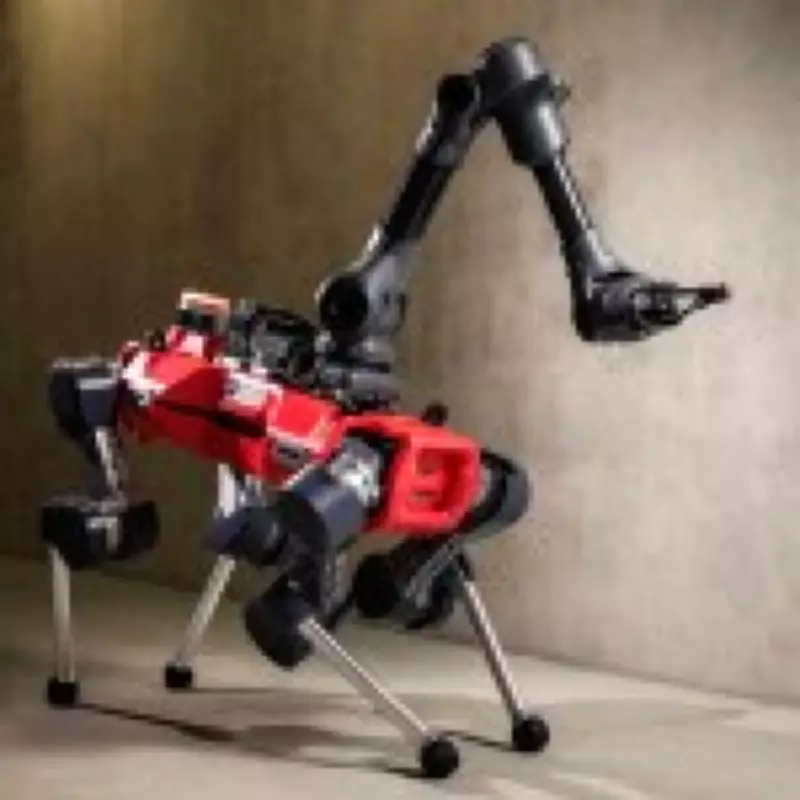
The study set out to determine whether a robot equipped with a relatively simple set of scientific instruments could rapidly analyze multiple targets while still producing meaningful scientific results. To test the concept, researchers deployed a quadrupedal robot known as ANYmal, fitted with a robotic arm carrying two instruments: a microscopic imager and a portable Raman spectrometer developed for the ESA-ESRIC Space Resources Challenge.
Testing in Simulated Martian Conditions
Experiments took place at the 'Marslabor' facility at the University of Basel, where planetary surface conditions are simulated using analogue rocks, dust-like materials known as regolith, and controlled lighting. During the trials, the robot autonomously approached selected targets, deployed its instruments, and returned images and spectral data for analysis.
The robot successfully identified a range of rock types relevant to planetary science, including gypsum, carbonates, basalts, dunite and anorthosite. Some of these materials are considered particularly important, as they may indicate the presence of resources for future missions.
Significant Time Savings with High Accuracy
"We compared two operational approaches: traditional single-target exploration guided closely by scientists, and a semi-autonomous multi-target strategy in which the robot performs measurements at several locations in sequence," the research team explained.
The semi-autonomous missions turned out to be much faster. Multi-target missions took between 12 and 23 minutes, while a human-guided mission required 41 minutes to complete comparable analyses. Despite the increased speed, scientific accuracy remained high. In one test, all selected targets were correctly identified.
Implications for Future Space Missions
The findings suggest that future missions could use similar systems to survey larger areas more quickly, allowing scientists to focus on the most promising locations for detailed study. Rather than waiting for instructions from Earth at every step, robots could navigate terrain independently, scan rocks and gather data at a much faster pace.
Instead of relying solely on large and complex payloads, future missions could deploy agile robots capable of rapidly scanning their surroundings and flagging areas of interest. As space agencies prepare for missions to the moon, Mars and beyond, researchers say such technology could play a key role in expanding exploration, supporting both resource prospecting and the search for signs of past life.
The results showed that semi-autonomous robots equipped with compact instruments could significantly speed up resource prospecting and the search for 'biosignatures' (evidence of life) on planetary surfaces. This development comes as NASA launched astronauts to the space rock for the first time in 53 years on Artemis II, marking a new era of space exploration where robotic companions may become essential partners in uncovering the secrets of our solar system.




