
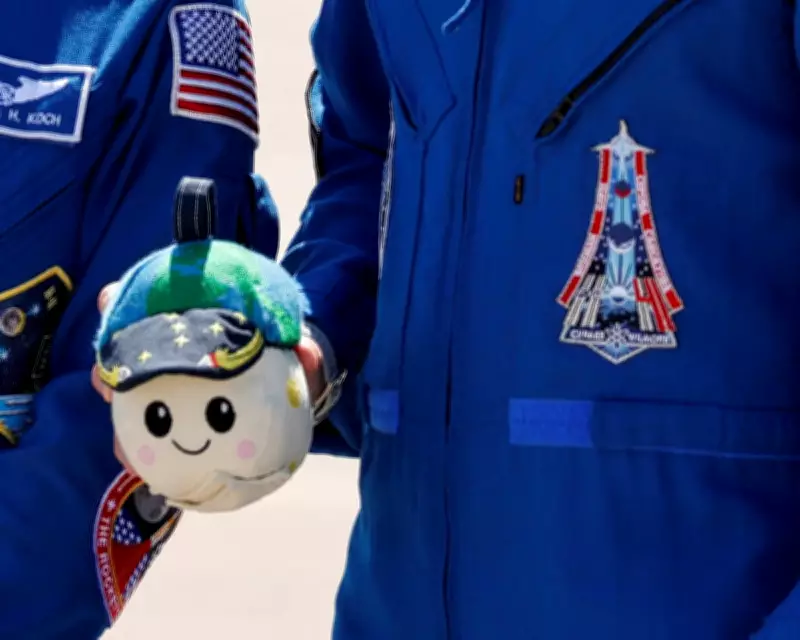
In an extraordinary moment for space exploration, a plush toy designed by an eight-year-old California boy is currently journeying toward the moon aboard NASA's historic Artemis II mission. The smiley-faced mascot, named Rise, serves as a zero-gravity indicator, floating to signal astronauts when weightlessness is achieved after launch.
Young Space Enthusiast's Dream Comes True
Lucas Ye, a second-grader from Mountain View in the San Francisco Bay Area, created the winning design in a global "moon mascot" competition organized by NASA and crowdsourcing company Freelancer. His entry triumphed over 2,600 other submissions from around the world.
"I like rockets, I like NASA, I like the solar system, I like studying about space," Lucas declared in a video submission that helped secure his place in the competition. The young space enthusiast aspires to work at NASA or become an astrophysicist, demonstrating a passion that has now literally reached for the stars.
Design Elements with Cosmic Significance
Rise features thoughtful design elements that pay homage to space exploration history. The plush toy sports a baseball cap with a star-spangled visor and a crown resembling Earth's green and blue surface. Lucas explained that parts of the design specifically reference the Apollo 11 moon landing in 1969.
The mascot's name itself carries historical significance, referencing the iconic Earthrise photograph captured by Apollo 8 astronaut William Anders in 1968. This connection to NASA's legacy missions adds depth to the young designer's creation.
Historic Mission Milestones
Artemis II represents NASA's first crewed lunar mission in over 50 years, though astronauts will not land on the lunar surface. The expedition marks several historic firsts: it features the first woman, Christina Koch, and first person of color, Victor Glover, to fly between Earth's orbit and the moon.
The crew is expected to travel farther from Earth than any humans in history during their approximately 10-day journey covering over 250,000 miles into space and back. As of Thursday following Wednesday's launch, the crew was preparing to leave Earth's orbit.
Emotional Reactions and Future Implications
Hours before the launch, when asked how he felt about his design traveling to space, Lucas stretched out his words with palpable excitement: "Really, really, really, really, really, really, really surprised and very happy."
Trisha Epp, director of innovation at Freelancer, congratulated Lucas in a news release, noting: "Your design is literally going to space, which is not a sentence most people get to say."
The mission carries significant implications for future space exploration. During the journey, astronauts' health will be monitored to inform Artemis IV, the 2028 scheduled mission intended to place humans back on the moon's surface. This aligns with broader political priorities, as former President Donald Trump made a lunar landing by the end of his potential second term a stated goal.
Historical Context of Space Mascots
Lucas's creation joins a long tradition of zero-gravity indicator objects accompanying space missions. In 1961, Soviet cosmonaut Yuri Gagarin, the first person in space, brought a doll on his historic mission. More recently, in 2014, NASA astronaut Reid Wiseman—who now commands Artemis II—took a toy giraffe with him on an expedition.
These mascots serve both practical and symbolic purposes, providing visual confirmation of weightlessness while representing human creativity and aspiration in the vastness of space. Rise continues this tradition while uniquely representing the dreams of a new generation of space enthusiasts.




