
Artemis II Mission Achieves Historic Milestone During Lunar Flyby
NASA's Artemis II mission has successfully completed a groundbreaking lunar flyby, setting a new record for the farthest distance humans have ever traveled from Earth. The four astronauts aboard the Orion spacecraft ventured approximately 5,000 miles (8,000 kilometers) beyond the moon, surpassing the previous record established by the Apollo 13 mission in 1970.
Emotional Moments and Presidential Connection
The Artemis II crew, consisting of commander Reid Wiseman, pilot Victor Glover, and mission specialists Christina Koch and Jeremy Hansen, experienced several poignant moments during day five of their mission. The astronauts engaged in a special video call with US President Donald Trump from the Orion spacecraft, sharing updates on their historic journey.
In a particularly emotional tribute, the crew honored the memory of Wiseman's deceased wife by naming a lunar crater "Carroll." Hansen explained during a live broadcast that the crater appears as "a bright spot on the moon" visible during specific phases of the moon's orbit around Earth.
Record-Breaking Achievement and Mission Progress
As the Orion spacecraft swung back around after its record-setting lunar flyby, NASA mission control in Houston officially announced the distance milestone. The achievement was celebrated simultaneously at the Canadian Space Agency headquarters in Longueuil, Quebec, where live feeds displayed the historic moment.
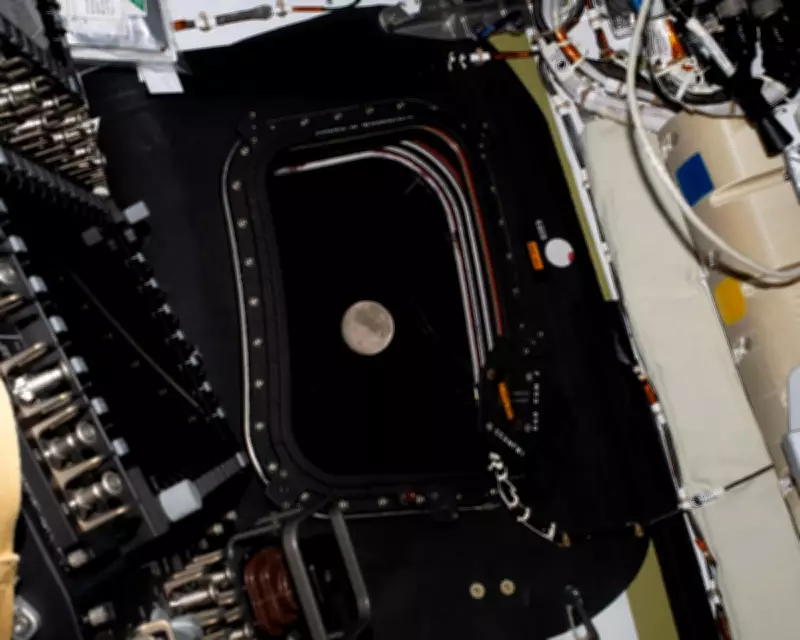
Before concluding their fifth day in space, the crew captured one final photograph of the moon as it appeared close through one of the spacecraft's windows. The image showcases the lunar surface with remarkable clarity, including the distinctive near side hemisphere visible from Earth and the massive Orientale basin—a nearly 600-mile-wide (970-kilometer) crater that spans both the near and far sides of the moon.
Ground Operations and Mission Support
Back on Earth, flight controllers at Johnson Space Center in Houston, Texas, maintained constant vigilance over the Orion spacecraft's systems and crew safety. The science mission operations room featured advanced touchscreen displays and dedicated personnel monitoring every aspect of the mission's progress.
Meanwhile, at the White House in Washington DC, an astronaut mascot greeted attendees of the annual Easter egg roll on the south lawn, connecting the historic space mission with public celebrations back on Earth.
Life Aboard the Orion Spacecraft
The Artemis II crew documented their daily experiences through photographs that reveal life inside the Orion spacecraft. Images show the astronauts giving thumbs-up gestures, Glover gazing toward Earth through a window before the lunar flyby, and their specially designed sleeping bags arranged within the spacecraft's living quarters.
Additional photographs captured from the Orion's solar arrays provide stunning perspectives of the spacecraft with both the moon and Earth visible in the background, offering unprecedented views of our planet and its natural satellite from deep space.
NASA's Artemis II mission continues to push the boundaries of human space exploration, combining technological achievement with deeply human moments as humanity returns to lunar exploration with new records and renewed purpose.




