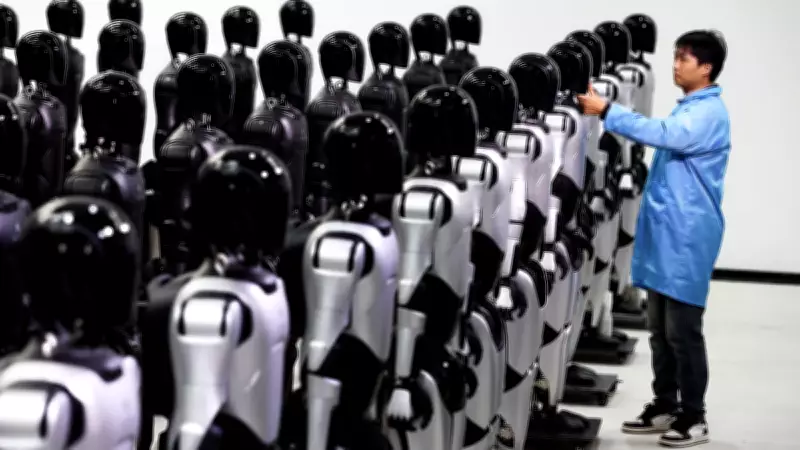
The Dawn of China's Humanoid Robotics Era
In a sprawling factory in Shanghai, the 5,000th mass-produced humanoid robot recently rolled off the production line, symbolizing China's aggressive push into advanced robotics. This milestone underscores a broader national ambition to lead the global automation race, blending artificial intelligence with mechanical dexterity to revolutionize industries worldwide.
Guchi Robotics: Pioneering Factory Automation
Chen Liang, the founder of Guchi Robotics, stands at the forefront of this transformation. A tall, heavy-set man in his mid-40s with square-rimmed glasses, Chen exudes calmness in everyday settings but radiates enthusiasm when discussing his life's work: eliminating human labor from car factories. Based in Shanghai, Guchi Robotics specializes in creating machines that install wheels, dashboards, and windows for top Chinese automotive brands like BYD and Nio. The company's name, derived from the Chinese word guzhi meaning "steadfast intelligence," reflects Chen's engineering-driven approach to solving what he views as a liberation of workers through technology.
Founded in 2019, Guchi focuses on automating "final assembly," the last and most complex stage of car production where components come together. Currently, Chen's robots can mount wheels, dashboards, and windows without human intervention, but he estimates that 80% of final assembly remains unautomated—a challenge he is determined to overcome. His vision is part of a larger trend in China, where deep learning, the technology behind AI models like ChatGPT, is being applied to robotics. Researchers believe that by absorbing vast datasets, machines can learn to navigate the physical world with human-like dexterity, paving the way for humanoid robots capable of performing factory tasks that employ hundreds of millions globally.
Government Backing and Rapid Progress
The resources fueling China's robotics boom are staggering. In 2025, the government announced a £100 billion fund for strategic technologies, including robotics, quantum computing, and clean energy. Major cities have also invested heavily, resulting in roughly 140 Chinese firms now developing humanoids. At the lunar new year festival gala in February, a state-choreographed spectacle watched by hundreds of millions, robots performed comedy sketches and martial arts routines, showcasing rapid advancements from synchronized cheerleading to cartwheels and parkour in just a year. This public display sent a clear message: China is positioning itself as the global leader in robotics production.
To understand the reality behind this vision, a journalist visited 11 robotics companies across five Chinese cities. The environment is deeply integrated with municipal governments, blurring the lines between private and public sectors. Entrepreneurs like Chen are engaged in a fierce race to commercialize robots that can replace human workers, with some already attracting eager Western buyers. For instance, at Guchi's warehouses, a team from General Motors tested wheel-installation machines destined for Canada, aiming to eliminate 12 assembly operators at a single factory. This irony highlights how China, often seen as a competitor, supplies the machinery for America's industrial revival.
Galbot and the Vision-Language-Action Model
Another key player is Galbot, a hyped humanoid robotics startup in Beijing. Unlike flashy competitors, Galbot focuses on building robots for mundane tasks like picking up items and setting them down reliably. Their technology centers on vision-language-action models (VLAs), which aim to enable machines to operate in unfamiliar environments. During a meeting at Galbot's headquarters, Chen explored how their robots could be deployed in electric vehicle factories, one of the world's most complex manufacturing settings. The collaboration targets training robots to perform micro-decisions, such as driving a screw—a task that involves finding the hole, aligning the screw, applying the right pressure, and knowing when to stop.
Galbot's progress is evident in public demonstrations. At a mall kiosk, their G1 model, a white mannequin-like robot, successfully retrieved a drink from a shelf, albeit with minor imperfections. By the lunar new year gala, an updated version featured articulated fingers and more assured movements, hinting at rapid improvements. However, skeptics like AI pioneer Yann LeCun doubt that current deep learning paradigms will achieve the desired results, emphasizing the challenges ahead.
Unitree: From Viral Performances to Global Sales
Unitree, based in Hangzhou, has gained international attention for its humanoid robots, shipping over 5,500 units last year—more than any company worldwide. Viral videos show their robots serving as backup dancers for pop star Wang Leehom and performing boxing routines with impressive stability. Despite its global stature, Unitree's headquarters are modest, located in a tech district flanked by auto dealers. The company's hardware is highly advanced and remarkably cheap, with robots starting at $1,600 compared to tens of thousands for American counterparts. This cost advantage stems from China's dense hardware supply chains in regions like the Yangtze River Delta, where tweaking prototypes can take less than a day versus weeks in Silicon Valley.
A Boston Dynamics developer noted that Unitree's success is driven by structural conditions, including easy access to parts and intense competition that fosters rapid innovation. With 330 types of humanoid robots in China, creative destruction is a normal part of the process. The industry spectrum ranges from general-purpose humanoids, akin to sci-fi visions, to specialized robots trained for single tasks. Chinese companies, pressured by commercial urgency and government contracts, often lean toward the latter, while American firms aim for broader capabilities. This dynamic suggests a future where the U.S. leads in generalized robotics, but China supplies affordable, reliable robots for specific functions.
Teleoperations: The Human Backbone of Robot Training
At the heart of robotics advancement is teleoperations, where human workers train robots by guiding them through tasks. Leju Robotics, affiliated with China's "largest robot training centre" in Beijing, employs roughly 100 teleoperators who perform actions like wiping tables or sorting boxes, logging data to train VLAs. These workers, often in their late teens or early 20s, are hired through labor dispatch companies from villages and vocational colleges, studying majors like "big data" and "the internet." They typically perform 15 different tasks daily, repeating each 10 times during eight-hour shifts.
Chinese officials frame teleoperations as a "new vocational training programme," but reports highlight its dehumanizing nature. One former employee at Tesla's Palo Alto lab described it as being "a lab rat under a microscope." Despite this, recruitment posters show strong interest, with pay ranging from 6,000 to 10,000 yuan monthly—comparable to delivery drivers but with better hours. Ulrik Hansen, co-founder of Encord, a Silicon Valley data services company, predicts a "huge boom" in teleoperations, arguing that for every 15 to 20 robots, one person is needed to manage them, potentially creating more jobs than are lost.
Government Coordination and Local Competition
China's rapid technology normalization is partly due to coordinated government efforts. Since President Xi Jinping came to power, the focus has shifted from "market-driven" innovation to the Chinese Communist party's "unified leadership" in setting priorities. Local governments compete to attract startups, offering incentives like factory space. For example, the Leju facility, over 10,000 square metres, was provided by the district government as part of a joint venture. Cities like Hangzhou, Shanghai, Beijing, and Shenzhen each back their own robotics champions, creating a Hunger Games-like environment where municipalities act as patrons.
During visits to startups, mid-level officials from cities like Shenzhen and Hefei were often present, listening to young engineers and offering support. Viktor Wang, co-founder of PsiBot, which specializes in dexterous robotic hands, received multiple unsolicited offers from municipal governments eager to establish training centres. This intense competition drives innovation but also leads to price wars and cost-cutting, as seen in industries like semiconductors and electric vehicles.
On the Factory Floor: Automation in Action
At a Huawei car factory in Hefei, Chen's robots are already deployed, installing dashboards, windows, and wheels on the Maextro S800 electric sedan. The factory, once a rural backwater, now produces more cars than Michigan, symbolizing China's industrial transformation. During a tour, Chen explained the challenges of automation, such as the complexity of "pick and place" tasks where workers manage various components. Humanoid robots still struggle to match human versatility, especially with tasks involving changing parts or stripping packaging.
Chen combines pragmatism with optimism, believing that much factory assembly will be nearly fully automated by the mid-2030s. He views labor displacement as an inevitable consequence of technological progress, suggesting that higher-skilled workers could retrain to manage robots, though he offers no solution for lower-skilled individuals. With 120 million factory workers in China, many with vocational training, the social implications are profound. Chen advises that future workers must "change careers," highlighting the urgent need for adaptation.
Global Implications and Future Outlook
China's robotics revolution is not just a domestic affair; it has global ramifications. Despite political tensions, American companies like General Motors rely on Chinese machinery, and Chen plans to visit Tesla and GM in the U.S. to seek new opportunities. He notes that working with Americans has improved his team's discipline through exposure to rigorous process management and safety standards. Moreover, he appreciates that "Americans pay on time," underscoring the mutual dependence in the global supply chain.
However, the rapid build-out of industries like robotics mirrors past infrastructure projects that masked issues like corruption and waste. As subsidies flood the sector, companies face price wars and slim profits, while the population grapples with economic challenges and youth unemployment. The dazzling advancements in robotics, from drone shows in Chongqing to driverless taxis in Wuhan, raise questions about who benefits from this technological leap.
In conclusion, China's humanoid robotics industry is advancing at a breakneck pace, driven by government support, intense competition, and innovative engineering. While the sci-fi vision of autonomous robots remains distant, tangible progress is being made in factories and beyond. As machines learn to perform tasks once reserved for humans, the world must prepare for a future where robotics reshapes labor, economies, and societies on a global scale.