
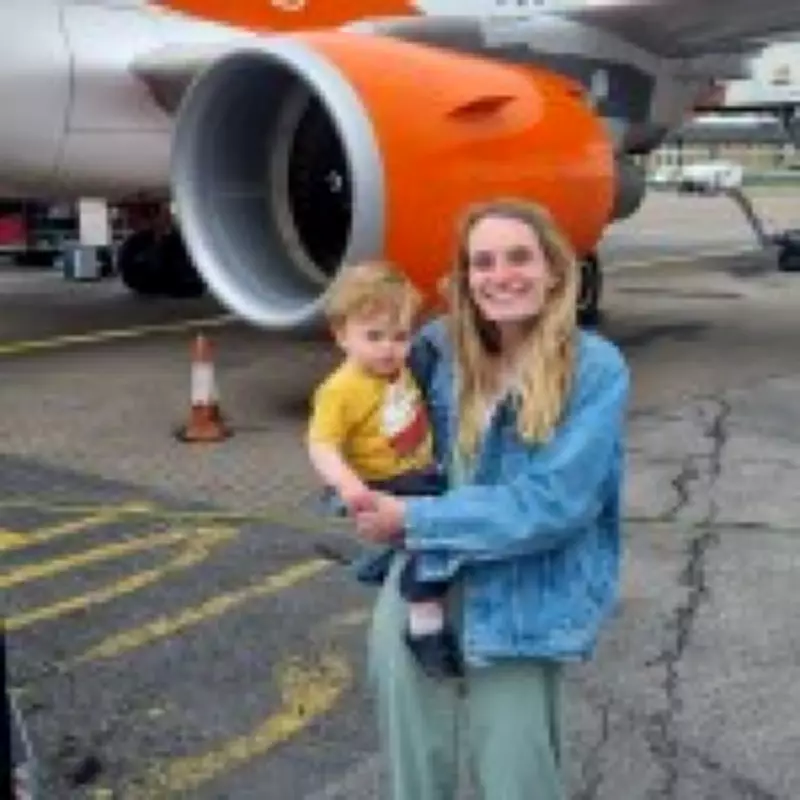
My mum's departing words as she hugged me goodbye at Luton airport summed up our holiday with depressing accuracy: 'We got through it.' Our first trip abroad with our son, then 14 months, wasn't what I'd anticipated. It started badly when the latest nursery bug saw me knocking back Imodium to get through the 2-hour 20 flight to Menorca, then only got worse. The cot, which we'd paid extra to hire, had a cardboard-thin mattress that led to terrible sleep for my son (and kept us up all night in turn). The villa pool was so cold, I couldn't blame him for only spending 10 minutes in it a day.
I'd imagined all eating out together, our son staying up late like the Spanish kids or dozing angelically in the buggy. In reality, the local restaurants didn't open until 7pm and he grizzled through almost every meal. There's a phrase that's often repeated in parenting circles: 'You're going to be parenting anyway, you might as well do it in the sunshine.' But nobody tells you parenting abroad can be much, much harder than at home, and you'll pay upwards of £800 for the privilege.
The Social Media Pressure
Four in 10 children have now visited five countries before the age of eight, according to new research from Club Med – a milestone parents wouldn't have hit until adulthood just two generations ago. But why are we doing this to ourselves? Separate research has found nearly 80% of parents with young children agree the thought of a holiday abroad is better than the holiday itself. I blame social media. When adventurous mums are posting their round-the-world maternity leave trips, you feel a bit pathetic (not to mention ungrateful) admitting a week in a villa with extra help from the grandparents felt difficult.
Recently, though, I hinted at the reality of 'baby's first holiday' on my Instagram Stories and the floodgates opened. 'Hard relate,' read multiple DMs. 'Solidarity!', 'We had the same' and 'Why does nobody talk about this?!'
Real Stories from Real Parents
Georgie Heather, 32 from Buckinghamshire, had a 'disappointing' first family holiday with uncanny similarities to mine. Her daughter Phoebe, then 14 months old, was a champion sleeper at home, consistently going 12 hours through the night and napping in her buggy no problem. But when they touched down in Faro, Portugal, last September, she rejected her new travel pram and refused to settle in the cot. 'Phoebe didn't sleep, so we didn't sleep,' says Georgie. 'She just seemed to be upset all the time. The contrast to home, where she's so content and sleeps so well, was really hard. It was almost like we were on holiday with a completely different child.'
The family booked a multigenerational villa, where Georgie and her husband were joined by her two sisters, their partners, the four cousins, the grandparents, and Phoebe's great-grandmother. An overtired Phoebe didn't want to go in the pool, the main source of entertainment, so the couple resorted to screen time inside – something they'd never had to do at home. To make things harder, Phoebe had recently learned to walk, but the villa had tiled flooring. 'I just felt on edge all the time,' says Georgie. 'I don't think I laid back on a sunbed once.'
Multigenerational holidays are booming, with recent Hilton research indicating 69% of grandparents have holidayed with grandchildren in the last year. But having 'all hands on deck' doesn't always ease tensions. 'Although when you go as a big family you've got help, when you're seeing other children that are loving it, it almost highlights even more how much your child isn't,' says Georgie. 'Obviously I'm so happy that my sisters got to somewhat relax, but it almost made it harder.'
Other mums share more dramatic experiences. Naomi McKee, now 50 and living in Bristol, tells me her first holiday with a baby got off to a ropey start when her husband crashed the hire car into some rocks on the dark drive from the airport. They'd hired a cottage in the south of France that was advertised as 'family-friendly'. 'There were vases balanced on plinths, tiled floors, hard surfaces everywhere, a high chair from the Victorian era and no bath,' she says. 'Our eight-month-old was 'cruising' and I was constantly terrified. They had shut the pool because 'it was too cold' and I caught gastroenteritis on the night we went into the local town for supper and spent four days vomiting.' They didn't dare to holiday abroad again until their youngest was six.
Another mum reveals how their first family holiday abroad almost ended in divorce. 'We argued constantly about how to deal with our baby's meltdowns and both said things we regret about the other's parenting capabilities. We've since had couples counselling to unpack the trip. That's how bad it was,' says Sarah*, now 42. 'I think there's the very basic expectation that a holiday will be better than home, so when it's worse, things can unravel very quickly.'
Why Do Babies Have a Personality Transplant on Holiday?
Dr Sasha Hall, an Essex-based educational psychologist, says 'no amount of reading or working with other people's children prepares you for the harsh realities of parenting.' Despite her profession, she found her first holiday abroad with her daughter, then nine months old, overwhelming. The family picked an all-inclusive hotel in a quiet little beach town, away from the clubbing side of Ibiza. Almost as soon as they landed, her daughter developed a temperature. 'Because she was our first child, it completely threw us,' says Sasha, who now has two children aged two and four. 'We suddenly found ourselves in a panic trying to locate a pharmacy in a fairly remote area to buy things like a thermometer and children's medication.'
Her daughter had prescribed formula due to allergies but started to refuse feeds. 'We became obsessed with worrying whether she was hydrated enough and what would happen if we ran out of formula abroad,' Sasha recalls. One of the hardest parts was realising there was no break. 'At home, even if parenting is tiring, you have familiar routines, toys, support from family members, and spaces that are set up for babies. On holiday, we had none of that. We became the entertainment all day long.'
Dr Sasha explains: 'Under 18 months especially, children are learning how to regulate themselves, so changes in sleep, temperature, sensory input, food, noise and environment can feel overwhelming very quickly. Holidays are incredibly stimulating. There are new sounds, smells, people, sleeping arrangements and schedules, and many young children become overtired. Parents often find bedtime suddenly becomes much harder away from home. I'd encourage parents to think carefully about the type of destination they choose. A quiet boutique hotel that feels relaxing as adults may not feel relaxing with a baby who cries, throws food or wakes at 5am.'
So, What's the Answer?
Every parent I spoke to stressed there were joyful moments too. I'll never forget my son seeing the sea for the first time, or wolfing down paella with delight. But the highs didn't entirely cancel out the lows. Still, parents deserve holidays too. So I asked each mum what they'd do differently if travelling with an under-two in the future. Georgie has booked a holiday with more entertainment on hand this year and advises testing your travel buggy and any new equipment at home. Naomi now opts for relaxed, outdoorsy breaks that better suit her children, including camping holidays with a bell tent. Meanwhile, Sasha will never holiday again without an extensive medical kit.
Though we've yet to brave another holiday abroad, we've enjoyed some brilliant UK trips by recreating our son's usual sleep routine with two-bedroom accommodation. Hotels like the Cotswolds' Calcot Manor or the Lake District's Another Place do this brilliantly, but a cheaper campsite chalet works just as well. You've also got the option of taking your own tried-and-tested travel cot. Mostly, though, I've learned to mute the travel influencers selling effortless family adventures. As Sasha says: 'With babies and toddlers, the “successful” holiday often isn't the one where everything goes perfectly. It's the one where parents adapt quickly and lower the pressure on themselves.'




