
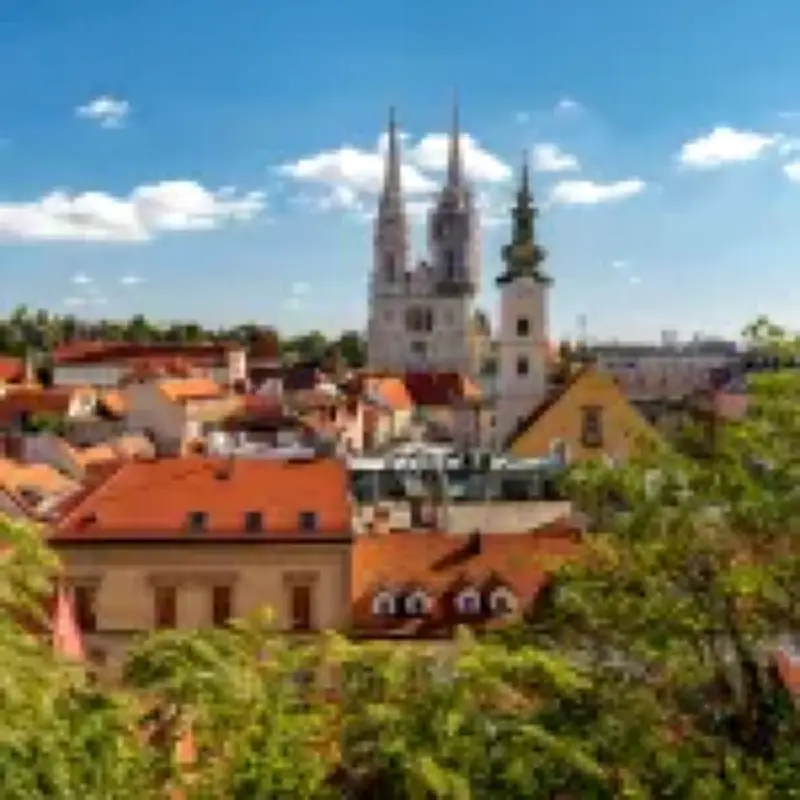
With only 24 hours to spend in the Croatian capital, a rainy start and a soggy pair of Birkenstocks didn't bode well. But Zagreb proved to be a curious, spontaneous city with free transport, cheap drinks, and museums dedicated to broken relationships.
A rainy arrival and a bargain flight
Speeding down a motorway beside an industrial estate, with heavens pouring and no umbrella in the bag, was not the Euro-summer I had pictured. Usually, I like the rain—even when travelling, a grey day never dampens my spirits. But the fact that I had only 24 hours to see Zagreb made the bad weather sting.
One step out of the Uber and my Birkenstocks were soggier than tea-dunked Digestives. After spending more than I should on a rip-off Šestine umbrella, I wondered if my day in the Croatian capital would end better than it began. Spoiler, dear reader: it did.
I ended up in Zagreb because I can't resist a bargain. Return flights from London Stansted were only £47 when I booked a last-minute trip to squeeze the last dregs of summer. Croatia may be the Balkans' star destination, drawing visitors with its dazzling Adriatic coastline, medieval walled cities like Dubrovnik, Roman ruins in Split and Pula, and the waterfalls at Plitvice Lakes National Park—not to mention the 1,000+ islands that embroider its shores. But Zagreb? Not so much.
Zagreb's numbers and the Fulir
While some 21 million tourists pack their bags for Croatia each year, only 1.3 million step foot in the capital. For context, around 102 million go to France per year, and just under 50 million of them to Paris. Still, there I was, wandering past Zagreb Cathedral beneath the drizzle, when a woman cut through the greyscale, brightly clad in red-framed sunglasses and cherry printed trousers.
'Quick, jump on!' said Helena—my tour guide. Before there was time for introductions, she was waving us onto an electric golf-buggy. This turned out to be the Fulir, a novel mode of transport designed primarily for the elderly or those with limited mobility, but also available to tourists and other citizens… for free. It runs daily around the city centre from 8am to 8pm, including holidays.
It's a utopian concept, and the ride was my first glimpse into how 'spontaneous' the city is. Less than five minutes in, I felt a disapproving frown from behind the crimson rims. 'Stop taking notes. You can re-read all of this information later. In Zagreb, we are in the moment,' Helena said.
Nightlife, food, and earthquake recovery
So in the moment, in fact, that Helena expects the unexpected every day, packing her rucksack in the morning 'ready to not return until the next.' 'You start with a coffee, and you end with a concert in the evening,' she says. Her favourite spot? Jazz Cafe, where live music continues well into the early hours.
Zagreb actually has decent nightlife, with everything from rock bars and trendy street-side terraces to underground techno clubs. Eating out is cheap, and with beers for €2.50 and house wine for €3, it's one of the most affordable spots in Europe.
The Fulir is a wonderful way to get a feel for Zagreb, especially when you're tight on time. No two routes are the same (and you can actually request stops), but highlights include Ban Jelačić Square, where markets bustle despite the rain, and Cvjetni Square, home to an attractive bell tower.
We hopped off at Zrinjevac Park, where signs of the earthquake that shook the city in 2020 can still be seen in damaged buildings. Two were killed and 27 injured. 'We are still rebuilding,' Helena explains.
Upper town and the essentials
A short walk away is the Art Pavilion, a palatial yellow structure that's home to gallery exhibitions and Croatian National Theatre Ballet rehearsals. If that's not your thing, I recommend strolling five minutes to Orient Express, a bar trussed up to look like the iconic train with wood fittings, leather upholstered seats and booths, and golden age trinkets on the walls.
We left Helena and the Fulir at Tkalčićeva, a pretty pedestrian street lined with a mishmash of colourful buildings and an abundance of restaurants, cafes and shops. The street follows the path of the old Medveščak stream, which once divided the rival medieval settlements of Kaptol and Gradec before it was paved over at the turn of the 20th century. Its most famous resident is Marija Jurić Zagorka, Croatia's first female journalist who was also a famous novelist and fierce advocate for women's rights.
I paid my respects to her statue before we moved on to the Upper Town, where medieval architecture still remains. We saw the Cravat Regiment marching in traditional military dress with drums and horses, and the firing of the Grič Cannon from the Lotrščak Tower to mark the middle of the day. Worth a quick look is the Stone Gate (built in 1242). It houses a shrine to the Virgin Mary, a nod to Croatia's devoutly Catholic past and present.
The Upper Town is a good place to make use of the Zagreb Card, which entitles you to free public transport and free admission to the city's best attractions (€38 for 24 hours or €48 for 72 hours). Highlights were the Zagreb City Museum and the Museum of Broken Relationships, a bizarre but entertaining space filled with relics from failed romances and the stories of the people who donated them. There's everything from a onesie to a horse shoe and a fridge that still contains a slice of birthday cake (expiry date, unknown).
We left the Upper Town on the world's shortest funicular, a pleasant 66-metre jaunt that takes less than 60 seconds. Zagreb may lack the aesthetics of the Adriatic, but it's still a lovely place to spend a day. Even in the rain, the city put a smile on my face.
You can fly direct to Zagreb from several UK airports, including Manchester, Birmingham, Newcastle, Edinburgh and London Stansted. One-way fares start from £16 in September with Ryanair. Accommodation options include Tia Apartments and Rooms (from £59/€69 per night), Novotel Zagreb (from £87/€102 per night), and Esplanade Zagreb Hotel (from £120/€140 per night).




