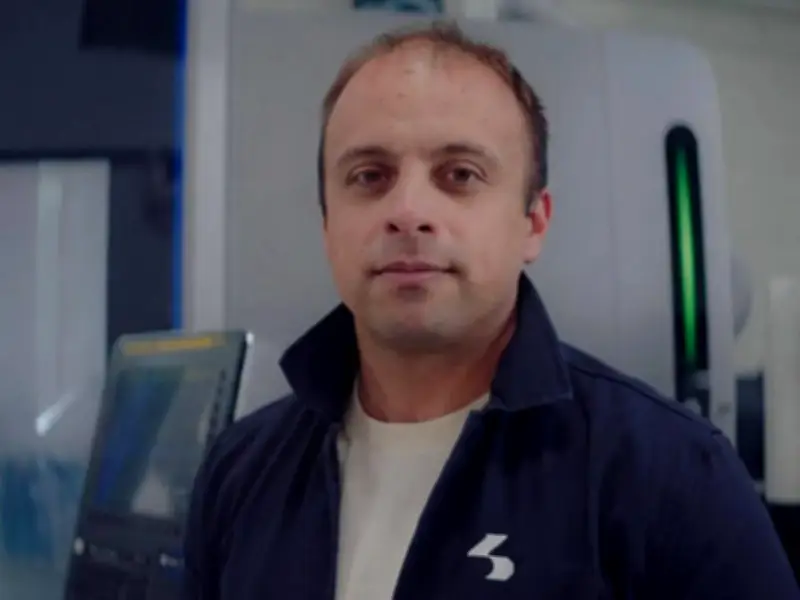
Alexander Fitzgerald, founder of Isembard, has unveiled London's largest new factory since the Second World War, a 160,000-square-foot facility in Southwark, just over a mile from the Square Mile and beneath the Shard. The factory, which opened weeks ago, marks a significant step in his mission to revitalise Britain's high-precision manufacturing industry, which he describes as a source of national pride.
A Factory Built on Patriotism and Precision
Inside the vast, brightly lit production floor, the only decoration is a 50-square-foot Union Jack, illuminated by a light that remains on even when the factory shuts down. Fitzgerald explains, "We're incredibly proud to be actually trying to build stuff in and for Britain. And fun fact, the light above the flag is the only one that stays on when the factory shuts down; so people staying late can see it, and know what they're working so hard for."
Isembard, named after the Bristolian polymath Isambard Kingdom Brunel, is a high-precision defence and aerospace manufacturing business. Despite its unconventional start-up status, the company has quickly become a key supplier to SpaceX and Rolls-Royce, as well as several undisclosed weapons manufacturers. The components produced are highly intricate and confidential, often resembling parts for modern compact cars.
Rapid Growth Through Software and Franchising
Fitzgerald attributes Isembard's rapid expansion, from a single facility at the start of last year to 17 now, to two pivotal choices. The first is the development of proprietary software called Mason OS, which allows its machines to manufacture components faster and more efficiently than competitors. The second is the adoption of a franchising model, a strategy typically associated with hospitality and retail, making Isembard the only precision engineering firm in Britain to license its technology in this way.
"The beauty of what we're doing is, whenever we launch in a country, we're not setting up a bunch of Isembard corporate-owned factories – it's all local franchisees," Fitzgerald says. This approach has enabled the company to expand internationally, with seven facilities in the US, one in France, one in Germany, and eight across the UK. It also allows the group to distribute financial obligations and enhance access to investment capital.
Fitzgerald notes that the franchise model has attracted a diverse range of franchisees, including former military personnel, ex-Amazon employees, and established McDonald's and Subway operators. "If you applied today – with your CV and a letter saying why you wanted to own your own factory – we'll assess you," he explains. "We'll then offer you a franchise agreement, you'll sign. And then from signing on the dotted line to your factory making rocket parts or satellite parts, it should take between 60 and 100 days."
Challenges and Ambitions Beyond Earth
Despite the rapid growth, Isembard faces challenges from Britain's deindustrialisation, with manufacturing's contribution to the economy falling from a third in the 1970s to under 10 per cent today. Since the pandemic, England has lost 6,500 manufacturing businesses, particularly in the North East and Midlands. The UK also has the highest industrial energy costs in the developed world, 50 per cent above European neighbours and four times higher than the US.
Fitzgerald remains measured on energy costs, stating, "Energy costs aren't actually the big barrier for us. Along with rent and hiring, it's one of the big costs, sure. But the biggest one is actually machines. That's why we're banging the drum a lot trying to get the government to help make it easier to set up factories." He also criticises the culture of think tanks, saying, "There was a think tank I was speaking to – and they characterise what they do as, 'publishing PDFs on the internet'. I think there's too many people publishing PDFs on the internet in the UK – as opposed to actually just going out and doing stuff."
Looking ahead, Fitzgerald aims to open "two or three factories a month," targeting every nation with an industrial foundation "apart from Russia, China, Iran and North Korea." He envisions building one of the most valuable companies in the world, with potential expansion beyond Earth. "If we can build hundreds of factories in every country in the world, and we can make all the components, not just for critical industries but uncritical industries as well – and if we can do that not just on this planet but many more planets – I feel like you just get a cornucopia of human improvement," he says.
The competitive spirit among franchisees is already evident. Fitzgerald recalls, "I was here the other day, when I saw a franchisee from the States on a ladder. When I asked what he was up to, he told me he was measuring how big our flag was – so he could make a Stars and Stripes version that was a few inches bigger."