
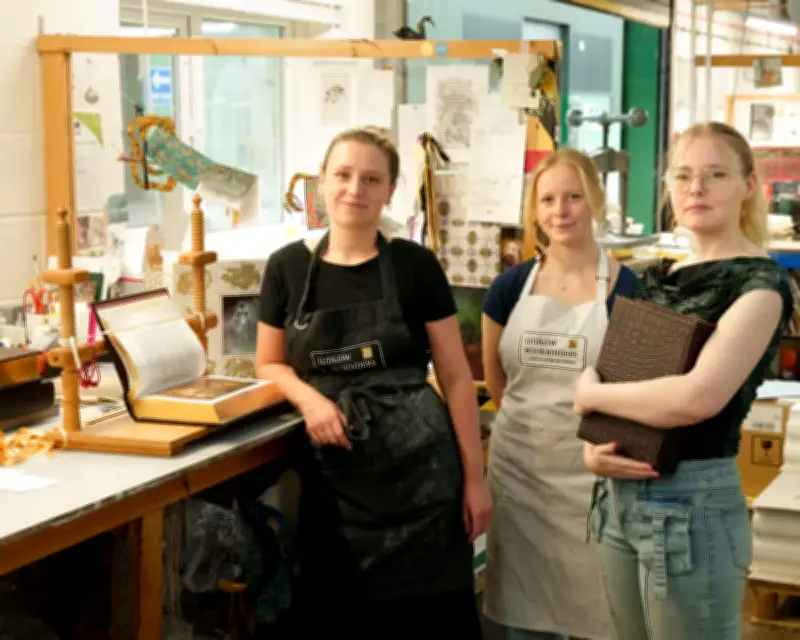
Young workers, facing a job market disrupted by artificial intelligence, are increasingly turning to heritage crafts such as bookbinding, metalwork, and boatbuilding, seeing these hands-on trades as “AI-proof” career paths. Apprenticeship schemes at companies like Ludlow Bookbinders in Shropshire and Cox London are seeing a surge in interest, with one employer reporting over 160 applications for just two places. However, this trend is accompanied by a new challenge: a flood of AI-generated job applications that employers are struggling to manage.
From Politics Graduate to Bookbinder
Eryn Lawley, a 27-year-old politics graduate, said future-proofing her career meant walking away from the digital world. She is now a second-year bookbinder apprentice at Ludlow Bookbinders, learning a trade whose core techniques have not changed for centuries. “Even just staring at a screen too long was bad for me,” she said. “I always wanted to do something more material, and I think there is something more inherently valuable to something when it is made by a person.”
The work at Ludlow is slow, detailed, and tactile. The bookbinding process is almost entirely by hand, using Victorian-built presses, foil-blocking machines, and glue brushes. Lawley noted the appeal of physical creation in an algorithm-driven world: “People are discovering that, as everything is already decided for you by a computer or algorithm, being able to make or own something physically is good. And it is very satisfying to repeat a task to perfection. It is meditative as a job so it is extremely low-cortisol.”
Industry Sees a Lifeline
Paul Kidson, Ludlow’s chief executive and a fourth-generation bookbinder, said the influx of interest from young people represents a lifeline for a rapidly shrinking industry. He estimates there are now fewer than 50 handcraft-operating bookbinders in Britain today. “British bookbinding has a terrific reputation across the world, but like so many things in the 50s, 60s and 70s, the training just started to dry up,” Kidson said. “All the formal apprentice schemes collapsed in the early 1980s, and the industry got no training at all. We have to train our own people because you can’t recruit at volume because there aren’t any [courses]. Fortunately there is now a desire among a lot of people to want to have the satisfaction of actually making something.”
Commercial demand remains strong. High-end publishers are betting that shoppers will pay a premium for objects crafted by human hands. Joanna Reynolds, chief executive of the Folio Society book publisher – which partnered with Ludlow for a limited edition release of a Game of Thrones book – said the company rejected generative AI tools in its creative processes. “We do not use AI in terms of our art,” she said. “We believe in the importance of supporting the creative world, and we know there is huge pressure on them at the moment. Their skills and their abilities need to be supported by as many people as possible.”
Metalwork and Theatre Crafts See Rising Interest
The number of young people hoping to fill these creative posts is growing rapidly. Cox London, a design house that specialises in artistic metalwork, started its apprenticeship scheme last year. Nicola Cox, a co-founder, said this year the company received more than 160 applications for two apprenticeship places. “People want to make things and work with materials, [to] have that closeness with it,” she said. “There is AI-proofness about art that is made with someone’s hands. There is a real resonance in something that has a mark and the energy of human hands.”
For Lucky Emerson, an apprentice at Cox London, there is a “worrying feeling” that AI is taking over the creative world. “The physicality of actually making things is incomparable, especially when people crave originality. Even though technology has advanced, handcrafted art is considered a lot more valuable and will always remain that way.” Nazifa Tabassum, also an apprentice at Cox London, said she did not think AI would replace her work, but that it could change it. “For me it isn’t just about making things with my hands,” she said. “It’s about continuously developing my skills, and using technology where it adds value, while still providing the expertise and craftsmanship that people can’t easily automate. I see AI as a tool that can assist, but not something that replaces, the satisfaction and value of skilled manual, handcrafted work.”
At the National Theatre in London, technical apprenticeships span everything from IT to traditional wig-making, costume design, prop-making, and metalwork. Kath Geraghty, head of technical qualifications, said, “Our apprenticeships are partly about the need to create a more representative workforce, both for the National Theatre and for the [wider] creative sector. It is also about plugging the skill gap. These theatre crafts are dying out – our metalworkers are all over 50, wig-making as a skill is really dying. There’s a real need to create our own talent. And it’s always been about creating a skilled workforce for the wider creative sector beyond theatre, such as film, TV and broadcast.”
Sarah Ray-Dobson, a 27-year-old apprentice prop-maker at the National Theatre, said she felt her practice had been shielded from AI disruption that affected other creative pursuits. “Everything I’ve been doing for the past two years is very hands-on,” she said. “At my level, it has not been affected by AI.”
Employers Face AI-Generated Application Flood
Geraghty adds that, like many employers, the National Theatre is struggling with the huge number of AI-generated applications for its apprenticeship programme. “We used to think that 100 applicants was a popular apprenticeship,” she said. “In this most recent round of recruitment, we had 728 applications for one role. We haven’t yet worked out how to manage it, because it’s not viable for our staff to read 700 applications with care and attention. But the job market that young people are in is difficult, and they are applying for anything they can.”




