
Union Now Initiative Aims to Revitalize Ailing US Labor Movement
Leaders from some of the largest unions in the United States have launched a bold new drive to jumpstart the country's struggling labor movement and address escalating wealth inequality under the administration of Donald Trump. The initiative, named Union Now, is a non-profit organization designed to increase labor union density by making it easier for workers to join unions and strengthening their bargaining power against powerful corporations.
Putting Power Back into the Hands of Workers
Sara Nelson, president of the Association of Flight Attendants-CWA and a key leader in the push, emphasized the core mission of Union Now. "This is really about trying to put power in the hands of people," she stated. Nelson highlighted a stark disparity in union representation, noting that while 70% of workers express a desire to join a union, only 10% currently have one. "If it were a company, they would figure out how to get the product into the hands of the 70% who wanted it," she remarked, urging workers to adopt a more strategic approach akin to corporate tactics.
The architects of Union Now hope the initiative will provide mobilizing workers with the necessary financial firepower to overcome organizational challenges. Nelson explained that existing unions are stretched thin, balancing representation of current members with contract negotiations and other duties. "The reality is that even if unions spent all of their money on organizing and all of their efforts on organizing, it wouldn't be enough," she said. Union Now aims to support workers in standing up to employers who engage in illegal practices, such as firing employees during organizing drives, and to bolster recognition and contract strikes.
Historical Decline and Current Challenges
Union density in the US has seen a dramatic decline over the decades, dropping from over 30% in the 1950s to just 10% in 2025, despite widespread public approval of labor unions. The number of union members peaked at 21 million in 1979 but has since fallen to 14.7 million, even as the US population has grown by more than 100 million.
Julie Su, New York City's deputy mayor for economic justice and former secretary of labor under the Biden administration, pointed to significant hurdles faced by workers. "In NYC, as across the country, one of the biggest challenges workers who have already chosen a union has faced is the time it takes to get a first contract," she said. Su described these delays as a form of union busting, exacerbated by a National Labor Relations Board that has become hostile to workers under Trump's return to office. On average, it takes more than 450 days to reach a first union contract, with many employers deliberately prolonging negotiations for years after workers vote to unionize.
High-Profile Support and Ongoing Struggles
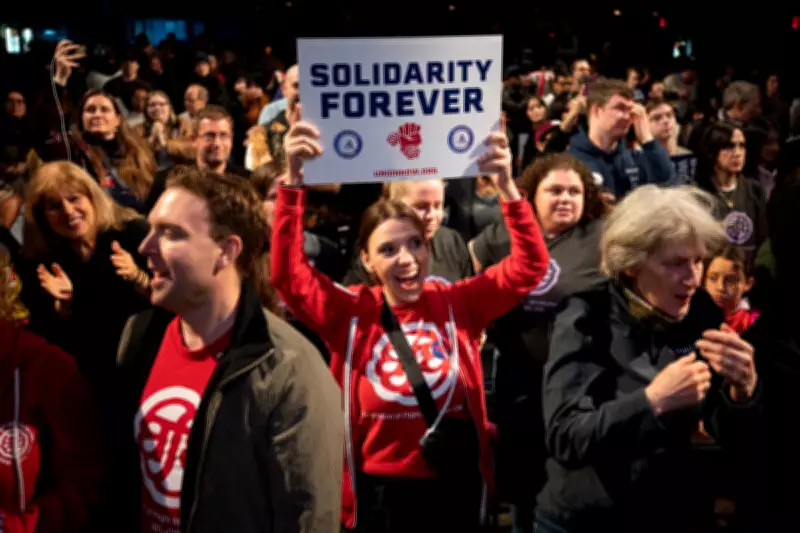
At a rally marking the launch of Union Now on April 12, 2026, in New York City, Senator Bernie Sanders and New York City Mayor Zohran Mamdani issued a rallying cry to workers seeking to challenge billionaire power. The event featured workers from high-profile union organizing efforts at companies like Amazon, Starbucks, REI, Delta Air Lines, and Wells Fargo, all of which have faced staunch employer opposition.
Brittany Norris, a Delta Air Lines flight attendant involved in organizing efforts, spoke at the rally, emphasizing solidarity among workers. "There are more of us than there are them," she declared, highlighting the community built by employees. The organizing drive at Delta aims to unionize 30,000 flight attendants, the last major US airline where flight attendants remain non-unionized. Delta has opposed the effort, citing its culture of employee care, while federal law requires a majority of union authorization cards within 12 months to file for an election.
Mina Leon, a Starbucks worker in New York City, shared her experience of fighting for a first union contract, noting similarities in poor working conditions across different companies. "We were understaffed, underpaid and overworked," she recalled, expressing hope inspired by the growing union movement. Starbucks did not respond to requests for comment on the matter.
Legal Battles and Corporate Resistance
Connor Spence, president of the Amazon Labor Union, detailed the ongoing struggle against Amazon, which has spent years trying to overturn a victorious union election at JFK8 in Staten Island. "Every day in this movement, there are workers who are putting it all on the line at great cost to themselves," he said, urging perseverance in the face of employer tactics aimed at fostering futility and despair. Amazon denied allegations of interfering with workers' rights, asserting that employees have always had the choice to unionize and that the company provides competitive benefits.
Union Now represents a concerted effort to reverse the decline of the US labor movement, leveraging collective action to combat wealth inequality and empower workers across the nation. With support from prominent figures and grassroots organizers, the initiative seeks to rebuild union density and ensure that workers' voices are heard in an increasingly challenging economic landscape.




