
The Night Shift: Vermont's Hidden Dairy Workforce
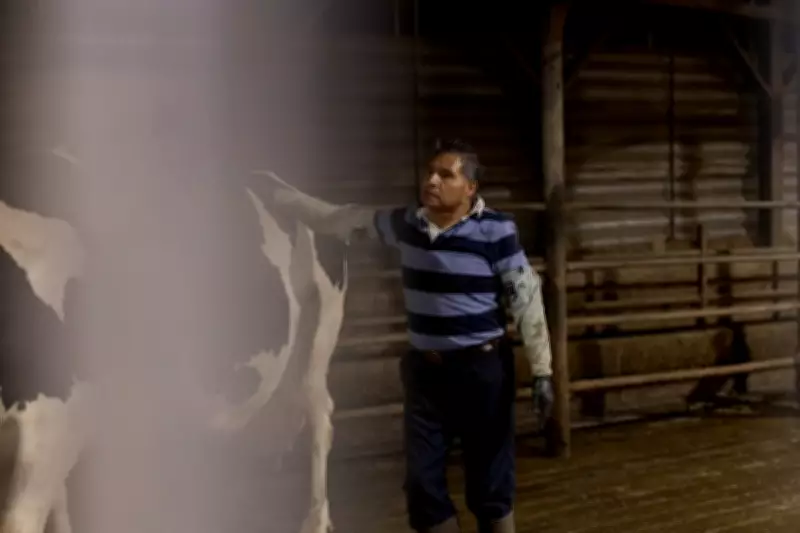
At 10:30 PM on a late October evening, Hilario lifted a red fleece blanket and rose from his makeshift bed next to a kitchen sink. The 65-year-old dairy worker pushed aside a lace curtain covering his apartment door, separating his living quarters from the sour-smelling milking parlor where his work began. Twice his size, black-and-white Holstein cows peered out from vinyl curtains as the horseshoe-shaped milking platform hummed awake.
"They're smart and curious, and they're nervous," Hilario explained. "You have to be gentle with them." He and his co-worker began their rhythmic routine: clapping the bumpy rears of cows, twirling towels, and attaching milking machines to beach ball-sized udders in one fluid motion.
No Clock to Punch, No Line Between Work and Rest
They finished around 2:30 AM, hosing down the parlor before falling asleep next door. Hilario, who asked not to have his full name used due to safety concerns, began his next shift at 6:30 AM. He worked roughly 60 hours, seven days a week, for $650—well below Vermont's $14.42 minimum wage. There were no days off, no clock to punch, no clear line between night and morning.
When a cow was injured or equipment broke, he worked more without extra pay. "There was no moment when the job truly ended," he said. His hourly wage amounted to approximately $11, more than $3 less than the state minimum.
An Industry Built on Exclusion
Vermont's $5.4 billion dairy industry has consolidated dramatically as farm family labor disappeared. Workers without permanent legal status have become indispensable, comprising more than half of the state's agricultural economy. A 2025 state report found more than nine in ten Vermont dairies employed migrant workers.
Yet Vermont has refused to codify rights for any of the state's 8,300 farm workers, including roughly 1,000 undocumented individuals according to Migrant Justice, a Vermont-based human rights organization. These workers remain exempt from minimum wage rules, overtime protections, and the right to unionize—exclusions dating back to federal policies from the 1930s that Vermont reinforced in the 1960s.
The precedent of exclusion is so entrenched that in 2024, when Vermont expanded unionization rights, farm workers' protections were stripped at the eleventh hour.
Progressive Identity, Regressive Reality
This vulnerability stands in stark contrast to Vermont's progressive identity and the values espoused by many state leaders. Under the second Trump administration, the outlook has darkened with constant threats of detention and deportation. U.S. Immigration and Customs Enforcement runs surveillance operations in Vermont and detained community members, including three without a warrant, in early March.
"We have workers who are now living arguably even more in the shadows than they have in the past," said Democratic state representative David Durfee, chair of the house committee on agriculture, food resiliency and forestry.
Legislative Inaction and Industry Consolidation
More than a year ago, Durfee led a taskforce that recommended establishing minimum wage and overtime pay for farm workers while rejecting calls for collective bargaining and unionization. At least two bills addressing these recommendations stalled in 2025, with lawmakers giving little attention during the 2026 legislative session.
"In Vermont, we want to protect farms more than we care about workers," said state representative Kate Logan, a Progressive/Democrat from Burlington who sponsored one such bill. "We care more about making sure a farm can be profitable or continue to exist than we care about whether or not the person working at the farm can afford their rent."
Only 13% of Vermont's dairy workforce receives minimum wage according to a 2024 Migrant Justice survey of 212 Spanish-speaking dairy workers.
Vanishing Farms, Growing Production
Vermont's agrarian utopia has receded dramatically. In the 1940s, there were 11,000 dairies across the state. By 2024, only about 480 remained. Yet dairy production has grown—since 2013, cows per farm increased by nearly 70% to about 250 average, and state income from dairy doubled over the last decade.
Farmers operate within an 89-year-old federal milk pricing program that fluctuates with global supply and demand and hasn't kept pace with inflation. Milk's perishability requires producers to sell at least every other day regardless of price, making dairy especially labor-intensive with milking occurring two to three times daily.
On Maple Grove Farm in Derby, Andy Birch milks 50 cows with his wife and a high school student paid $15 hourly. He lost his other employee when her family moved and couldn't afford to replace her. His biweekly milk check declined by about $5,500 between 2024 and 2025.
The Fight for Dignity
Hilario spent his youth in coffee fields in Chiapas, Mexico, before factory work in Mexico City and coming to the U.S. in 2006. He's worked in Vermont since 2013, paying to put four daughters through college. "Vermont is now my home," he said. "My children are grown, and I don't plan to return to Mexico."
His life outside work revolves around church and volunteering for Migrant Justice, formed 15 years ago after a 19-year-old farm worker was strangled by dairy machinery. For years, his organizing pushed businesses to join the Milk With Dignity program that creates partnerships between companies and farms to pay milk premiums in exchange for better conditions, housing, wages, and a protected complaint system.
In 2017, Ben & Jerry's committed to sourcing milk from Milk With Dignity farms—about 54 farms or one-eighth of Vermont's dairies. Most remain outside the program.
Corporate Resistance and International Complaints
Last November, Hilario joined workers and supporters protesting outside Hannaford supermarket in Middlebury. "I'm a dairy worker. I've worked on the same farm for five years. I've been paid below minimum wage, living in a house that isn't fit for human habitation," he said in Spanish through an interpreter.
The protest was part of a years-long campaign to force Hannaford, owned by Dutch company Ahold Delhaize, to join Milk With Dignity. In 2024, Ahold Delhaize wrote that it recognized "migrant workers are vulnerable throughout supply chains worldwide" and took abuse reports "very seriously." The company said Hannaford was engaged in "a thorough due diligence review across its dairy supply chain."
Last April, Migrant Justice filed an international human rights complaint against Ahold Delhaize alleging worker abuse. The company launched an investigation including Hilario's farm. In October, Hilario and co-worker Nicolas laid out demands to investigators: their own bedrooms, state minimum wage, and one day off weekly.
Waiting for Change
At 65, Hilario could be retiring and eligible for social security benefits from taxes he pays yearly. Instead, for years his only relief came Sundays when he paid his co-worker $100—one-sixth of his weekly $650 salary—to cover his morning shift so he could attend church.
He left his old farm in February after working every day for five years. Nicolas remains on his farm, where he arrived three years earlier. In December with flu-like symptoms, he worked without sick days. When two co-workers suddenly left, Nicolas worked three shifts daily for two days before replacements were found.
"Nothing's difficult about the work," Nicolas said while milking, a wry smile under his thin moustache. "It's just the same thing every day."
Through the milk barn door, the scene looked pleasant and pastoral: soft fog over farm fields, ramshackle barns along winding roads, black-spotted cows peering between fence rails within Vermont's humpback Green Mountains.
"Those on the outside think everything's fine," Nicolas said.




