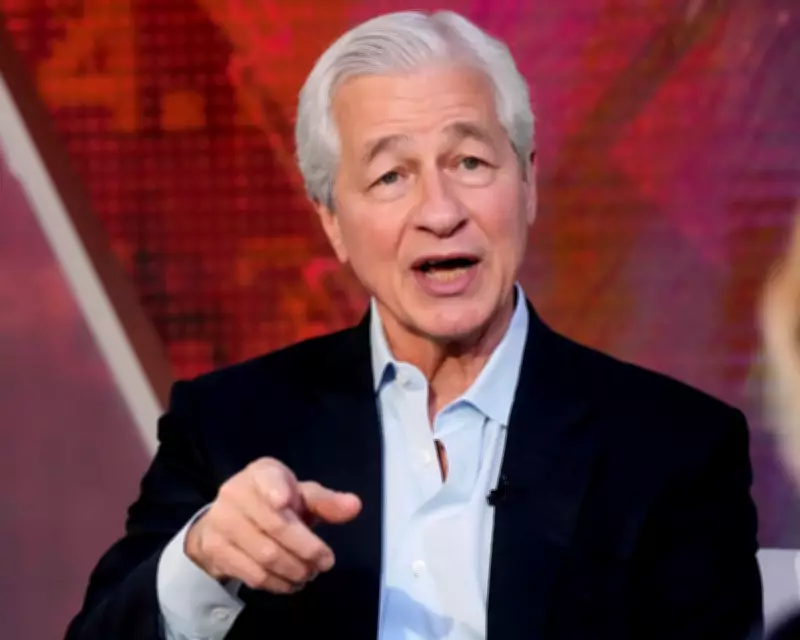
JP Morgan Chief Advocates for Stronger Economic Alliances in Subtle Rebuke of Trump Policies
The head of America's largest financial institution has issued a compelling call for the United States to fortify its economic relationships with democratic allies, delivering what analysts interpret as a carefully veiled critique of former President Donald Trump's foreign and trade policies. In his extensive annual letter to shareholders, Jamie Dimon, the influential chair and chief executive of JP Morgan Chase, emphasized that effective US foreign policy should prioritize American interests while maintaining robust international partnerships.
A Delicate Diplomatic Balancing Act
Dimon's remarks arrive during a particularly tense period in US politics, just weeks after Trump initiated legal proceedings against both the banker and the Wall Street giant, seeking damages exceeding five billion dollars. The former president alleges that JP Morgan engaged in what he terms "debanking" practices against him, further straining an already complicated relationship between the financial titan and the political figure.
"Economic weakening of the world's democracies or a fragmentation of their economic bonds could lead to truly adverse consequences," Dimon cautioned in his detailed communication. "This is precisely what some of our adversaries and many autocratic nations want—it is their stated objective. They would like to see all of our allies far less dependent on the United States and therefore far more dependent on them."
Tariff Policies Under Scrutiny
The banking executive offered measured criticism of Trump's signature tariff regime, which has imposed increasing duties on imported goods—including those from traditional allies and established trading partners. While acknowledging that tariffs have "brought people to the table" and enabled corrections to past trade practices, Dimon advocated for a more comprehensive approach to US foreign economic policy.
"Not only should our foreign economic policy help us grow as a nation, but it should also help other countries grow," he asserted, suggesting that America's economic strategy should foster mutual prosperity rather than unilateral advantage.
From Political Ally to Potential Adversary
Dimon's relationship with Trump has undergone a remarkable transformation since the president's first term, when the banker reportedly declined an offer to lead the US Treasury department. Initially perceived as having surprisingly close ties to the administration, the lifelong Democrat has increasingly distanced himself from Trump's policies and rhetoric.
During a 2018 panel discussion in New York, Dimon addressed speculation about his own presidential ambitions with unusually direct language: "I think I could beat Trump... because I'm as tough as he is, I'm smarter than he is... And by the way, this wealthy New Yorker actually earned his money. It wasn't a gift from Daddy."
Broader Economic Concerns and Technological Optimism
Beyond political commentary, Dimon's comprehensive letter—spanning nearly fifty pages and containing over twenty thousand words—addressed multiple economic challenges and opportunities. He warned about potential inflationary pressures that could emerge by 2026, describing this as "the skunk at the party" that could disrupt economic stability.
The banking leader also expressed considerable optimism about artificial intelligence's transformative potential, predicting that AI "will cure some cancers, create new composites for manufacturing uses, and reduce accidental deaths, among other positive outcomes." He foresaw that technological advancement would eventually reduce work hours in developed nations while extending lifespans and improving safety.
Global Context and Strategic Implications
Dimon's comments emerge against a backdrop of escalating Middle East tensions and strained transatlantic relations, with Trump recently urging governments to "go get your own oil" by force from the Gulf region. Economists have warned that prolonged conflict could drive oil prices beyond one hundred seventy dollars per barrel, potentially triggering a global recession.
The JP Morgan chief's annual shareholder letter represents one of Wall Street's most anticipated communications, offering insights into both corporate strategy and broader economic philosophy. This year's edition particularly highlights the growing tension between America's financial establishment and populist political movements, while advocating for international cooperation in an increasingly fragmented global landscape.