Midwest's Critical Bridge Receives Long-Awaited Upgrade Amid Controversy
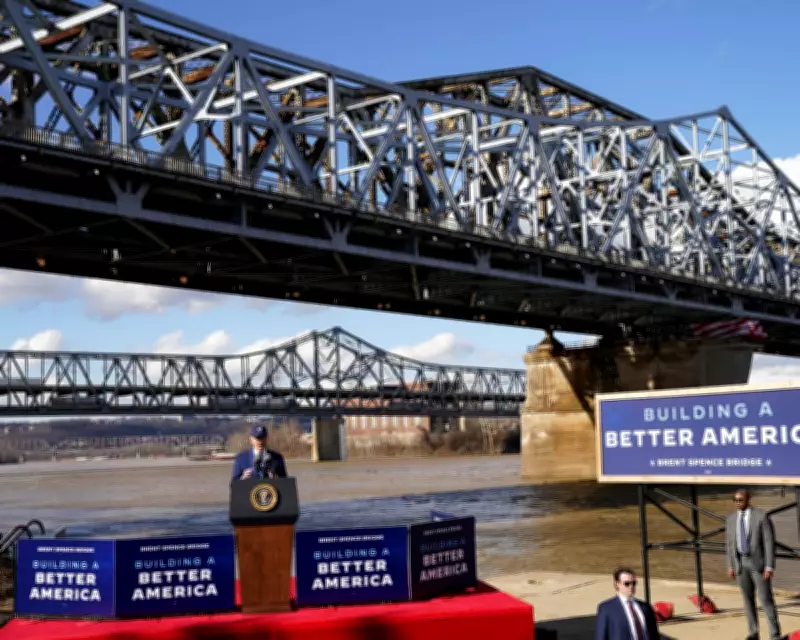
The Brent Spence Bridge, a vital transportation link spanning the Ohio River between Kentucky and Ohio, is finally undergoing a major transformation after decades of political gridlock. Originally constructed in the early 1960s to handle 85,000 vehicles daily, the bridge now struggles with approximately 170,000 vehicles each day along the crucial Interstate-75 corridor. This critical artery connects Canadian border regions to Florida's southernmost points, carrying an estimated $1 billion worth of freight daily while ranking among America's worst trucking bottlenecks.
Federal Funding Breaks Political Deadlock
For years, politicians failed to reach consensus on financing a replacement for the aging structure known for narrow lanes, curved approaches, and frequent accident-related closures. The breakthrough came in 2024 when President Joe Biden announced $1.6 billion in federal funding as part of broader national infrastructure improvements. Construction commenced last month on a companion bridge featuring ten lanes across two decks, with completion projected for 2031.
However, the project faces immediate challenges before any asphalt has been removed. Original cost estimates have already increased by $800 million, raising concerns that the final taxpayer burden could significantly exceed the initially proposed $3 billion. Ohio and Kentucky state governments are financing most construction costs through taxpayer funds rather than implementing road tolls.

Environmental and Community Concerns Mount
Local residents and environmental advocates have voiced substantial objections to the bridge expansion. Amy Townsend-Small, a Covington, Kentucky resident and University of Cincinnati environmental studies professor, highlights existing pollution problems that will likely worsen. "The expanded highway will increase noise, particle, and air pollution in our neighborhood," she explains. "Additionally, the project reduces green space, including impacts on Covington's popular Goebel Park."
Environmental impact complaints filed by citizen groups in 2024 remain pending in federal court, while some Kentucky residents face displacement due to construction requirements. The project extends beyond bridge construction alone, involving approximately eight miles of highway modifications to integrate the new structure into Cincinnati's existing road network.
Historical Echoes and Housing Priorities
The current construction evokes difficult memories for Cincinnati's West End community, where Interstate-75 construction in the 1960s displaced approximately 25,000 predominantly African American residents. Current West End residents now confront renewed disruption as part of the bridge corridor project, despite developers promising "improved connectivity" and potential "enhanced landscaping" through a $441 million investment in overpass improvements.
Galen Gordon, president of the West End Community Council, questions these priorities. "We don't have middle housing options or first-time homebuyer opportunities here," Gordon states. "Those millions could help address housing gaps rather than expanding highways." This concern resonates particularly as Cincinnati recently ranked highest among 44 metro areas for median rent asking prices, with West End residents experiencing some of the city's highest asthma rates near congested highway approaches.
Conflicting Visions for Urban Development
The bridge project coincides with broader gentrification efforts in Cincinnati's West End, including FC Cincinnati's $332 million development plan involving substantial property acquisitions. Meanwhile, Ohio Department of Transportation spokesperson Matt Bruning emphasizes regional benefits: "This project will benefit not only Cincinnati residents but the entire region and nation. We're adding thousands of feet of new sidewalks and shared-use paths while freeing approximately 11 acres for green space or development."

Yet transportation experts note that dozens of studies demonstrate highway expansions don't automatically reduce congestion. Townsend-Small identifies a fundamental contradiction: "Cincinnati has a net-zero greenhouse gas emissions goal, but the mayor publicly supports this highway expansion plan." City officials declined to address whether road construction aligns with progressive urban priorities like housing density, noting simply that "the city is not building the bridge."
As construction progresses, the Brent Spence Bridge project embodies America's infrastructure challenges: balancing economic necessity with environmental responsibility, addressing historical inequities while planning for future growth, and reconciling immediate transportation needs with long-term sustainability goals.