
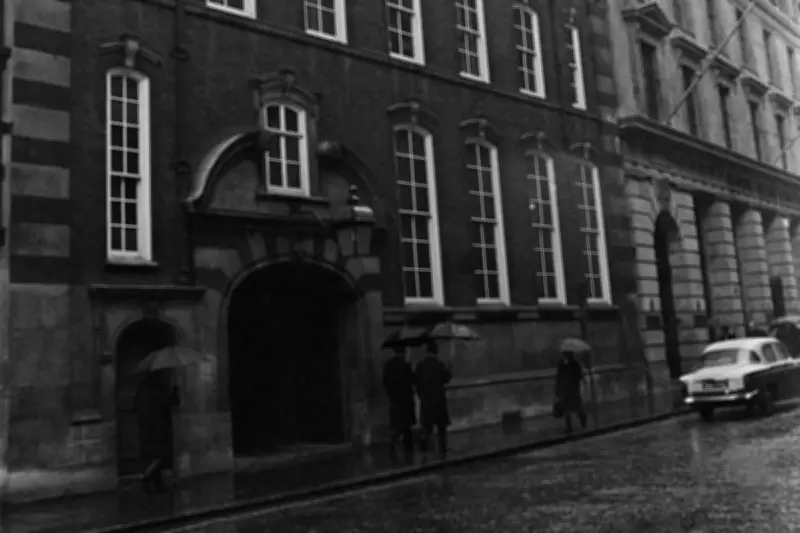
The Day Barings Bank Fell: A 233-Year Dynasty Destroyed
On February 26, 1995, exactly 31 years ago today, one of the City of London's most venerable financial institutions was declared insolvent. Barings Bank, founded in 1762 and once described as one of Europe's six great powers alongside nations like England and France, had been brought down by a single employee's massive fraud.
From Royal Favor to Financial Powerhouse
Barings Bank's origins trace back to 1762 when Francis Baring, a young Exeter apprentice, founded the institution with his elder brother John. During an era when London was scandalized by satirical newspapers and British America still consisted of 13 colonies, the Barings brothers built what would become a financial dynasty.
The bank moved several times during its first four decades before settling at 8 Bishopsgate in 1806, an address that would remain its formal home until the collapse. Beginning in the textile sector that supported the main family business, Barings rapidly diversified with the frantic commercial energy of the long eighteenth century.
The bank financed imports and exports, participated in the transatlantic slave trade, and serviced government debt. The brothers joined Britain's political elite, with John Baring serving as MP for Exeter from 1776 to 1802 and Francis representing several constituencies between 1784 and 1806.
The Louisiana Purchase and European Power Status
By 1803, Francis Baring and Co. had become an established financial powerhouse of such stature that the company was asked to arrange what was then the largest property deal in history: the Louisiana Purchase.
The French Colony of Louisiana encompassed 828,000 square miles stretching from the Great Lakes to the Gulf of Mexico, territory mostly inhabited by Native Americans. The United States paid the French Republic $15 million for this vast territory, effectively doubling its own size at a cost of just $18 per square mile.
Barings, together with Hope & Co. of Amsterdam, purchased $11.25 million of the total in US Treasury bonds, enabling France to receive cash and expediting the monumental transaction. The bank's influence grew so substantial that by 1818, French Prime Minister the Duc de Richelieu declared without hyperbole: "There are six great powers in Europe: England, France, Russia, Austria, Prussia and the Baring brothers."
The dynasty maintained impeccable standing for generations, with five separate hereditary peerages still held by Barings family members today: the earldom of Cromer and the baronies of Ashburton, Northbrook, Revelstoke and Howick of Glendale.
The Rogue Trader's Ascent and Descent
In 1989, a reticent 22-year-old from a Watford council estate named Nick Leeson joined the settlements department of Barings Securities. Having previously held back office roles at Coutts and Morgan Stanley, Leeson was regarded as reliable, competent and stable.
When Barings decided to open a Futures and Options division in Singapore in 1992, Leeson was appointed general manager. This position gave him responsibility for both back office services and a presence on the trading floor, creating the perfect conditions for what would follow.
Leeson began making unauthorized speculative trades, a process facilitated by loose management oversight. By the end of 1993, he had seemingly earned Barings £10 million, representing approximately one-tenth of the bank's overall profits. However, these official trading figures concealed a much darker reality.
Because Leeson managed the back office, he was able to use an error account numbered 88888 to conceal mounting losses. In his memoir, Rogue Trader: How I Brought Down Barings Bank and Shook the Financial System, he later admitted: "I was probably the only person in the world to be able to operate on both sides of the balance sheet. It became an addiction."
While Barings believed Leeson had generated a £10 million profit, the error account actually masked a loss of £23 million. Like most addictions, this one proved expensive and potentially ruinous. Leeson adopted the strategy of a reckless gambler who can see no other way out, doubling down whenever he incurred losses.
This approach had saved him in mid-1993, but 18 months later, the £23 million loss had ballooned to £208 million. Leeson's reputation for generating profits prompted London headquarters to supply him with cash injections under extraordinarily little scrutiny, but even the most lackadaisical oversight could not remain insensible forever.
The Final Gamble and Catastrophic Collapse
On January 16, 1995, Leeson made a short straddle in the Singapore and Tokyo stock exchanges. This aggressive and risky bet essentially predicted that the Tokyo Stock Exchange would remain broadly stable overnight.
The act of God he received was not the miracle he needed. At 5:46 a.m. the next day, a massive earthquake measuring over seven on the seismic intensity scale struck the southern part of Hyōgo Prefecture on Honshu, Japan's largest home island.
The Great Hanshin earthquake destroyed or irreparably damaged 400,000 buildings, caused 300 fires, and killed more than 6,400 people. Asian markets tumbled in response, and the Tokyo Stock Exchange—which Leeson had bet would remain stable—dropped eight points in just five days.
Desperate to recoup his losses, Leeson made ever-riskier trades predicated on the Nikkei Index making a swift recovery. It didn't. The Nikkei had opened at 19,322 on January 17 and would not close higher than that level until December 7—far too late for Leeson or Barings.
On February 23, Leeson fled Singapore, leaving behind a note that simply read: "I'm sorry." Barings had even more reason for regret. The bank's losses had reached £827 million, twice its available trading capital.
Aftermath and Legacy
On February 26, 1995, Barings—Britain's oldest merchant bank—was declared insolvent. Just eight days later, on March 5, Dutch banking corporation ING purchased what remained of the institution for the symbolic sum of £1.
Leeson had been detained at Frankfurt Airport three days before the collapse and was extradited back to Singapore. There he was convicted on two counts of misleading Barings' auditors and defrauding the stock exchange. Sentenced to six and a half years' imprisonment in Changi Prison, he was released after four years and four months for good behavior while suffering from colon cancer.
The asset management division of Barings lives on today as a subsidiary of the Massachusetts Mutual Life Insurance Company. Leeson survived his cancer and now resides in Galway, where he investigates corporate fraud and advises on managing liquidity—a classic case of doing as he says, not as he did.
The collapse of Barings Bank remains one of the most dramatic stories in financial history, illustrating how centuries of prestige and power can be undone by a single individual's actions when combined with inadequate oversight and management failures.




