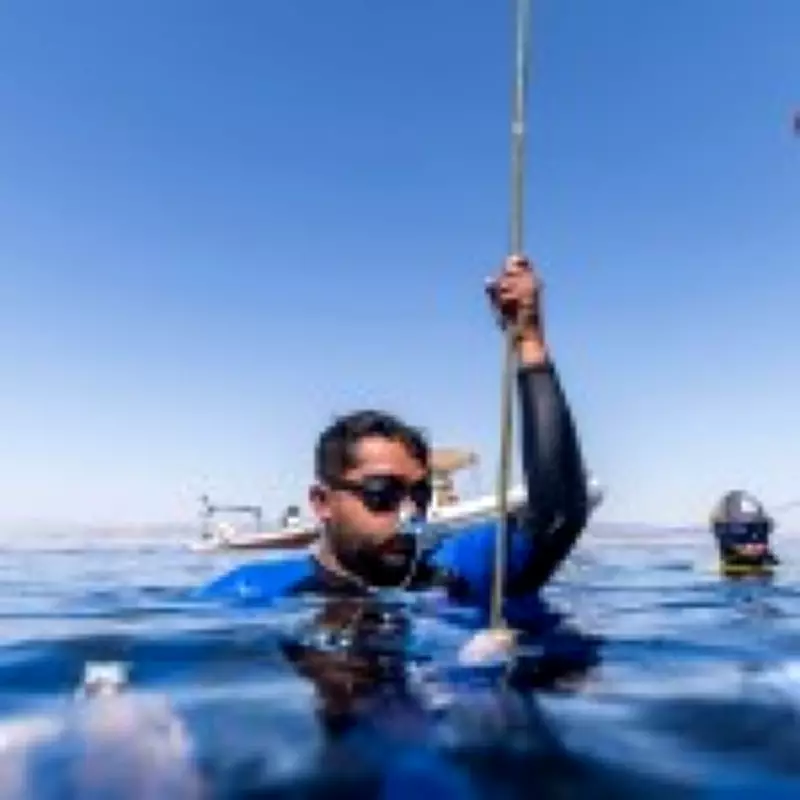
A competitive freediver has risked the dangers of the Iran war to return to his favorite diving spot in the Strait of Hormuz, describing it as a place of inner peace despite the ongoing conflict.
Diving into Danger
Freediving is inherently risky, involving diving into dark waters on a single breath. However, one freediver, Mr. Khurana, could not resist breaking the blockade of the Strait of Hormuz to revisit his beloved location. The strait is currently a focal point of the Iran war, with cargo shipping lanes halted due to fears of sea mines and a 'shoot to kill' order from Donald Trump against small Iranian boats deploying them.
A Sanctuary in a Warzone
Despite the turmoil, Mr. Khurana finds peace at the center of the warzone. He notes that the blockade and absence of international shipping have allowed marine life to flourish. 'I have been on dive trips in most parts of the world — the Maldives, Asia, the Red Sea, and Europe,' he said. 'But I promise you, there is no diving spot that compares with the Strait of Hormuz. I first went three years ago and have been in love with it ever since.'

He described the experience as amazing, with clear signs that the ocean is thriving. 'It was a bit green and algae-filled, with jellyfish. There were fish everywhere, and the fish-eaters on the boat were very happy with what they caught.'
Personal Connection and Encounters
Just two hours from his home in Dubai, the location has become deeply personal. In his many dives, he has encountered whale sharks, hammerheads, and even the elusive mola mola. Night dives in complete darkness are something he trusts more here than anywhere else. 'There are very few spots I feel so safe diving at night,' he added.
Since the Iran war began, he stayed away until last week. He joined a trusted boat crew he had dived with over 15 times, but there were moments of trepidation. Crew members worried about being boarded by Iranian speedboats or crushed by US warships. However, the freediver saw no naval battles and paid no tolls. 'I don't even know what the navy looks like,' he said. His only dangerous encounter was when two groups of pirates tried to sell his crew smuggled oil.
Misunderstood Region
He believes the Strait of Hormuz is one of the most misunderstood regions on Earth, with dolphins, sunfish, and sea turtles making up a diverse ecosystem. 'The beauty of nature is that it can thrive through anything. A lotus can bloom even in the dirtiest of places, and even the worst-affected regions have their own beauty. It is up to us to find the beauty and ignore the noise.'
'Nature is a very powerful force. As humans, we like to believe that we are above nature, but a single act of nature can wipe us out.'
Depth and Philosophy
The deepest Mr. Khurana has been during training is 101 meters down. 'I am not a big believer in creating too many targets. I will go as deep as the ocean will let me.' His only fear is that Omani authorities might block him from returning to his beloved spot after reading this story. But with the war raging above, it is beneath the waves that he feels calm.
'My family don't really worry,' he says, not contemplating the dangers of the war. 'They have seen the safety protocols I keep in place and are very supportive. I'm no longer the type of person to push for a record or prize, and I only go as deep as I can joyfully.'
Hope for Peace
He 'absolutely' wants the conflict to end so people can appreciate the beauty of the area again. 'Even as someone completely outside the world of geopolitics, I can see how the tension is affecting everyone. I have staff in the Philippines who are struggling. I have family in India who are struggling. I really hope that this tension can end with a resolution that is suitable for everyone.'
Asked for his message to world leaders fighting over the strait, he says: 'We came from nature and we will go back to nature. We need to respect the power of the forces that are beyond our comprehension.'