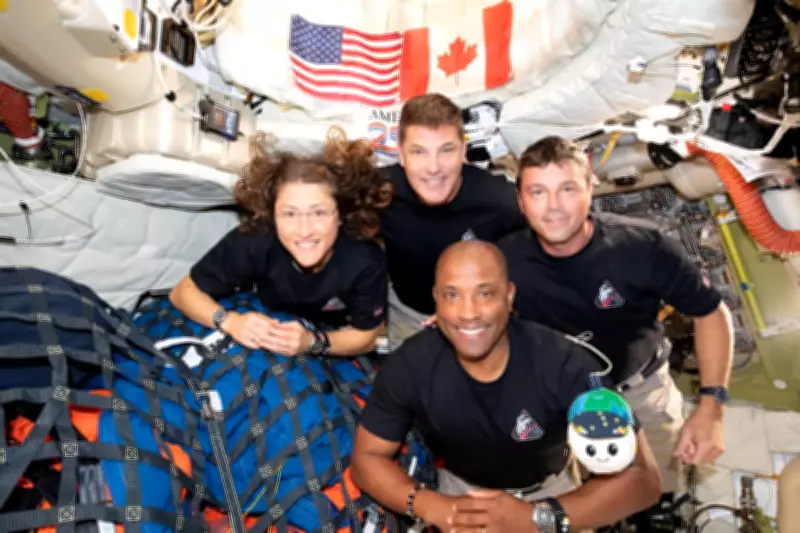
Artemis II Crew Concludes Historic Mission with Pacific Splashdown
The number of humans who have traveled to the moon and returned safely to Earth has increased to 28, as NASA's Orion capsule, carrying the four Artemis II astronauts, made a gentle splashdown in the Pacific Ocean on Friday night. The landing, scheduled for 5:07 PM PT off the coast of San Diego, marked the end of a 10-day lunar odyssey, making the three Americans and one Canadian the first people to venture beyond lower Earth orbit since the final Apollo mission in December 1972.
A New Beginning for Space Exploration
This mission signals a fresh start for NASA and its international partners, following a highly successful test flight around the far side of the moon. Initial observations indicate that all objectives were met, proving NASA's capability to safely send humans to and from cislunar space. The knowledge gained will propel the Artemis program toward a scheduled crewed moon landing in 2028, 56 years after the last.
During the mission, the world came together in a rare moment of unity, enjoying stunning video footage and high-resolution images of the lunar surface and Earth from afar. The astronauts shared profound reflections on their experiences, with NASA astronaut Christina Koch describing an overwhelming sense of awe upon seeing the moon up close.

Record-Setting Achievements and Personal Moments
The Artemis II crew set multiple records during their journey. They traveled farther from Earth than any humans before, reaching 252,756 miles, surpassing the previous record set by the Apollo 13 crew. Christina Koch became the first woman to travel to the moon and back, Jeremy Hansen of the Canadian Space Agency was the first non-American, and pilot Victor Glover was the first person of color to achieve this feat.
The mission was not without its challenges. Orion's toilet malfunctioned multiple times, requiring temporary fixes and repairs from Koch, who took on the role of plumber. However, there were also lighter moments, such as an Easter egg hunt with dehydrated scrambled eggs and regular appearances of the mission mascot, a plushie named Rise, designed by an eight-year-old California student.
One of the most emotional episodes occurred when the crew proposed dedicating an unnamed moon crater to Carroll Taylor Wiseman, wife of commander Reid Wiseman, who passed away from cancer in 2020. This heartfelt gesture brought tears and hugs among the astronauts.
Technical Evaluations and Future Plans
On the operational side, the crew evaluated Orion's life support systems, radiation detectors, next-generation spacesuits, and other critical components for future deep-space missions. NASA's long-term plans include building an ambitious $20 billion moon base within a decade, with Artemis II serving as a crucial step toward this goal.
The splashdown, though less visually dramatic than the fiery launch from Florida's Kennedy Space Center, required meticulous planning and precision. Changes to the heat shield, based on lessons from the uncrewed Artemis I mission, ensured Orion could withstand re-entry temperatures up to 5,000°F. A steeper re-entry path was chosen to reduce heat stress, with a series of parachute deployments slowing the spacecraft to a safe 17 mph splashdown.
Recovery and Legacy
Coast Guard and NASA recovery crews were positioned in a 550-mile diameter landing zone for the retrieval. After medical checks and a brief stop at a San Diego military base, the astronauts will reunite with their families at Houston's Johnson Space Center. They now join the exclusive group of 24 other astronauts, all American men, who traveled to the moon and back during the Apollo era.
Nicky Fox, associate administrator of NASA's science mission directorate, emphasized the mission's impact, stating that the astronauts took humanity on an incredible journey and brought back images that will inspire generations to come. This successful return not only marks a historic achievement but also paves the way for future explorations and a renewed era of space discovery.