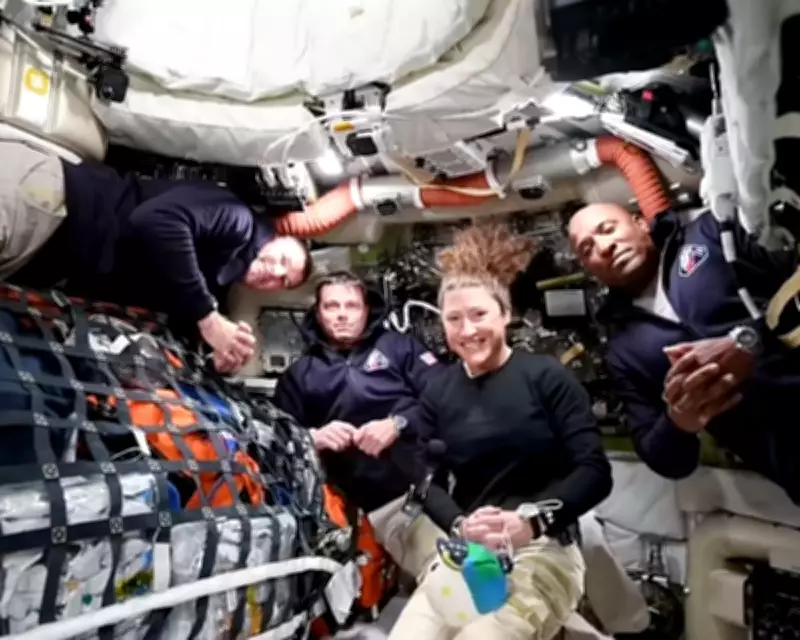
Artemis II Crew Embarks on Historic Deep-Space Journey
The four-person crew of NASA's Artemis II mission is currently experiencing a profound moment of solitude in space, as they orbit the far side of the moon, completely out of contact with Earth. This critical phase marks a significant milestone in human space exploration, with astronauts Reid Wiseman, Victor Glover, Christina Koch, and Jeremy Hansen venturing further from our planet than any humans before them.
Unprecedented Isolation and Lunar Exploration
During this period of radio silence, which lasts approximately 41 minutes, the crew is entirely alone among the stars, with Earth hidden from view by the lunar landscape. This isolation is a key part of the mission designed to test human endurance and the limits of deep-space travel. The astronauts are documenting regions of the moon unseen by human eyes since the Apollo missions over five decades ago, using this opportunity to gather crucial data for future lunar landings.
The mission, launched from the Kennedy Space Center on April 1, aims to prepare for a planned lunar landing by 2028, as part of NASA's broader strategy to establish a continuous human presence on the moon. Over the past days, the crew has been busy checking spacecraft systems, testing spacesuits, and rehearsing scientific experiments essential for the mission's success.

Overcoming Challenges and Scientific Advancements
Despite being millions of miles from home, the astronauts have faced familiar logistical issues, such as repairing a malfunctioning toilet—a $30 million facility featuring the first private cubicle on a spacecraft of this type. This contrasts sharply with earlier Apollo missions, where waste management was primitive and prone to leaks, highlighting technological progress in space habitation.
The Artemis program, with an estimated cost nearing $100 billion, has sparked debate over its expense amid economic challenges on Earth. However, bipartisan support in the United States has ensured its continuation, despite previous attempts to cut NASA funding. Critics question the timeline for returning astronauts to the moon by 2028, with skepticism about political influences on the schedule.
Groundbreaking Research and Future Implications
As volunteers in scientific experiments, the crew is contributing to advancements in space medicine and technology. They are collecting saliva samples to study immune system responses to radiation, isolation, and distance from Earth, investigating whether dormant viruses like chickenpox could reactivate during space travel. Additionally, they are using "organ-on-a-chip" devices to simulate bone marrow sensitivity to radiation, aiming to develop personalized medical kits for future astronauts.
The mission also tests a radiation protection shelter against solar flares, addressing the dangers of "space weather" for deep-space missions. These efforts underscore the mission's role in enhancing our understanding of long-duration space travel and ensuring crew safety.
A Moment of Human Unity and Inspiration
Astronaut Victor Glover, the first Black person to travel to the moon, emphasized the human aspect of this experience, hoping it fosters a sense of global togetherness. The crew's journey, streamed live on platforms like YouTube, showcases the enormity of human achievement and international cooperation in space exploration.
As the Orion spacecraft prepares to re-enter Earth's atmosphere later this week, facing temperatures up to 1,650 degrees Celsius, the mission continues to inspire awe. Today's period of solitude serves as a poignant reminder of humanity's capacity to push boundaries and explore the unknown, setting the stage for future endeavors beyond the moon.