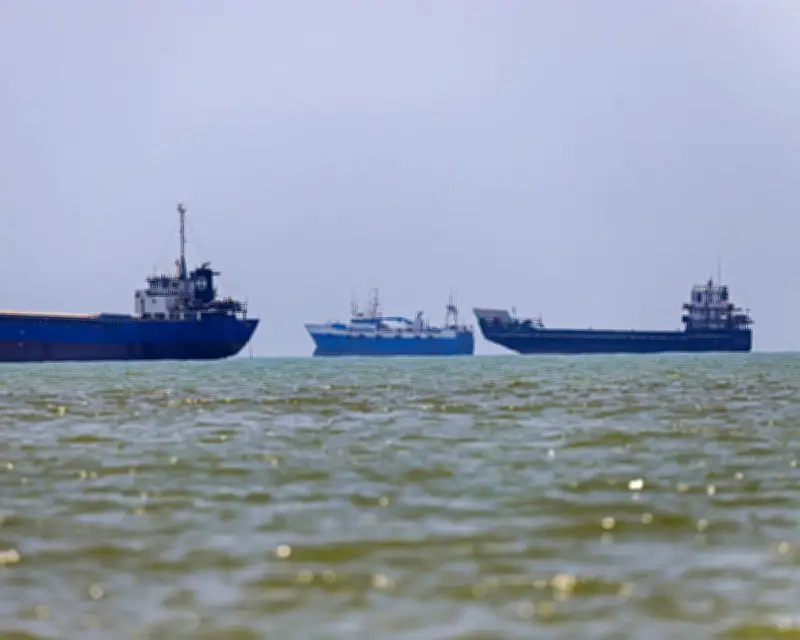
Oil prices jumped and stocks fell after the US launched a fresh wave of attacks against Iran amid an escalating standoff over the Strait of Hormuz. Brent crude, the international benchmark, rose 3.4% to $78.59 a barrel on the renewed hostilities. It had been trading at $72.48 before the outbreak of the war in February and hit as high as $120 in April.
European and Asian markets decline
European stock markets slipped, with the Stoxx Europe 600 index down 0.2%. European airline stocks were among the hardest hit, with Ryanair, Air France, and International Consolidated Airlines Group falling between 1.8% and 2.2%. Rivals Wizz Air, Finnair, and Lufthansa dropped between 1% and 3%. Asian stock markets were down sharply, with South Korea's Kospi falling 8% and Japan's Nikkei 225 and China's Shanghai Composite each declining 2%. Chip companies were also hit, with shares in South Korea's SK Hynix slumping 15% and Samsung Electronics sinking 10%.
UK FTSE 100 flat due to oil giants
In the UK, the blue-chip FTSE 100 index was broadly flat, thanks to rises in oil companies BP and Shell, which were up 2.8% and 1.2% respectively. The market swings came after the US launched more strikes against Iran on Sunday evening, prompting retaliation from Tehran.
US strikes and Iranian retaliation
US Central Command (Centcom) said on X that the strikes were “to continue degrading their ability to attack civilian mariners and commercial ships freely transiting the strait of Hormuz”. It added that Donald Trump “has directed the strikes to hold Iranian forces accountable”. This marked the latest cycle of attacks in the Middle East as Iran seeks to assert control over the Strait of Hormuz, a vital shipping channel through which a fifth of the world's oil supply normally passes.
Impact on US-Iran truce and oil supply
The escalations have cast further doubt on the fragile interim US-Iranian truce signed last month. Analysts at Goldman Sachs wrote in a note: “Recent attacks highlight how uncertain Gulf exports remain and that a serious re-escalation could re-intensify the short-run upside risk to oil prices.” The number of vessels passing through the strait is already falling, according to data analyst Kpler. It found that only six vessels crossed the strait on Sunday, the fewest in five weeks.
Vessel traffic and Iranian actions
Tankers that exited the strait included the very large crude carrier Humanity, which carried 2 million barrels of Iranian oil, and another tanker, Capetan Andreas, carrying about 500,000 barrels of Kuwaiti oil products, Kpler found. Three empty tankers entered the Gulf to load oil, it said. Most tankers switch off their transponders when crossing the strait. Trump said on Sunday that the shipping route was open to commercial traffic, although Iran said earlier that it had closed the strait after a vessel travelled on an unapproved route. Iran's Islamic Revolutionary Guard Corps said on Monday that its navy stopped two ships in the strait on Sunday by shutting down their systems, although it did not name the vessels involved.
Gold falls and Opec lowers demand forecast
Gold fell on Monday by 1.4% to $4,083 an ounce, as higher oil prices stoked fears that central banks might have to increase interest rates to combat inflation. Gold becomes relatively less attractive when interest rates are higher as the metal does not pay a yield. Oil prices pared back some gains on Monday after the Opec cartel of oil-producing nations lowered its forecast for global demand growth in 2026 to 780,000 barrels a day, compared with its previous estimate of 970,000. This marks the third consecutive downward revision by the producer group. However, Opec has continued to estimate a smaller impact on global energy demand compared with other forecasters. The Paris-based International Energy Agency has said it expects demand to decline in 2026 by 1 million barrels a day.