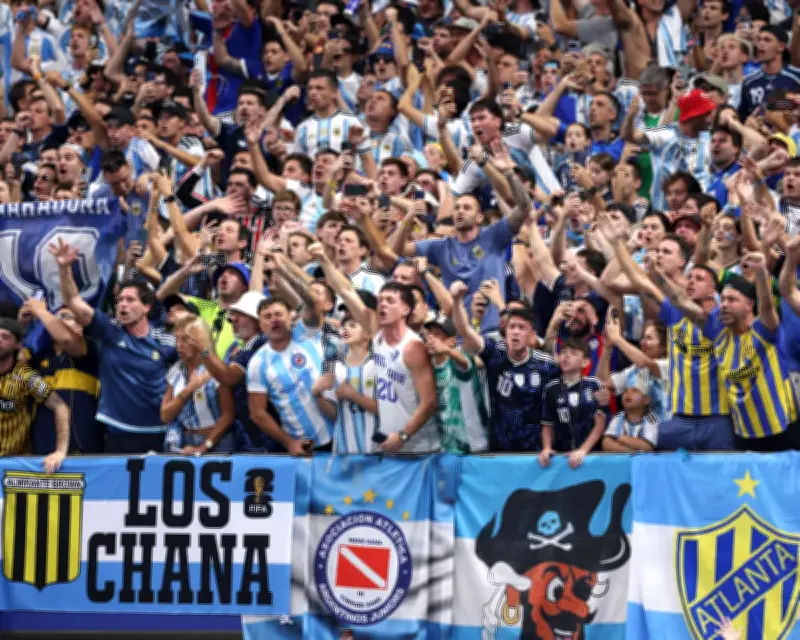
A history of racism and ongoing footballing rivalries have made the choice of which team to support in Sunday's 2026 World Cup final a charged topic across Latin America. Many people in the region have declared their support for Spain over Argentina, breaking with the tradition of backing fellow South American teams.
Columnist's stance reflects growing sentiment
Brazilian journalist Julia Duailibi, who usually writes about politics for O Globo, penned a column explaining why she would not support neighboring Argentina. She cited racist scenes involving a minority of Argentina fans and the silence of the majority. "I admit that the racist scenes involving a minority of the fans, and the silence of the majority on the pitch, turned my stomach," she wrote after Argentina's semi-final victory over England.
Academic analysis of shifting loyalties
Nicolás Cabrera, an Argentinian sociologist and anthropologist who studies football supporters across Latin America, noted that the tendency to support a Latin American team against a European one has changed. "In the past, people were more likely to support a Latin American team against a European one, but that has changed quite a lot in recent years," he said. Cabrera, who lives in Rio de Janeiro, pointed out that this shift was once confined to Argentina's traditional rivals—Brazil, Uruguay, and Chile—but now extends to Mexicans, Colombians, and Ecuadorians.
Cabrera identified several reasons for the rifts. Argentina has been Latin America's most successful national team, reaching three of the past four World Cup finals. Meanwhile, neighbors like Brazil have not reached the final since winning their record fifth title in 2002. The presence of Lionel Messi, even at 39, also fuels envy. Additionally, increased club matches in the Copa Libertadores—expanded from about 20 teams to nearly 50—and social media have amplified hate speech and racism. "Hate speech, racism, xenophobia and discrimination began to circulate in ways that had previously been more marginal and less visible," Cabrera said.
Racist incidents fuel controversy
Racist incidents involving Argentina fans have been documented for decades. In 1920, an Argentinian newspaper published a cartoon depicting Brazilian players as monkeys. Recently, several Argentine tourists were arrested in Brazil for racial insult. During the current World Cup, an Argentine tourist was filmed making monkey gestures at a Black Brazilian in Bahia but was not arrested. In 2024, Argentina players chanted racist and homophobic songs about France squad members after winning the Copa América. A well-known Argentinian journalist said on TV that he hated Mexicans "with all his soul" and made unfounded claims about Mexican drug cartels threatening Ecuadorian players. Mexico's president, Claudia Sheinbaum, called the remarks "outrageous."
Brazilian historian offers counterpoint
Despite condemning racism, Brazilian historian Fábio Luís Barbosa dos Santos said he will support Argentina in the final. "If the issue is racism, then you couldn't support Spain either," he said, citing Spain's colonial past and recent racist abuse of Brazilian footballer Vinícius Júnior by La Liga fans. Santos supports Argentina "because we are countries bound together by our colonial past, by dictatorships and now by the far right," noting Argentina's President Javier Milei and Brazil's former President Jair Bolsonaro. "Their misfortunes are ours too, as their joys should be," he added.
Brazilian fans rally behind Argentina
Ride-hailing driver João Felipe Jr, 32, will travel 270 miles from Rio de Janeiro to São Paulo to watch the final at a bar founded by Argentinians, which has welcomed dozens of Brazilians supporting Argentina. Felipe Jr, who attended a Brazil-Argentina match with Argentina supporters three years ago, dismissed conspiracy theories about Fifa favoring Argentina. "They deserve to be in the final, above all because of what Messi is doing. For me, it has everything to do with him. When he retires, I'll stop supporting Argentina," he said.