The Unlikely Appeal of Barefoot Hiking: 'It Makes You Feel Quite Primal'
From designated clay trails in Seoul to remote Australian coastlines, a small but dedicated community of hikers worldwide are abandoning their footwear to experience nature directly through their soles. This unconventional practice, described by enthusiasts as both enlivening and primal, represents a growing movement toward more sensory outdoor experiences.
Global Footprints: From Urban Seoul to Wild Australia
Gen Blades, an outdoor education lecturer and researcher based in Castlemaine, Victoria, discovered barefoot hiking unexpectedly while tackling South Korea's 147km Namsan Dulle-gil trail. When she encountered a specially designed clay section known as "hwangto," she removed her boots without hesitation. "There's something about that direct contact of the sole of your foot in the clay," Blades explains. "It almost feels like mud, but then you realize, 'Oh yeah, it's oozing up between my toes!'"
South Korea has embraced barefoot walking as a health practice, with more than 150 parks in Seoul alone featuring designated barefoot areas complete with foot-washing stations, shoe lockers, and safety handrails. "The trails were often right in the busy part of town where people were out exercising after work," Blades notes about the accessibility of these urban barefoot experiences.
In contrast, Australian barefoot hikers typically forge their own paths. Dale Noppers, a 37-year-old health and safety superintendent from Perth, has been hiking barefoot for approximately seven years. What began as curiosity about bush survival skills has evolved into a regular hobby that he describes as primal. "It makes you feel quite primal," Noppers says, "being in nature and slowing everything down."
Physical Adaptation and Sensory Awareness
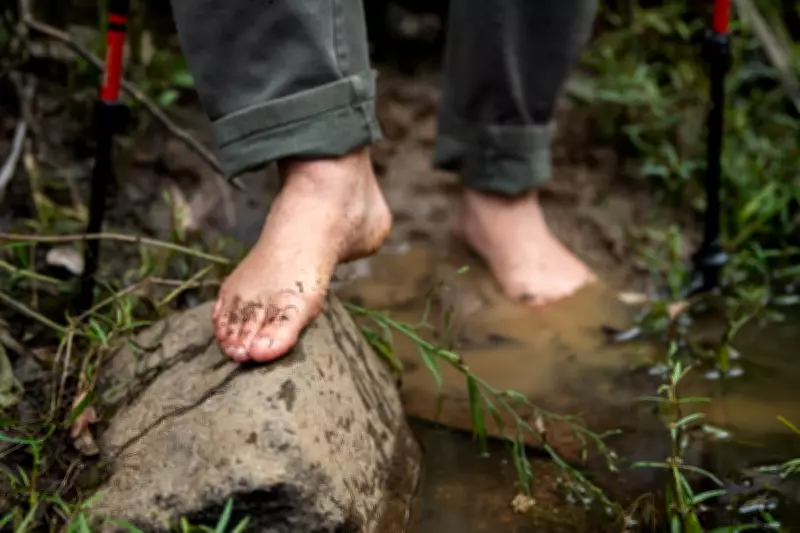
Noppers' barefoot journeys have progressed from initial half-hour attempts to hikes lasting up to seven hours on challenging terrain like the 14km Kitty's Gorge trail at Serpentine National Park, which features steep rocky inclines, uneven ground, mud, and his least favorite surface—pea gravel. Despite these challenges, his feet have adapted remarkably. "The bottom of my feet are nice and soft and supple... it's almost like they've had a pedicure," he observes with amusement.
Podiatrist Dr. George Murley offers a balanced perspective on the practice. "It's really person-specific," he notes, explaining that both overly cushioned footwear and going barefoot without proper conditioning can lead to injuries. However, Murley acknowledges benefits including improved balance and coordination. "Our feet are one of the most sensitive parts of the body," he explains. "If you place an interface like a shoe with soft cushioning between your skin and the ground, you reduce the neural input into the body."
For those interested in trying barefoot hiking, Murley recommends gradual progression. "You've got to be slow and progressive," he advises. "Almost like treating it as a gym session for your feet."
Heightened Awareness and Environmental Connection
Barefoot hiking demands increased vigilance against natural hazards including ants, spiders, snakes, and occasional glass shards. Noppers acknowledges these risks but emphasizes that "bugs are one of those things that come with the territory." His only significant incident occurred when he cut his foot on a broken bottle while entering a river after a walk.
For Blades, this heightened awareness represents part of the practice's appeal. "When walking barefoot, awareness of the ground opens up," she says. "I notice the ants and step aside."
Uralla Luscombe-Pedro, a 32-year-old conservation researcher who grew up on a farm near Walpole on Western Australia's south coast, brings extensive barefoot experience to the conversation. As an adult, she has walked hundreds of kilometers of wild coastline without shoes, including a two-week journey from Batemans Bay to Mallacoota on Australia's east coast and a week-long trek along Western Australia's south coast from Bremer Bay toward Albany.
"Your feet are sensory organs," Luscombe-Pedro explains. "You can feel with your feet as you can with your hands." After extended barefoot walking, she notices physical changes. "You definitely feel like a more lean animal. Your body feels more capable."
Philosophical Dimensions and Modern Relevance
Blades' academic research explores the embodied experience of walking, paying attention to bodily sensations while moving through landscapes. She has experimented with barefoot walking in various settings, including sections of the 80km Lurujarri heritage trail north of Broome, led by Goolarabooloo elders.
"Walking is already a radical act in our modern world," Blades reflects. "You choose to slow down—going barefoot slows things down further still. Your senses become more attuned to what's around you."
Near her Castlemaine home, Blades finds that barefoot walking reveals environmental details she might otherwise miss: tiny orchids pushing through grass, delicate cobwebs across paths, and subtle ground texture variations. In an era of climate crisis and species loss, she believes this heightened attention to the living world carries particular significance.
"Walking barefoot allows you to sink into country," Blades concludes. "You're perceiving not just with your eyes, but with your body."
Noppers now organizes group barefoot hikes around Perth, attracting modest but dedicated participation ranging from three to ten people across various ages, including his five-year-old son Achille on gentler outings. This growing community suggests that despite its unconventional nature, barefoot hiking continues to attract those seeking deeper connections with both nature and their own physical experience of movement through landscapes.