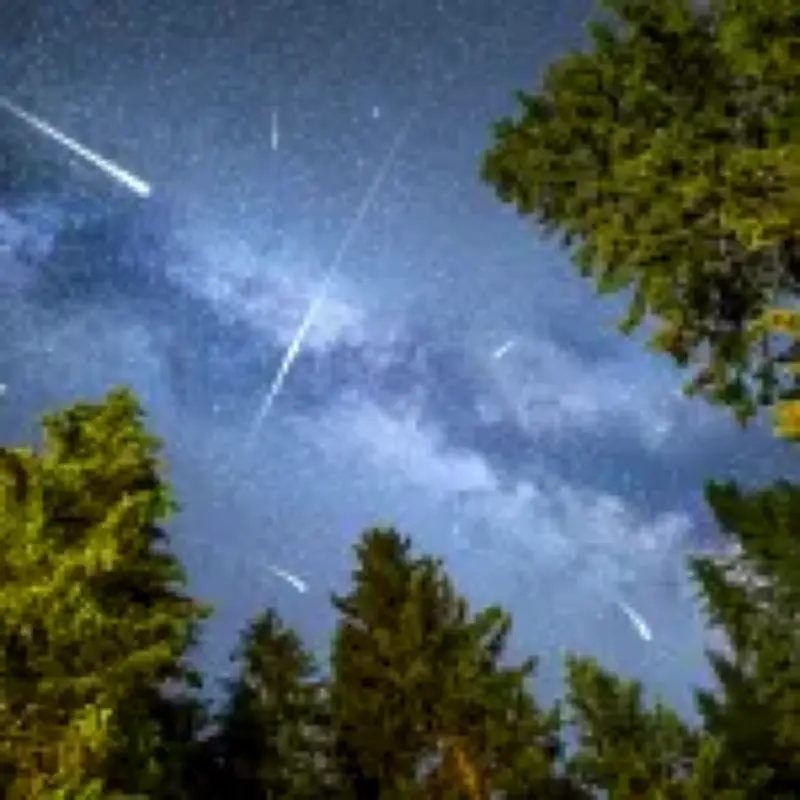
The Perseid meteor shower, one of the strongest annual displays of shooting stars, reaches its peak tonight, coinciding with the partial solar eclipse. According to the Royal Museums Greenwich, the best viewing window in the UK is between midnight and 5am tomorrow, when stargazers can expect dozens of colourful meteors per hour.
Unlike the eclipse, which requires special glasses, the meteor shower can be seen with the naked eye. No telescope or binoculars are necessary, though they may aid viewing depending on location. The shower is visible across the whole of the UK, but a dark site with minimal light pollution and a clear horizon is essential. Experts advise giving your eyes about 15 minutes to adapt to darkness before spotting meteors.
Peak timing and visibility
The shower peaks between August 12 and 13, continuing at reduced rates until August 24. Each night after the peak, the number of meteors decreases, making them harder to see. If missed, the Perseids will return next year around the same time.
Meteors will appear to radiate from the constellation Perseus in the north-eastern sky. Stargazing apps can help locate the constellation. Visibility will depend on local weather: clear skies are forecast in southern England, while cloudier conditions are expected further north. Checking the local forecast before heading out is recommended.
Solar eclipse and viewing advice
The UK will not experience a total solar eclipse, as it lies outside the path of totality, unlike northern Spain or Greenland. In the totality path, the moon completely blocks the sun for over two minutes. The Met Office has shared a list of the best UK locations to catch the partial eclipse. Warnings have been issued about the dangers of using phones to view the eclipse, as eclipse glasses sell out across the country.
For those who miss both events, a full moon is expected at the end of the month, offering another celestial spectacle.
What causes the Perseid shower?
The Perseids originate from debris left by Comet Swift-Tuttle, officially designated 109P/Swift-Tuttle. Discovered in 1862 by Lewis Swift and Horace Tuttle, the comet takes 133 years to orbit the Sun. It last reached perihelion (closest approach to the Sun) in 1992 and will do so again in 2125.
As Earth passes through the comet's trail of ice and rock, particles enter the atmosphere at high speed, burning up as shooting stars. Small meteors vaporise, leaving light trails, while larger ones explode as fireballs. The peak occurs when Earth crosses the densest part of the debris field.