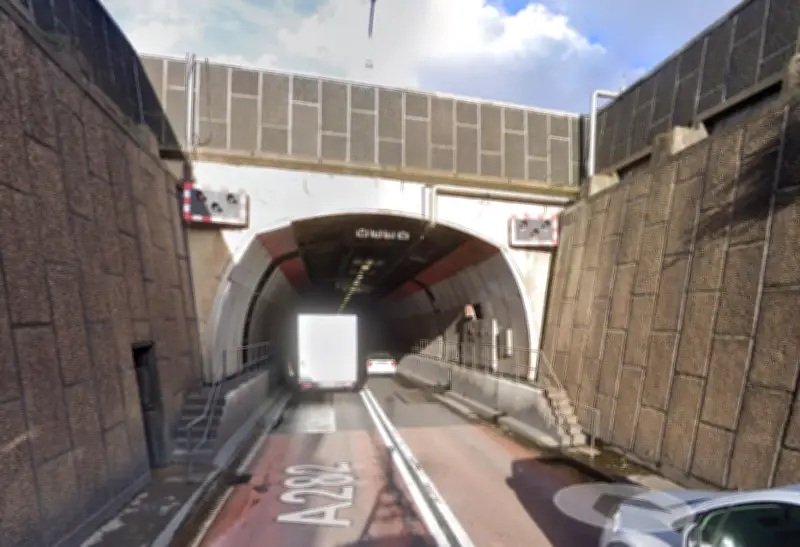
The Dartford Crossing's unusual configuration—two tunnels for northbound traffic and a single bridge for southbound—is the result of nearly three decades of separate construction projects, not a single planned design. National Highways reports that the crossing now handles an average of around 150,000 vehicles daily, with peaks of up to 180,000, totaling more than 50 million journeys a year.
Original Construction and Early Demand
The first Dartford Tunnel opened in 1963, predating the completion of the M25. According to National Highways, plans for a river crossing in the area date back to the 1920s. Initial work began in the 1930s but was halted by the Second World War, resuming in 1959.
When the first two-lane tunnel opened, it was expected to serve around two million vehicles annually. However, by 1970, the tunnel was already accommodating around eight million vehicles each year—four times the original projection.
Second Tunnel and M25 Completion
The rapid increase in traffic necessitated the construction of a second tunnel. The eastern tunnel opened in 1980, providing two additional lanes across the Thames, with each tunnel now direction-specific. Yet traffic continued to rise, especially after the M25's completion in 1986, which turned the crossing into a vital part of London's orbital road network.
National Highways states that traffic soon began regularly surpassing the tunnels' designed maximum of around 65,000 vehicles a day, with predictions indicating annual traffic could exceed 40 million vehicles. This prompted the next major expansion.
The Queen Elizabeth II Bridge and Directional Split
In response to these increasing demands, the Queen Elizabeth II Bridge was constructed, providing a new four-lane crossing in one go. This cable-stayed bridge, approximately 2.8km in total length, opened in October 1991 at a cost of around £120 million. It was officially opened by Queen Elizabeth II.
The bridge moved southbound vehicles onto its four lanes, allowing the two tunnels to handle northbound traffic exclusively, effectively creating a four-lane road in each direction. Under normal circumstances, the QEII Bridge carries southbound traffic from Essex into Kent, while the two Dartford tunnels manage northbound traffic from Kent into Essex.
However, the system can adapt. When the bridge needs to close for maintenance or due to severe weather, southbound traffic can be directed through one of the tunnels, with the other tunnel handling northbound vehicles. There are also restrictions on vehicle types due to differing tunnel sizes: vehicles more than 4.8 metres high can only use the eastern tunnel, while vehicles over five metres cannot use either tunnel.
Traffic Challenges and Future Plans
Despite the three structures at Dartford, demand has consistently outgrown them. National Highways states that the modern crossing was designed to handle around 135,000 vehicles a day. Currently, it carries an average of around 150,000 vehicles daily, with peaks of up to 180,000 on the busiest days, totaling more than 50 million journeys a year. This has led to the planning of another road crossing of the Thames further east via the Lower Thames Crossing project.
The distinctive combination of two tunnels and one bridge at Dartford is a testament to the crossing's historical evolution rather than a planned engineering decision. The first tunnel was the original crossing in 1963, the second was added in 1980, and the four-lane QEII Bridge followed in 1991 as demand continued to rise. What may appear today as an unusual engineering choice is, in fact, a record of nearly three decades of efforts to accommodate the growing number of vehicles crossing the Thames between Kent and Essex.