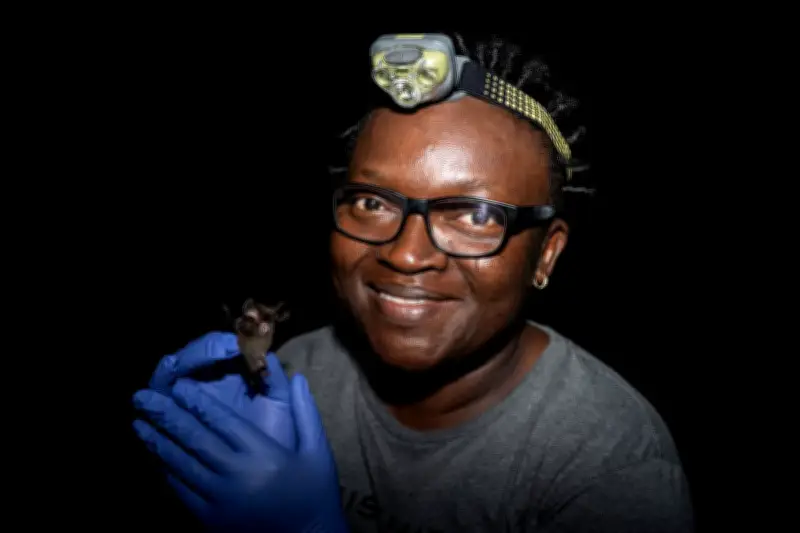
Just after sunrise, a loud chorus of whoops and chatter echoes through the lush forests of the Afi mountain wildlife sanctuary. Located within the Cross River rainforest in southeastern Nigeria, this steep sanctuary covers an area about the size of central Paris. It serves as a haven for endangered gorillas, drill monkeys, grey-necked rockfowl, and the short-tailed roundleaf bat.
A Moment That Changed Everything
Nigerian biologist Iroro Tanshi vividly recalls the moment she first spotted this endangered bat in 2016 during a field expedition for her PhD research. 'We were trapping near a roost that night, so we caught a lot of bats,' Tanshi says. 'But this looked very, very different. Big-eared.' She quickly consulted her identification guide and realized the tiny furry creature in her fingers was Hipposideros curtus, the short-tailed roundleaf bat, last seen in the wild in the 1970s.
'That was the moment that changed everything,' she recalls. 'There was the catching and the moment of realisation, like: “Oh my gosh.”'
Rediscovery and Conservation Efforts
Spurred by this discovery, Tanshi and her small team of local assistants set up harp traps and mist nets, tracking cave networks within the Afi sanctuary and the nearby Cross River National Park. During their gruelling survey, they found 15 more individuals of this bat species.
The short-tailed roundleaf bat weighs about as much as a level teaspoon of salt. Unlike large fruit bats, it has relatively small eyes and a large, intricately folded nose that helps it navigate total darkness through echolocation. It is extremely sensitive to noise and bright lights, so Tanshi uses red light during her field research.
'You put it on for a short time and turn it off again to see your way or see the bat that’s hanging there,' she explains.
Historical Context and Threats
For decades, the species was believed to exist only in specific forest caves in Cameroon and Equatorial Guinea. Due to human activities such as deforestation and hunting, all previously documented roosts had disappeared by the 2010s. Scientists feared the species had quietly gone extinct until Tanshi's crucial discovery. The small colony she rediscovered around the Afi sanctuary is the only confirmed population of this endangered bat still actively roosting.
However, Tanshi noticed that most conservation attention in the sanctuary focused on primates and other large animals, which local people treated with respect. 'People were very familiar with the need to protect nature and conserve these animals,' Tanshi says. 'You couldn’t kill those animals in the village without getting reported. But everything else was up for grabs. Regardless of the fact that we were in a protected area, bats were still heavily hunted.'
Cultural Perceptions and Challenges
Historically, bats have been burdened by negative stereotypes, often linked to witchcraft and bad omens. Their association with health emergencies like the Ebola outbreak and COVID-19 has not helped. 'Bats can’t catch a break, sadly,' says Tanshi, describing the cultural perception of bats in Nigeria as a 'complex scenario.' Amid this cultural aversion, some Nigerian communities treat bats as food.
In Abia, a remote village 70 km (45 miles) from the Afi sanctuary, the straw-coloured fruit bat is considered 'normal bushmeat for us, like fish and chicken in other places,' says villager Judith Ojong. Bats for meat are typically sold in fours for 5,000 naira (about £2.70).
Taking Action
In response, Tanshi, along with fellow bat specialist Benneth Obitte, founded the Small Mammal Conservation Organisation (Smacon) in 2016 to champion bats, rodents, and other small creatures. The following year, they launched the Zero Wildfire Campaign to combat destructive blazes that pose another threat to bats.
As part of the campaign, Tanshi and her Smacon team designed colour-coded alert systems to guide farmers on safe bush burning. She also formed a group called Forest Guardians to supervise farmers during burning and provide swift response in case of an outbreak. The incidence of wildfires within the forest area has plummeted over the past five years, she reports.
Recognition and Future
In April, Tanshi became one of only six women globally to receive a Goldman Environmental Award, in recognition of her successful wildfire campaign around the Afi mountain wildlife sanctuary. She has also been named a National Geographic Explorer and won a Whitley Award.
A decade after finding the short-tailed roundleaf bat, Tanshi, now a postdoctoral fellow at the Washington Research Foundation, remains captivated by the hidden diversity in Nigeria’s rainforest and is still amazed at her discovery. 'Something that we thought was extinct was in this beautiful place that nobody goes to,' she says.