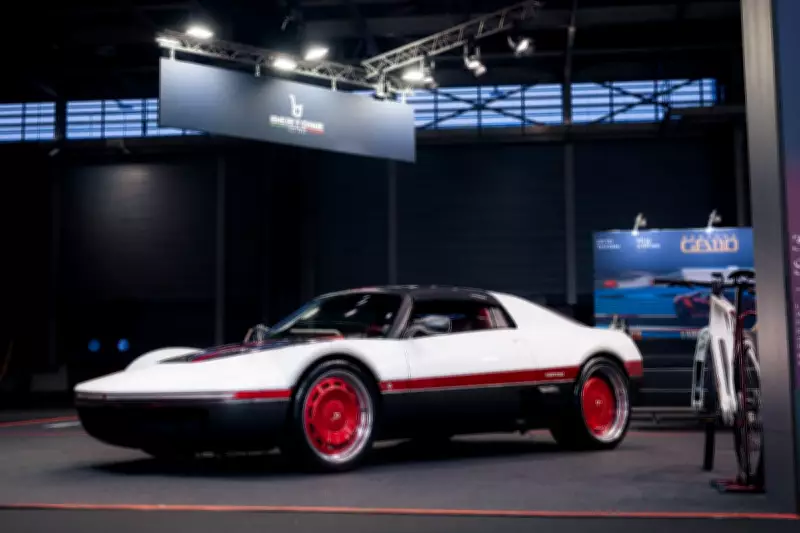
Bertone Revives Iconic 1969 Concept with Exclusive Runabout Roadster
While international motor shows continue to grapple with post-pandemic financial challenges, Paris's annual Retromobile exhibition has carved a distinct niche by celebrating automotive history. This focus on classic vehicles and restorations provided the perfect platform for legendary Italian design studio Bertone to unveil its most ambitious project in decades: the Bertone Runabout.
A Modern Tribute to a Gandini Masterpiece
The new Runabout represents a bold reinvention of the Autobianchi A112 Runabout, a concept sports car originally penned by design maestro Marcello Gandini during his tenure at Bertone in 1969. This contemporary interpretation maintains the spirit of the original while incorporating cutting-edge automotive technology.
Production will be strictly limited to just twenty-five examples worldwide, available in two distinct configurations: the fully open Barchetta or the Targa version with a removable roof panel. Each vehicle features a lightweight carbon fiber body with distinctive wedge-shaped styling, mounted on a precision-engineered aluminium chassis.
Performance Meets Heritage
Beneath its retro-inspired exterior lies thoroughly modern performance credentials. Power comes from a formidable 3.5-litre supercharged V6 engine generating 475 horsepower, capable of propelling the Runabout from 0 to 62 miles per hour in a blistering 4.1 seconds.
During an exclusive interview at Retromobile, Andrea Mocellin, head of design for the Runabout project, explained the philosophy behind this limited-production roadster. "While I've always been fascinated by future mobility concepts, my education and early career in Turin immersed me in the legacy of Italian coachbuilding masters like Gandini and Giugiaro," Mocellin revealed.
Design Philosophy and Practical Challenges
"Bertone has consistently approached vehicle design with radical thinking," Mocellin continued. "For me, that innovative spirit represents the true essence of new mobility. Contemporary design must communicate effectively not only with the driver but with today's discerning market, which demands exceptional vehicles that blend heritage with performance."
The design team faced significant challenges in translating a 1969 concept into a modern, road-legal automobile. "You must approach such projects with production realities in mind from the very beginning," Mocellin explained. "Those practical boundaries fundamentally shape the design process. Close collaboration with engineers transforms initial sketches into vehicles that genuinely belong on public roads."
Artistic Expression with Functional Purpose
When questioned about whether the Runabout could be considered automotive art, Mocellin offered a nuanced perspective. "We certainly hope the Runabout achieves beauty that might one day earn it a place in art museums alongside automotive collections. However, we equally intend for these vehicles to be driven and enjoyed. Historically, Bertone has always championed art with practical function."
The selection of the Runabout concept for Bertone's revival was deliberate and strategic. "This project marks the renaissance of the Bertone brand," Mocellin stated. "Alongside our GB110 hypercar, we wanted our second vehicle to offer a completely distinct ownership and driving experience. While the GB110 draws inspiration from Bertone's extensive history, the Runabout represents a deep, focused exploration of a single iconic design."
Distinctive Design Elements
Several design features proved non-negotiable during the development process. The prominent red stripe visually divides the vehicle into two distinct design languages: the lower section references nautical boat hull inspiration, while the upper portion follows Bertone's iconic wedge silhouette.
The distinctive coda tronca (cut-off tail) and L-shaped B-pillar complete the sculptural form, ensuring instant recognition. The interior maintains a minimalist aesthetic dominated by horizontal lines that create a wraparound cockpit experience, with premium materials and limited digital intrusion preserving an analogue driving feel.
Global Design Influences
Mocellin's international experience in Turin, London, and Munich profoundly influenced his approach to automotive design. "Turin remains the spiritual heart of automotive design," he reflected. "Munich's industrial environment fuels my interest in technical innovation, while London—along with markets in Asia and America—revealed the global appetite for unique vehicles that transcend mass production."
"This international perspective also reinforced just how globally revered the Bertone brand remains, and how much affection enthusiasts still hold for its classic designs," Mocellin added.
The Future of Coachbuilding
Bertone's revival through projects like the Runabout demonstrates that scarcity, craftsmanship, and clear design intent retain the power to captivate automotive enthusiasts. As the industry approaches the physical limits of pure performance, manufacturers increasingly inject emotion through nostalgic design elements.
The reborn Lamborghini Countach, with modern Aventador mechanicals beneath retro-inspired bodywork, exemplifies this trend. Bertone aims to position itself at the forefront of a genuine coachbuilding renaissance, where contemporary, usable underpinnings meet historic design language.
For the fortunate twenty-five collectors who will own a Runabout, this vehicle represents an exclusive automotive artifact. For the broader automotive community, it serves as a powerful reminder of what Italian coachbuilding can achieve when granted creative freedom and space for artistic expression.