
Tuchel's Competitive England Setup Creates Selection Battleground
England manager Thomas Tuchel has implemented a strategic split-squad approach for the upcoming international friendlies against Uruguay and Japan, creating an environment of intense competition as players vie for coveted spots in the 2026 World Cup squad. With 35 players called up for the Wembley matches, including nine new faces Tuchel hasn't previously worked with, the manager has deliberately structured direct positional battles that will determine who remains in contention for the tournament in the United States, Canada, and Mexico.
Long-Term Planning Meets Immediate Pressure
Despite recently extending his contract through Euro 2028, Tuchel's current focus remains firmly fixed on World Cup preparation. The manager has brought in several players for their first England camp appearances, including Ben White, Lewis Hall, Kobbie Mainoo, James Garner, and Fikayo Tomori, who left Chelsea just days before Tuchel's arrival at the London club in 2021. Additional first-time call-ups include Jason Steele, Harry Maguire, Harvey Barnes, and Dominic Calvert-Lewin, though some serve more as training assets than immediate match options.
The Uruguay friendly has been specifically framed as a direct shootout for particular players to maintain their World Cup hopes, with Tuchel planning to release at least seven outfield players back to their clubs before the Japan match. While the manager has privately identified those most likely to be sent away, he's kept this information confidential to maintain competitive tension and allow for potential changes based on performance.
Positional Clarity Creates Direct Duels
Tuchel's obsession with positional clarity has resulted in specific one-on-one battles throughout the squad. On the right wing, Noni Madueke faces competition from Jarrod Bowen, with Bukayo Saka joining for the Japan match. The manager has made these competitive relationships explicit to players, creating what Madueke describes as a clear understanding of "what you need to do and who you're competing against."
The positional battles extend across the pitch: Tino Livramento versus Ben White at right-back, Djed Spence against Lewis Hall on the left, and a three-way competition between John Stones, Fikayo Tomori, and Harry Maguire for two center-back positions. In midfield, Jordan Henderson and Adam Wharton contest the defensive midfield role while Kobbie Mainoo and James Garner battle for the advanced midfield position.
Forward Line Competitions and Tactical Considerations
On the left wing, Marcus Rashford competes with Harvey Barnes, while up front, Dominic Calvert-Lewin faces Dominic Solanke in Harry Kane's absence. Tuchel believes this creates an opportunity for the center-forwards to prove themselves without being overshadowed by England's captain, though there remains a possibility the manager might take no backup striker to the World Cup, instead relying on versatile attackers like Bowen, Rashford, Anthony Gordon, or even Phil Foden.
The most intriguing competition emerges in the number ten position, where Cole Palmer battles Phil Foden despite Jude Bellingham's presence in the squad. Bellingham won't feature against Uruguay as he manages his return from a hamstring injury, but his eventual inclusion adds further complexity to selection decisions. Tuchel's respect for both Palmer and Foden is evident in his plan to keep both in the squad after the Uruguay match, even with Morgan Rogers joining for Japan and Bellingham potentially available.
Limited Preparation Time Adds Challenge
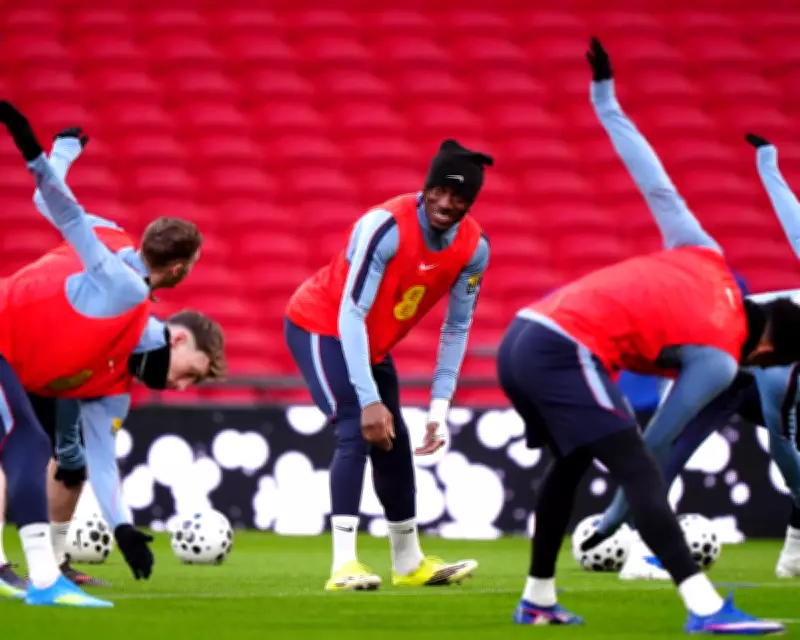
England's preparation for the Uruguay match has been compressed, with only four training sessions at St George's Park and Wembley before facing Marcelo Bielsa's team. This limited preparation time adds another layer of challenge to what Tuchel has designed as a unique evaluation opportunity. The manager's structured approach creates what players describe as palpable competitive tension, with every training session and match moment carrying weight in the selection process for what remains England's ultimate objective: World Cup success in 2026.
As the friendlies approach, Tuchel's split-squad strategy represents both immediate evaluation and longer-term planning, with players understanding that performances against Uruguay could determine their international futures. The manager's transparent approach to competition has created what one insider described as "pulsing competitive tension" throughout the camp, with every positional battle carrying implications for World Cup selection.