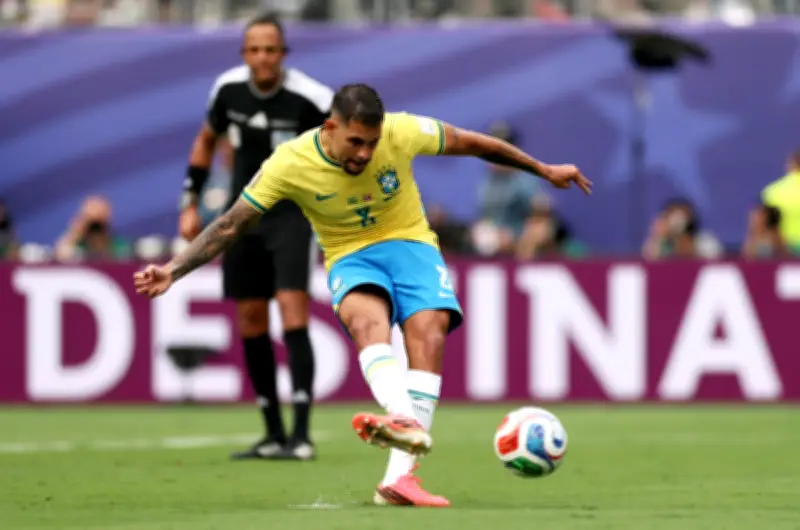
Bruno Guimarães' stuttering spot-kick failure was crucial as Brazil were eliminated from the World Cup by Norway on Sunday. The midfielder's stutter penalty was saved by Ørjan Nyland, who dived to his left to parry the weak effort in the first half of the last-16 contest in New York-New Jersey. The match was scoreless until two second-half goals from Erling Haaland gave Norway the victory, with substitute Neymar claiming a consolation deep into stoppage time via a successful penalty after another halting run-up.
Stutter-Step Penalty Under Fire
The technique is widely reviled among fans. "Every player that takes a stutter-step penalty should be blindfolded and left out in the desert to find their way back on their own," was one of the milder comments on social media after Guimarães' miss. Despite its unpopularity, the stutter-step penalty remains a notable trend of this World Cup.
Among the most famous practitioners is Cristiano Ronaldo, who scored a penalty for Portugal in their 2-1 last-32 win over Croatia. The 41-year-old began a long straight run-up, veered left, briefly slowed, then sent Dominik Livakovic the wrong way with a carefully placed low shot. Kylian Mbappé also converted in similar fashion after a fleeting pause in France's 1-0 victory over Paraguay, but a hesitant Lionel Messi sent his spot-kick wide during Argentina's 2-0 win over Austria.
Brazilian Origins of the Paradinha
Though its bungled deployment had dire consequences for Brazil against Norway, the paradinha – Portuguese for "little stop" – and its modern-day variations have Brazilian origins. Pelé explained in his autobiography, My Story: "In 1959, I can remember a training session with the national team where I saw Didi invent a new trick. He ran up to the ball, but just before he kicked it he stopped and instantly looked up to see which way the keeper was moving. In that split second he judged where to kick the ball and, of course, beat the keeper."
In February 2010, Neymar, then an 18-year-old prodigy, enhanced his reputation as the "new Pelé" when he scored a paradinha for Santos against São Paulo that was so audacious it caused a sensation. The rule-making International Football Association Board (Ifab) subsequently banned the move and made it a yellow-card offense shortly before that year's World Cup, deeming it unsporting. A contentious stuttering penalty run-up during Egypt's 4-0 semi-final win over Algeria at the 2010 Africa Cup of Nations so infuriated Algeria goalkeeper Faouzi Chaouchi that he appeared to aim a head-butt at the referee.
Evolution of the Rules
In 2016-17, the wording of the relevant law was tweaked. Ifab stated that "feinting to kick the ball once the kicker has completed the run-up" is forbidden, but "feinting in the run-up is permitted." Its definition of feinting is "an action which attempts to confuse an opponent." As a form of compromise, stopping, swaying, and similar shenanigans are allowed until the moment when the kicker plants their standing foot next to the ball.
The technique repudiates the received wisdom that the best penalties are decisively struck by players who hew to a clear plan and don't change their minds at the last instant. It's an act of bravado: a player betting on themselves to win the psychological battle with their adversary.
Psychology vs. Precision
A penalty-taker has two fundamental choices: pick a spot and hope to strike the ball with enough strength and accuracy that the goalkeeper won't save it even if they dive in the correct direction; or choose psy-ops. Mind games and deception can send the goalkeeper the wrong way or provoke them into committing to a dive before the shot, leaving half the net empty. Historically, the first strategy, known as goalkeeper-independent, has been more common at World Cups than the goalkeeper-dependent approach.
The taker's biggest fear is missing the target altogether, which is embarrassing and a 100% guarantee of failure. The goalkeeper generally wants to make a dive due to action bias – the instinctive urge to move, to be active rather than passive, and to be seen making an effort. That's why aiming straight down the middle is often effective, as it was for Egypt's Mo Salah, who scored in his side's shoot-out win over Australia in the last 32.
A hard kick risks blasting the ball off-target, especially if the player is aiming for the corner because they think there is a good chance the goalkeeper will go the right way, making precision essential. If the shooter is sure they will wrong-foot the 'keeper, there's no need to aim high or exactly into the corner; anywhere in the open side of the net should do.
The dangers, however, are that a convoluted run-up will leave the kicker slightly off-balance and at risk of mis-hitting the ball. If the 'keeper guesses correctly or holds their nerve and waits for the kick, they have an excellent chance of saving a shot that may be soft and near the centre of the goal. That's what happened with Guimarães' attempt. In theory, Neymar's effort was also eminently saveable – except that this time, Nyland didn't dive. He stood and watched as the ball went past him.
Mixed Results and Future of the Technique
The technique has brought mixed results in the tournament as a whole and was costly for Arsenal in this year's Champions League final. It was ridiculed by France goalkeeper Mike Maignan when his side faced Poland at Euro 2024, and he groused about Robert Lewandowski's "87 feints." But it's likely to persist, not only because it's been adopted by some of the sport's biggest stars and used with record-breaking perfection by Raúl Jiménez in the Premier League. In an era of abundant data analytics, which means goalkeepers are likely to have studied patterns and probabilities to predict where the kicker will aim, it's hard to prepare for a situation where the taker doesn't know where they are going to direct the ball until a split-second before contact. That's Harry Kane's theory.
To thwart opponents who've done their research, Kane varies his style: sometimes stuttering, sometimes not. His stutter effort in England's opening game, a 4-2 win over Croatia, was saved by Livakovic. However, the goalkeeper had moved off his line too quickly, and Kane scored the re-take after a smoother run-up. "When I watched the clips, I saw that he likes to move early, pretty much," Kane told the BBC. "So I knew there was a chance, if I [did] the stutter, that he would come off the line. When it happened, I was 80% sure that it was off the line. I wasn't 100% sure. And then obviously, once it got retaken, I changed the technique a little bit."
Kane's run-up was fast and fluid as he scored another penalty in the 3-2 win over Mexico that set up a quarter-final clash with Norway. Jiménez stuck to his trusted style with equal success at the other end, staccato steps followed by a shot with the pace and direction that Guimarães had lacked earlier in the day. As the Mexico forward approached the spot, Jordan Pickford appeared to commit by taking a step to his left. Jiménez then calmly directed his shot to the other side of the net. Though the England goalkeeper immediately changed direction and dived to his right, he was too far across to reach the ball. In what was ultimately a losing effort, it was a fine example of psychology combining with technical precision under immense pressure.