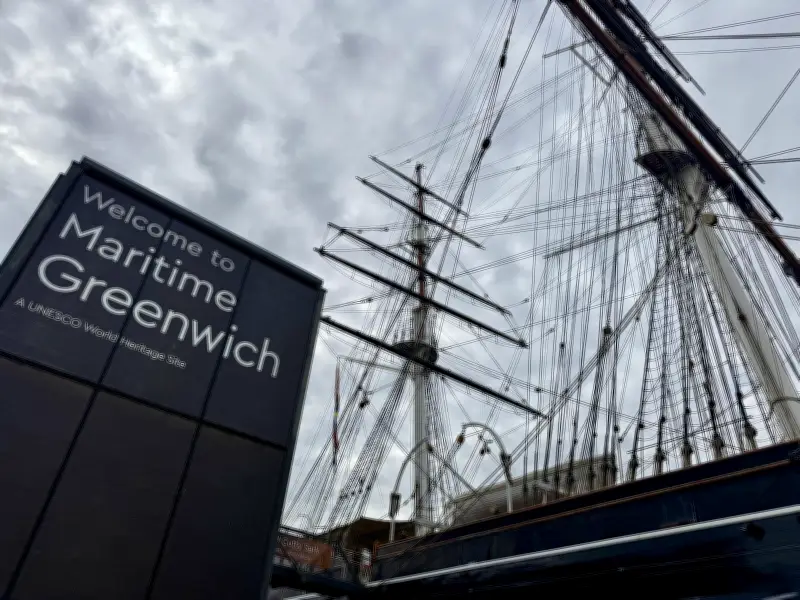
The Cutty Sark, the world's only surviving tea clipper, stands as a testament to Britain's maritime heritage in Greenwich. Built in 1869 in Dumbarton, Scotland, this historic vessel achieved speeds of up to 17.5 knots (20mph) during its career, designed specifically for the lucrative tea trade between China and Britain.
A Masterpiece of Naval Engineering
Named after a character from Robert Burns' poem Tam O'Shanter, the Cutty Sark was designed by naval architect Hercules Linton as an "extreme clipper." Its construction featured a combination of an iron frame and wooden planking, a cutting-edge design that provided both strength and speed. The ship's long, narrow hull and towering masts carried around 32,000 square feet of sail, with every aspect intended to outpace rivals in the tea trade.
In its early years, the Cutty Sark's biggest rival was the Thermopylae, built in 1868. People often placed bets on which vessel would arrive in port first, reflecting the intense public interest in these racing ships. During a fierce storm in 1872, the ship lost its rudder, but ship's carpenter Henry Henderson engineered a replacement at sea, allowing the crew to complete the voyage safely. He later received a reward of £50, worth around £4,000 in today's money.
Surviving Fire and Time
Despite a catastrophic fire in 2007, much of the Cutty Sark's original structure remains intact. Museum staff estimate that around 90 per cent of the vessel is original to 1869, thanks to a major conservation project that had already stripped many historic fittings before the fire. This resilience has ensured the ship remains the world's only surviving tea clipper.
The ship's time in the tea trade was relatively short-lived due to the opening of the Suez Canal in 1869. After completing only a few years in the China tea trade, the Cutty Sark turned to other cargoes, becoming heavily involved in the Australian wool trade from 1883. It completed regular voyages between Australia and London, establishing its reputation as one of the fastest sailing ships in the world.
A Storied Career and Dark Chapters
One of the ship's longest-serving captains was Richard Woodget, who served from 1885 to 1895. He is remembered as one of the most successful masters in the ship's history and was also an enthusiastic breeder of collie sheepdogs, transporting them to wool farmers in Sydney during voyages.
However, the Cutty Sark's history includes darker episodes. During a troubled voyage in the 1880s, nicknamed the "Hell Ship Voyage," seaman John Francis died at sea after a dispute with first mate Sidney Smith. The incident led to allegations of brutality, with Smith fleeing while the ship was in port to avoid arrest. The voyage descended into chaos with disease outbreaks, deaths among the crew, shortages of supplies, and growing unrest. Captain Wallace eventually took his own life during the voyage, marking one of the most controversial chapters in the ship's history.
From Trading Vessel to Museum
In 1895, owner John "Jock" Willis sold the vessel, and it entered Portuguese ownership under the name Ferreira. For the next 27 years, it traded between Portugal, Africa, and the Americas as a general cargo vessel. While many contemporaries, including its old rival Thermopylae, were lost—Thermopylae was sunk after being used for target practice—the Cutty Sark survived.
The ship was brought to Greenwich and placed in a purpose-built dry dock in 1954 before opening to the public as a museum in 1957. Today, visitors can see the Cutty Sark just a short distance from the River Thames, where it once unloaded cargo, connecting modern Greenwich with London's maritime past. The ship remains a permanent home on the banks of the Thames, preserving a unique piece of naval history for future generations.