
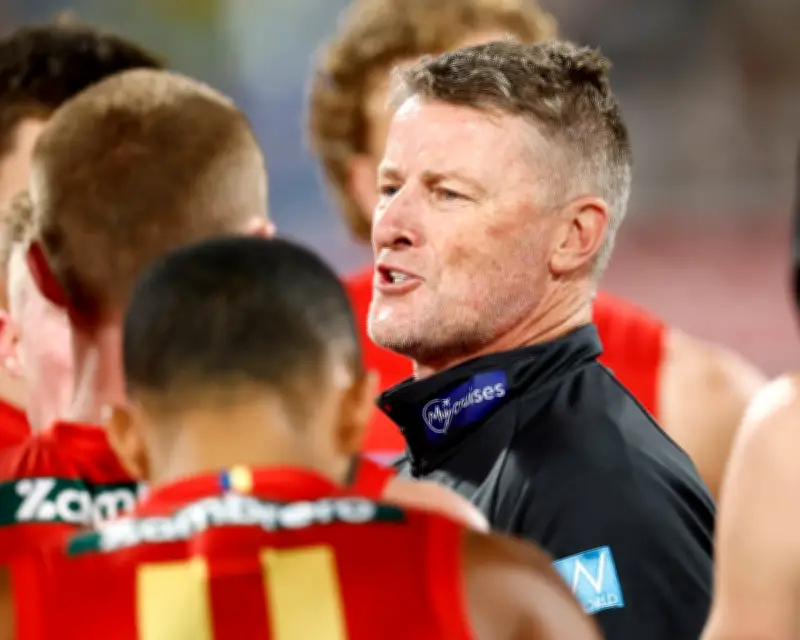
Damien Hardwick had another one of his gripes last week, teeing off at the officiating and the clamorous Geelong crowd. Lots of things have raised his ire over the years – umpiring, rules, fixturing, trade speculation, panel show inanity, journalistic pestering and woke governments. We shouldn't be too hard on him for that. We want coaches to speak their minds, and to hate losing. In the absence of proper leadership at the AFL, they're often the ones best placed to drive change. The more premierships they've won, the more emboldened they are to be critical. Chris Scott does it with a studied passive aggression. Hardwick rarely bothers with the passive part.
Hardwick pushes back on the view that he and the Gold Coast Suns have had everything handed to them on a silver platter. “Mate, we don't get much,” he said last year. But he's enjoyed some of the softest fixturing an algorithm could conjure up. He has a dozen top-10 draft selections on his list, and half of those were top-three picks. He's enjoyed all the fruits of the Suns academy. He has the reigning Brownlow medallist, a former Norm Smith medallist, and the current leader of the Coleman medal count. So why is there that familiar drift? And why are so many players angling to leave?
Hardwick's Italian Riviera Decision
Hardwick was in the Cinque Terre region on the Italian Riviera as he weighed up the pros and cons of taking on the job. He scoured the Wikipedia pages of players he barely knew. It was so tempting – the list, the climate, the challenge. There'd be no more stories about his marriage, no more crap winters, no need to conjure up new stories for a tired playing group.
But Hardwick had things at Richmond he doesn't have at the Suns. At Richmond, he'd found the perfect balance of risk and reward, of the compassionate and the pitiless, of the champion and the jobber. They'd grind the opposition to dust, and tidy up their changerooms afterwards. Crucially, he had what he called “perimeter players” – gut runners who would patrol a wing to maintain structure, small forwards who would devour space, defensive midfielders who would do the heavy lifting for the superstars. He had a handful of solar talents and a constellation of role-players orbiting around them. When Dustin Martin is inducted into the Hall of Fame, he will thank the likes of Kane Lambert, Jack Graham and Jason Castagna in his acceptance speech.
The Missing Role Players
Hardwick doesn't have those kinds of players at the Suns. He has too many of what he calls “trudgers” – footballers whose energy and pressure is conditional. He has too many colonels, and not enough privates. And so, when Matt Rowell injures himself in the state game, or Noah Anderson's output drops just a fraction, or Jarrod Witts is market corrected by the new rules, it exposes the next rung of players, and that rung is rickety.
Club or Franchise?
But his biggest challenge is the one that goes beyond structures and roles, and gets to the core of the club itself. At Richmond, he didn't have to sell the sport or the club. He could narrow his focus to his players and for half a decade he had them in the palm of his hand. It's questionable whether Gold Coast should be called a club at all. It's a franchise, a program, a punt. His preferred way of playing – the messiness, the “schnell, schnell!” tempo – relies on the total buy-in from the playing group. But it's hard to get that when your best players are being lured home, and when their managers are leaking to the media.
Hardwick's Coaching Genius
Hardwick is a divisive figure. But he's one of the greatest coaches this sport has seen. You only have to listen to his half-time address in the 2020 grand final to realise why he's been so successful. In two minutes, he proves that you don't have to be a grand orator, or a raving lunatic, or a chess master to be a master coach. It's two minutes of clarity, calm and cohesion.
But he is also a worrier. He keeps a notebook by the side of his bed, and will wake in the middle of the night to jot down ideas, hooks and anxieties. The worse the ladder position, the more he wakes up. When all was going well at Richmond, he'd quote the Zen proverb “chop wood, carry water”. In other words – do the work, and keep it simple. He had a stable administration. He had a playing group with what he called “role discipline”. And he had Dusty. At face value – and he emphasised this at his first press conference – the task at the Suns was even simpler. He had a lot of shiny toys, he just had to deploy them properly. But it's never that easy. His challenge now – and it may be beyond even him – is to get them to connect, to convince them to stay, and to find enough of them willing to do the dirty work.