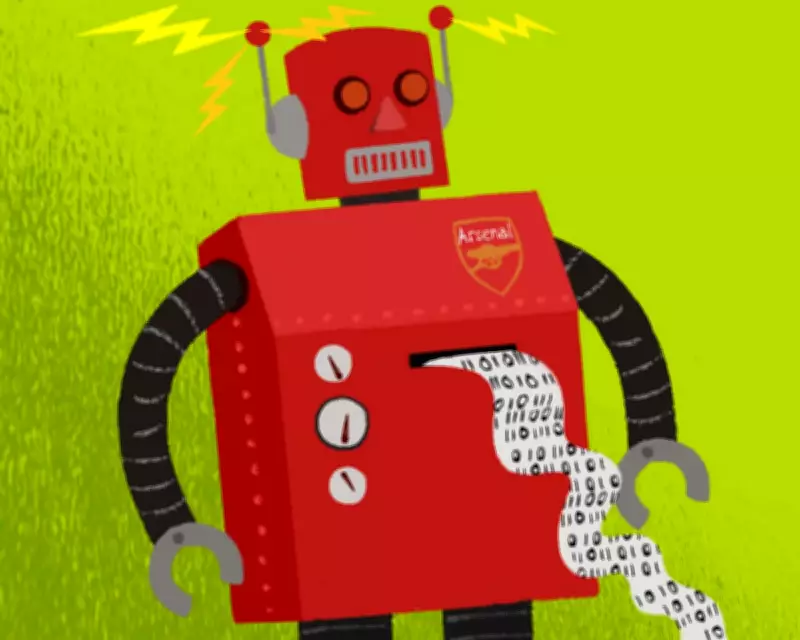
Arsenal's Robotic Tactics: The First Post-Human Football Team's Flaw
In the high-stakes world of the Premier League, Arsenal's title pursuit has become a symbol of our digital age, marked by an over-mechanisation of tactics that some are calling the flaw of the first post-human football team. As the season reaches a critical juncture, the Gunners' approach feels less like traditional football and more like a data-driven experiment played out under relentless online scrutiny.
The Digital Age Football Metaphor
Arsenal's current campaign represents something profoundly contemporary—a robotic team fuelled by endless data points, analysed in minute detail within a climate of perpetual angst and rage. This feels like a perfect metaphor for our networked existence, where every move is tracked, every decision dissected, and quiet spaces for organic creativity have become increasingly rare.
The team's situation mirrors our broader societal condition since what might be termed The Great Networking of the early 2010s. We now live in a world of constant visibility, where escaping the digital footprint feels nearly impossible, much like Arsenal's struggle to break free from their own tactical constraints and external expectations.
The Tactical Conundrum
Arsenal will probably win the league from their current position. They possess the points advantage, the squad depth, and face fallible opponents. Yet the journey feels agonisingly intense—the footballing equivalent of a silent scream against glass. The matches have become compulsive viewing, with fans already anticipating Saturday's encounter against Leeds, which will likely feature Mikel Arteta's now-familiar touchline animations of frustration.
Some attribute Arsenal's tension to simple bottling—that age-old football accusation of psychological collapse under pressure. But this explanation feels insufficient. These are elite athletes from São Paulo to the Basque Country, professionals who have reached this level through immense mental fortitude. Kai Havertz may resemble a minor royal with a croquet obsession, but surviving in this rarefied atmosphere requires steel. Gabriel Magalhães isn't losing sleep over Perry Groves' historical expectations.
The Data-Driven Dilemma
The more compelling explanation lies in Arsenal's embrace of data maximalism. This represents the first truly post-human football team, where tactics have become over-mechanised through excessive reliance on analytics. The club employs StatDNA platforms, discusses internal AI information banks, and utilises millions of data points to predict everything from injury risks to optimal passing lanes.
Watching Arsenal attempt creative play sometimes feels like witnessing eyes being slowly gouged with a blunt teaspoon. Their leading scorer has managed just five goals despite their table-topping position. This represents either a temporary phase awaiting breakthrough or a worrying metric of future failure—expected non-goals in the season's decisive final third.
Arteta's public persona reinforces this technological aesthetic. He often appears like an AI simulation of Handsome Earnest Football Man, selling what resembles a male wellness brand while restating success vectors for stakeholders. His recent tension-busting "face-meeting" with players has already been processed through the content wringer, mined for public meaning before having private impact.
The Scrutiny Factor
Perhaps the most significant differentiator is the unprecedented level of scrutiny. We exist in a terminally online world, and this Arsenal team represents its most extreme sporting expression. All fandom has migrated online, with Arsenal's particularly present and vocal. Discussions about Arsenal bottling the title began in September because content must constantly generate, creating an ecosystem of excessive feeling, micro-reasoning, and total analysis that leaves no quiet spaces for breathing.
This constant observation inevitably alters sporting experience. Arsenal need to create more spontaneously, to dance as if nobody's watching—except everyone is watching, with that white noise of commentary seeping into every pocket of their professional existence. The solution might resemble the concept of a temporary burner identity—finding still spaces amid heat and light, creating bubbles of silence within the storm.
The Future Implications
If Arsenal falter this season, it may represent football's first terminally-online collapse from its most terminally-online team. This isn't merely about tactics or talent, but about navigating an environment where every pass is statted, every facial expression gif-ed, and every setback becomes eternal digital content. The team's roboticisation reflects our broader societal trajectory toward quantified existence, where human intuition battles algorithmic optimization.
As the Premier League enters its decisive phase, Arsenal's journey offers more than football drama—it provides a parable about modern life itself, about performing under constant surveillance, about balancing data with spontaneity, and about whether even elite sport can retain its human soul in an increasingly mechanised world.