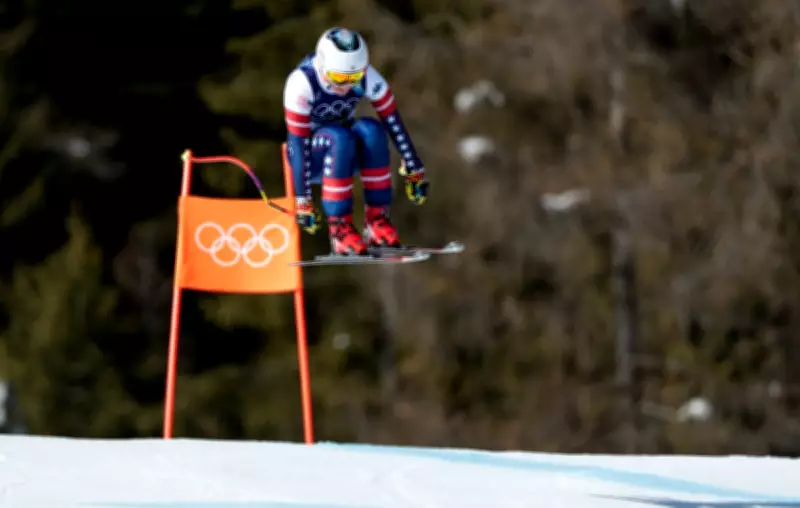
Breezy Johnson Secures Olympic Downhill Gold in Dramatic Cortina Victory
American alpine skier Breezy Johnson has achieved a remarkable Olympic triumph, winning the women's downhill gold medal at the Milano Cortina Games with the narrowest winning margin in the event's history outside a dead heat. The 30-year-old from Jackson Hole, Wyoming, completed her historic run just three weeks after celebrating her birthday in the shadow of the Dolomites above Cortina d'Ampezzo, marking a career-defining moment after years of perseverance.
A Victory Measured in Hundredths of a Second
Johnson's winning time of 1 minute 36.10 seconds edged out Germany's Emma Aicher by just four-hundredths of a second, delivering the United States their first medal of these Olympic Games. This minuscule margin represents the blink of a camera shutter or the wingbeat of a hummingbird, yet proved sufficient to elevate Johnson to winter sports immortality on a sun-splashed morning in the Italian Alps.
The extraordinary victory makes Johnson only the second American woman to claim downhill gold, following in the footsteps of Lindsey Vonn who achieved the feat in Vancouver sixteen years earlier. Johnson's achievement becomes even more significant considering she accomplished this without a single World Cup victory throughout her eleven-year career on the circuit.
Overcoming Adversity and Injury
Johnson's path to Olympic glory has been anything but straightforward. The skier has endured multiple setbacks including serious injuries that forced her to miss the Beijing Games after crashing on the same Cortina course during training in 2022, tearing cartilage in her knee. More recently, she served a fourteen-month suspension in 2024 after missing three anti-doping whereabouts tests, a violation that carries significant penalties even without evidence of banned substances.
"I was telling my mom, you go to your first Olympic Games to have been to the Olympic Games," Johnson revealed. "You go to your second Olympic Games to win a medal. And you go to your third Games to win the whole damn thing."
Race Day Drama and Emotional Climax
The downhill competition took on sudden gravity when Lindsey Vonn, attempting an audacious medal bid at age 41 with a nonexistent ACL, crashed barely thirteen seconds into her run and required airlifting off the mountain. Johnson was seated in the leader's chair when the race suspended, creating a tense atmosphere that lingered throughout the competition.
When racing resumed after nearly thirty minutes, Johnson's time held up against thirty-one subsequent competitors. Her winning run demonstrated exceptional pace and precision rather than spectacular showmanship, featuring clean lines, minimal correction, and controlled momentum that gathered time rather than surrendered it throughout the descent.
Wearing the number six bib, Johnson seized control early by posting a time more than a second faster than any of the five skiers before her. Despite a brief wobble high on the course near the Schuss section with its sixty-four percent gradient, she recovered to reach a top speed of 80.2 miles per hour in the second section before maintaining flawless technique through the remainder of the run.
From Near-Misses to Olympic Champion
For much of her career, Johnson has existed slightly out of frame, respected among peers since her Olympic debut at age twenty-two in 2018 but overshadowed by global superstar teammates like Vonn and Mikaela Shiffrin, who have collectively won 192 races on alpine skiing's top flight. Her journey represents a quieter version of sporting excellence built on recovery, persistence, and perfect timing rather than prodigious talent or early dominance.
"I knew I had to push, I knew I had to go harder than I did in training," Johnson explained after her victory. "I had to be super clean, and I felt like I did that."
A Symbol of Perseverance in Alpine Skiing
Johnson's story offers something different for sports audiences worldwide. She represents the athlete who endures multiple knee injuries, fractures, surgeries, and professional setbacks yet continues to rebuild both physically and mentally. Her victory serves as both a generational handoff from American skiing legends and a powerful reminder that elite sport is often decided not just by raw talent but by survival and perseverance through adversity.
"People are jealous of people with Olympic gold medals," Johnson reflected near the finish area. "They're not necessarily jealous of the journey it took to get those medals. I don't think my journey is something that people are envious of. It's been a tough road, but sometimes you just have to keep going because that's the only option."
The emotional climax arrived as Johnson became misty-eyed watching the final racers finish before tears flowed freely during the Star-Spangled Banner on the podium. Her teammates described it as the best run they had ever seen from her, while for Johnson it represented something nearer to closure, with the course that once dashed her Olympic dreams now completing them.
In a sport where careers can end with a single bad landing, Johnson has embraced what she calls "a beautiful and brutal sport" with all its duality. Her victory demonstrates that sometimes four-hundredths of a second can represent a lifetime of work, allowing an athlete to finally step out from the long shadow cast by legendary predecessors and into history of their own making.