LeBron James Defies Age and Expectations in Lakers Playoff Run
In a stunning turn of events, 41-year-old LeBron James finds himself once again shouldering the burden for the Los Angeles Lakers in the NBA playoffs. Despite expectations that he would transition into a supporting role in his 40s, injuries to star teammates Luka Dončić and Austin Reaves have thrust James back into his familiar position as the team's primary catalyst.
A Familiar Role for the Aging Superstar
James must be experiencing déjà vu. This scenario echoes his Cleveland Cavaliers days when he carried undermanned teams to the NBA finals in 2007 and 2015, and the 2018 season that inspired Saturday Night Live to create a skit mocking his lack of support. "I'm 53 years old," joked one fictional teammate in the clip. "I have seven kids, and two of them are also on the Cavs." Now in 2026, James faces a similar situation with the Lakers, where his two best teammates are sidelined and one of his actual children is on the roster.
The irony is palpable. This season was supposed to mark James's graceful transition to third option behind Dončić, who was enjoying a career-best stretch before hamstring trouble, and Reaves, who strained his oblique in the same game. Both are in their athletic primes, while James has battled what some might call "old guy injuries"—sciatica that delayed his season start and arthritis in his left foot that caused subsequent absences. Yet somehow, it's the younger stars who fell to injuries while James remains the iron man, challenging the conventional wisdom that athletes in their 40s should retire to broadcasting booths.
Stepping Up Against the Rockets
James has at least one advantage beyond his status as arguably the greatest player ever: the Lakers face the dysfunctional Houston Rockets in the first round. This Rockets team, missing key contributors Fred VanVleet and Steven Adams, managed to blow a 13-point lead in overtime—a feat few NBA teams could accomplish, even those actively tanking. The situation worsened for Houston when Kevin Durant injured his knee in practice, forcing him to miss Saturday's series opener, which the Lakers won 107-98. Removing Durant from the Rockets' offense is like taking the bacon and bread from a BLT sandwich.
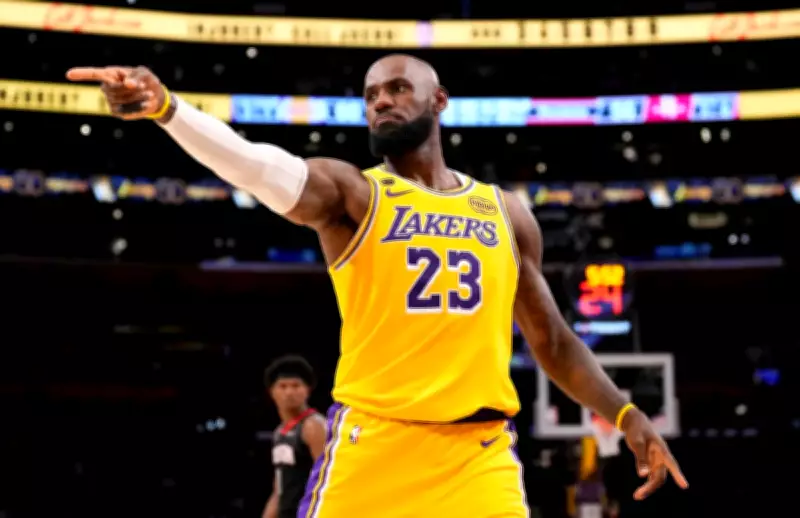
While James didn't need to carry the Lakers single-handedly in Saturday's victory—Luke Kennard led with 27 points, while James and Deandre Ayton each contributed 19—the King controlled the game's tempo and flow. James dished out 13 assists, many creating wide-open shots, and either scored or assisted on 15 of the Lakers' first 19 points. He hit a crucial fourth-quarter three-pointer and a difficult fadeaway over Amen Thompson, Houston's top defender. In a first-quarter highlight, James saved a possession by leaping while falling out of bounds and bouncing the ball off Thompson's legs. Playing 38 minutes, he finished with a team-best +11 on-off rating.
A Season of Adaptation and Excellence
Saturday's performance was no fluke. James's play this season has been remarkable not just for its sustained quality at age 41, but for its effort and intentionality. In December, he sacrificed his streak of 1,297 consecutive regular-season games with 10+ points to pass to Rui Hachimura for a game-winner. During a March thriller against Denver, he dove for a loose ball with teenage enthusiasm, helping secure an overtime victory. Before Dončić and Reaves went down, James had transformed into an ultra-efficient role player, delivering restrained masterpieces that contrasted sharply with his do-everything finals heroics of the 2010s.
The reality remains that the Lakers are unlikely to win the championship this season. Even if they overcome the Rockets, the defending champion Oklahoma City Thunder likely await in the next round. James undoubtedly knows this, yet he appears unfazed. "I've been in every situation you can ever imagine as a basketball player," he stated after Game 1. Indeed, he has faced immense pressure since high school when comparisons to Michael Jordan began, weathered criticism after "The Decision," rebounded from the 2011 finals disappointment, and resisted becoming a ball hog despite fans often treating basketball as an individual sport. Sharing the court with Kennard, Ayton, Hachimura, and Marcus Smart instead of a superteam might seem like a minor challenge by comparison.
Legacy Considerations
Paradoxically, these less-than-ideal team situations may ultimately enhance James's legacy. In a calmer future, we might recognize that most of his finals losses weren't solely his fault. While better teams might have yielded more championships, adversity has forced James to reveal every extraordinary facet of his game. We've witnessed the full spectrum of his skills precisely because he faced such challenges. As he continues to defy age and expectations, LeBron James reminds us why he remains one of basketball's most compelling figures.