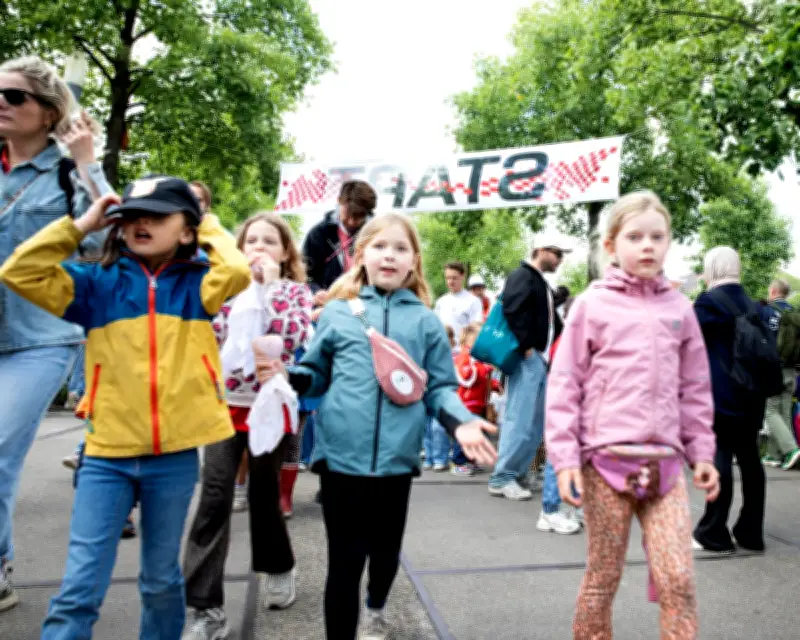
Once a year, Dutch children, parents, and teachers take part in a walking festival, heading out for four nights in a single week to explore their neighbourhoods, exercise, and make friends. This tradition, known as Avondvierdaagse, appears to be genuinely transformative for participants.
Rain Doesn't Stop the Walk
Despite thunderstorms and a bleak forecast, hundreds of children arrived at Amsterdam's Westerpark at 5pm, many by bike, with their parents. The park served as a starting point where volunteers coordinated registration, and groups of children, clad in raincoats, eagerly prepared for either a 5km or 10km walk through surrounding neighbourhoods.
This was the second night of Avondvierdaagse, organised by neighbourhood volunteers. It is not a race, but children who complete all four nights receive medals, a bouquet of flowers, and often sweets. Across the Netherlands, hundreds of thousands participate annually in the Week van de Avond4daagse, with variations also held in Suriname. The Royal Dutch Walking Association (KWbN) reports half a million participants in 700 locations, supported by tens of thousands of volunteers.
A Dutch Tradition with Military Origins
Inger Leemans, professor of cultural history at the Royal Netherlands Academy of Arts and Sciences, explains that Avondvierdaagse originated from military ideology. The first march in 1909 in Nijmegen was a military training event. After World War II, citizens joined soldiers, and the Nijmegen marches became the largest walking event globally, with 45,000 participants from over 80 countries. Arno van Gemert of KWbN describes Avondvierdaagse as the event's "little brother or sister," aimed at primary school children and their parents.
Leemans notes the walk evolved into a national identity marker for the Dutch, comparable to King's Day. Avondvierdaagse even has its own traditional delicacy: half an orange topped with a white Wilhelmina peppermint, wrapped in muslin for children to suck on while walking.
Building Positive Associations with Exercise
While the original walks did not promote exercise, Avondvierdaagse now motivates children to enjoy outdoor activity. Sanne de Vries, professor of physical activity in childhood at Leiden University Medical Center, emphasises the importance of physical activity and motor skill development from a young age. Walking through the week, rain or shine, and receiving rewards helps build a positive association with physical activity.
The event also builds resilience. Fernanda Gomes, walking with her seven-year-old daughter Alicia, notes that even in rain, children complete the challenge, sending a great message. Dutch children are consistently ranked among the happiest globally; a Unicef report placed them first out of 44 western countries for overall wellbeing and mental health, citing rich social relations as a key factor.
Social Connections and Community Spirit
Avondvierdaagse allows children to spend time with parents and school friends outside the classroom. Many wear matching shirts representing their schools. Robin Astill, 10, says it's fun with friends. Ansel Howard, 13, appreciates the yearly exercise and time with family and friends.
Parents also enjoy the event. Rebecca Astill, who participated as a child, has walked with her kids ten times, exploring her neighbourhood. Organisers select routes to expose participants to new places each year. Philip Bueters, an organiser, calls this the "art and craft of the routemaster." Joost de Koning notes that the walk brings the school community together.
Inclusivity and Volunteer Challenges
While overwhelmingly positive, some question inclusivity for people with disabilities or different cultural backgrounds. In Amsterdam, participants may not reflect the city's diversity, appealing more to higher-income parents. Another issue is the volunteer nature; some events have ceased due to lack of volunteers, as Bueters explains. Locals donate time, businesses provide food and flowers, and KWbN supports committees, recognising the event's importance.
Van Gemert says the event has survived for decades because it brings communities together simply, healthily, and screen-free, embodying the Dutch concept of "gezelligheid"—cosiness or togetherness. Bueters believes the formula can be copied anywhere there is a community.
A Celebration of Achievement
At the finish line on the last day, with the sun shining, volunteers hand out flowers from a local florist. Family members wait to celebrate. One grandma arrived early to see her grandson finish, reminiscing about her own childhood walks. As children cross the finish line, the area turns into a celebration with dancing to Snollebollekes' hit "Links Rechts" and Joost Klein's "Europapa." Parents proudly take photos of their kids with medals. Despite overcast skies, the focus is on the party—a feeling of pure joy that encapsulates the area. It's just gezellig.