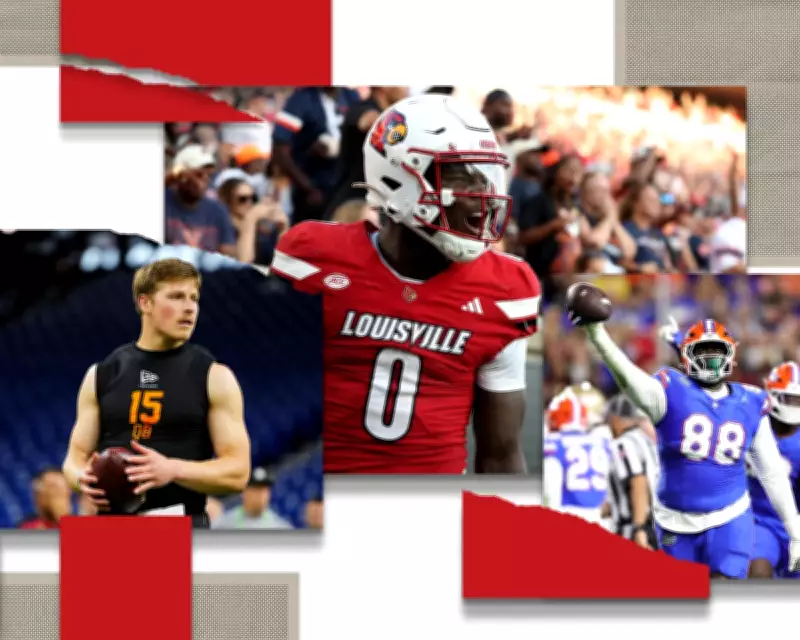
The 2026 NFL Draft's Hidden Treasures: Prospects Flying Under the Radar
While Fernando Mendoza is projected to go first overall, the real intrigue of the 2026 NFL Draft lies in the mid-to-late rounds, where teams can uncover raw talent with immense upside. This year's class may lack sizzle at the top, but several under-the-radar prospects could become franchise-altering steals for organizations willing to invest in development.
Cole Payton: The Athletic Quarterback Project
In a mediocre quarterback class, North Dakota State's Cole Payton stands out as a tantalizing mid-round option. The 6-foot-2, 235-pound lefty is built like a running back and played as one before becoming a starter in 2025, where he dominated at the FCS level with both efficiency and explosiveness.
According to Pro Football Focus, Payton joined elite company by posting a big-time throw rate over 8%, leading college football in big-time throws versus the blitz, and limiting his turnover-worthy play rate to less than 2% from a clean pocket. His throwing motion is unconventional—reminiscent of Philip Rivers and Tim Tebow—but he demonstrates the ability to make high-level throws across the field.
NFL teams will question whether Payton can develop into a viable pro quarterback, as he currently functions more as a runner who throws occasionally. Most likely, he'll be viewed in the Taysom Hill mold: a versatile offensive weapon who can contribute at multiple positions while developing as a passer in the background. In a weak quarterback class, Payton represents an intriguing late-day-two option for creative offensive coordinators.
Chris Bell: The AJ Brown Comparison
What if a team could get AJ Brown-level talent in the second round? Louisville's Chris Bell brings a similar profile: a big, physical receiver who excels at bodying up cornerbacks and creating separation late in routes. While not the consistent downfield threat Brown represents, Bell thrives on short, sharp routes and creates significant yards after the catch.
There are significant concerns that will push Bell down draft boards. He tore his ACL in his final college game, meaning he'll miss a substantial portion of his rookie season. Additional red flags include an aversion to the middle of the field, penalty problems, questionable college usage, and maturity questions. These factors make him a risky proposition for teams seeking immediate impact.
Yet the talent is undeniable. Bell represents exactly the type of player who falls through the cracks as teams overthink the evaluation process. For playoff-caliber teams with established receiver rooms, he could provide genuine playmaking ability outside the top 50 picks.
Max Iheanachor: The Raw Athletic Marvel
Arizona State's Max Iheanachor represents one of the draft's most remarkable stories. The 6-foot-6, 321-pound tackle only began playing football in junior college after growing up playing soccer and basketball. Despite his inexperience, he has developed into a potential first-round prospect with all the traits NFL teams covet: size, athleticism, balance, length, and natural power.
Iheanachor didn't surrender a single sack in 2025 and posted the lowest pressure rate among tackle prospects. Over recent years, teams have shown increasing willingness to bet on raw athletic tools along the offensive line rather than technical proficiency. What Iheanachor possesses—size, strength, and athleticism—cannot be taught, while technique can be developed.
There will be growing pains as he absorbs a pro playbook while refining his craft, but in a class lacking prototypical tackle prospects, Iheanachor's combination of measurables and upside could see him sneak into the first round.
Caleb Banks: The High-Risk, High-Reward Defensive Force
Florida's Caleb Banks presents perhaps the draft's widest range of outcomes. At 6-foot-6 and 335 pounds, he's the most naturally talented defensive lineman in the class, creating constant disruption with his rare combination of size, agility, and explosive power. Not since Jordan Davis has a defensive lineman of this size tested so well athletically.
However, Banks comes with significant medical concerns. He missed most of the 2025 season with foot injuries, fracturing his foot multiple times. For a player of his size, persistent foot issues understandably make teams nervous. Additionally, despite his physical dominance, Banks' production was relatively muted, with just 24 starts over three seasons.
The upside is tremendous. Banks posted a pressure rate of 21.4% on third down in 2024, placing him in the 90th percentile among defensive tackles drafted over the last decade. With rock-solid run defense added to his pass-rush potential, he could develop into a foundational piece reminiscent of Dexter Lawrence or Chris Jones. Medical concerns will likely push him to the second round, but his ceiling may prove irresistible to teams late in the first.
Uar Bernard: The Ultimate Athletic Project
In the draft's late rounds, teams often take fliers on exceptional athletes, hoping to develop them into football players. Nigerian prospect Uar Bernard from the NFL's International Player Pathway Program represents exactly this type of gamble. At 306 pounds with virtually no body fat and extraordinary length, Bernard broke all known jumping records for defensive line prospects at a recent pre-draft showcase.
His broad jump exceeded any defensive tackle at the combine by 14 inches, while his 39-inch vertical jump surpassed most wide receivers in this cycle. He also ran a 4.63-second 40-yard dash, nearly matching consensus second-round receiver Malachi Fields. "Hands down, he is the most explosive athlete I've ever seen in my life," said combine trainer Jordan Luallen.
The question remains whether Bernard can translate his athleticism to football success. He's admitted that training in pads has been an adjustment, and many athletic phenoms have failed to develop football instincts. However, as a member of the IPP program, Bernard comes with a roster exemption, making him essentially a free hit for any team selecting him in the seventh round.
These five prospects represent the hidden value in what many consider a weak overall draft class. While they come with significant questions and development needs, their physical tools and potential upside could make them the steals of the 2026 NFL Draft for teams willing to think beyond immediate impact and invest in long-term development.