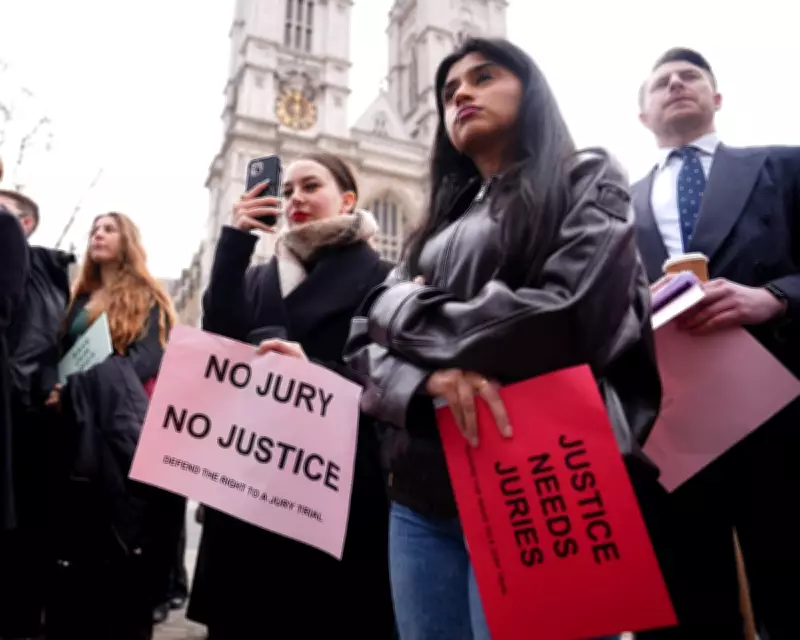
Legal Professionals Stage Westminster Abbey Protest Against Jury Trial Restrictions
Solicitors and legal academics gathered outside Westminster Abbey on March 10, 2026, to demonstrate against government proposals that would significantly restrict trial by jury in England and Wales. The protest comes amid heated debate about how to address the growing crisis in the court system, which currently faces a backlog of approximately 80,000 cases.
The Historical Debate Over Jury Trials
The controversy surrounding jury trials is not new to the British legal system. Supporters frequently cite Lord Devlin's 1956 declaration that trial by jury represents "the lamp that shows that freedom lives." Conversely, opponents reference GK Chesterton's argument that determining guilt or innocence is too important to be entrusted solely to trained professionals, a position championed by Professor Glanville Williams in his 1963 work "The Proof of Guilt."
Governments have historically been reluctant to restrict jury trials due to public perception concerns. There is no objective method to determine whether juries or judges are more likely to reach what the jury oath describes as a "true verdict according to the evidence." In legal terms, the distinction between actual guilt and evidence-established guilt is essentially meaningless.

The Current Proposals and Their Implications
Investigatory Powers Commissioner Brian Leveson has proposed creating "bench division" courts featuring a judge and two magistrates instead of juries for certain cases. This partial abolition approach attempts to navigate the contentious debate while addressing court efficiency concerns.
However, this compromise reveals inherent contradictions. If Leveson genuinely believes trials should be purely evidence-based reasoning exercises, why not recommend complete jury abolition? His recommendation to retain juries for the most serious offences acknowledges that public confidence in the justice system requires something beyond cold legal analysis—it demands public participation and a more human conception of justice.
The proposals raise significant questions about justice consistency. If jury participation provides essential human judgment in serious cases, why should lesser offences—where convictions can still permanently alter defendants' lives—be deprived of this safeguard? Many defendants would prefer their chances before a jury rather than a judge known for prosecution bias.
Practical Concerns and Alternative Solutions
There is little evidence that replacing juries with benches would actually speed up trials. Judges are not universally known for swift judgment drafting, despite decades of encouragement to streamline their processes. The current focus on jury arguments distracts from the immediate crisis: an 80,000-case backlog that continues growing daily.
Former Lord Justice of Appeal Alan Moses proposes an alternative solution: deploying retired judges to "winnow" through the backlog. These experienced legal professionals could review cases to identify those not worth pursuing—potentially eliminating up to one-third of pending cases through their expertise in distinguishing substantive matters from procedural chaff.
Thirty retired judges working voluntarily could review approximately 1,800 cases weekly. Their recommendations, while lacking legal force, could be adopted by magistrates, judges, or the attorney-general without additional scrutiny. This approach would leverage judicial experience while preserving the jury system that maintains public confidence in British justice.
Broader Case Resolution Strategies
Leveson identifies several methods to divert cases from the trial process, including mediation, plea bargains, and other compromises. These alternatives could be proposed during the winnowing process conducted by retired judges, potentially resolving matters without full trials.
The retired judges' voluntary service would represent meaningful contribution to a system that provided them with professional satisfaction throughout their careers. As Moses notes, this allows them to "make some recompense for the pride and enjoyment they experienced, in their youth, of tickling the jury like a trout."

This pragmatic approach addresses the immediate backlog crisis without compromising the fundamental principles of jury trial that have underpinned British justice for centuries, balancing efficiency with the democratic participation that maintains public trust in the legal system.