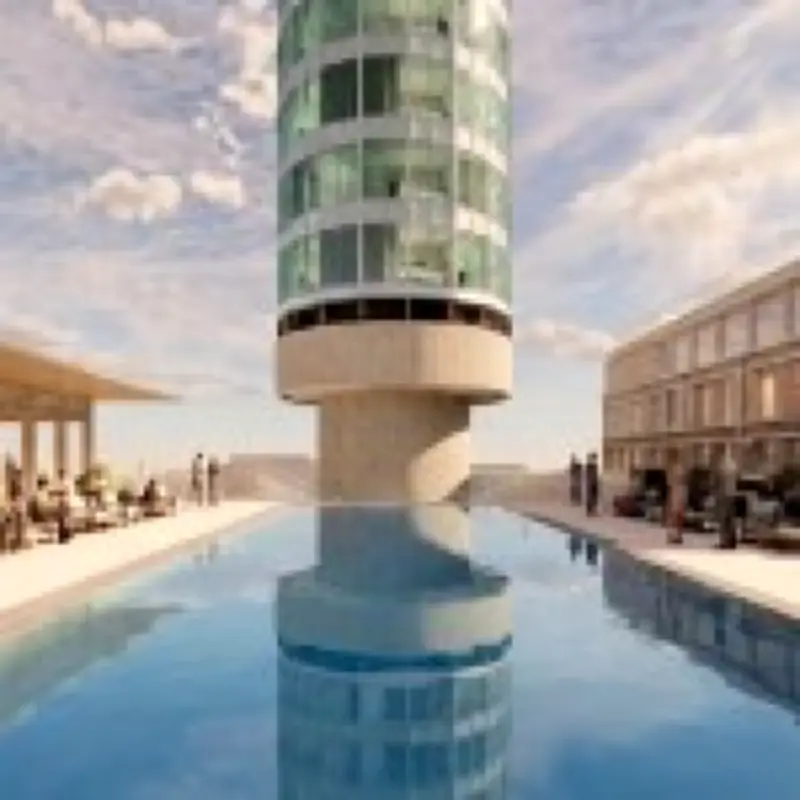
The BT Tower, a 620-foot London landmark closed to the public for over 50 years, is set to reopen as a luxury hotel in 2033, following its £275 million acquisition by MCR, the third-largest hotel operator in the United States. Newly unveiled plans include a publicly accessible rooftop pool, a 360-degree revolving observation deck, and the restoration of the iconic Top of the Tower restaurant space.
Transformation Details and Public Amenities
MCR's proposals, revealed after extensive consultation, will convert the former Top of the Tower restaurant—closed since the 1980s—into a revolving observation deck offering panoramic views of London. The Podium Building at the tower's base will be revamped to include a below-ground event space, ground-floor retail and food and beverage units, and hotel bedrooms across levels one to three. An exhibition exploring the BT Tower's history will occupy the lower-ground and ground floors of the Podium Building.
On top of the Podium Building, a swimming pool will be open to the public, with discounts for local community members. MCR plans to draw inspiration from its TAW Hotel heated pool, which operates year-round. The nearby Howland Building will undergo extensive restoration and extension to house hotel rooms and ground-floor retail and dining spaces.
Historical Significance and Restoration
Built in 1964, the BT Tower was the tallest structure in London until 1980. It first opened to the public in 1966, featuring a rotating restaurant on the 34th floor. The restaurant closed after a bomb explosion in the men's toilets, leading to the tower's closure to the public in the 1980s. It briefly reopened in 2015 for its 50th anniversary but has remained closed since.
Anne Archer, an archivist at the tower, told Metro: 'Because of its function, the building had to be erected at a considerable height and have nothing obstructing it so as not to interrupt communication waves. So it offers this stunning panoramic view. No matter what, the history of this building will always be preserved – there is no other building like this.' She added: 'But the new owners may be able to make the most of it more now. If a restaurant opens up inside the new hotel, more people will be able to come again.'
Public Square and Accessibility Improvements
Plans for a publicly accessible square between the buildings aim to 'revitalise the unwelcoming block' around the tower, with revamped entrances on Maple Street and Howland Street. New pedestrian walkways will allow the public to view the tower from below for the first time. Increased security with CCTV will be introduced to address anti-social behaviour.
The tower's iconic 'stick,' originally built for telecommunication equipment, will open to the public as the 'heart' of the hotel. Proposed plans for floors seven to 23 include adding a second staircase to meet modern fire safety standards, with each floor comprising four hotel bedrooms arranged around the tower's curved geometry.
Preservation and Design Approach
According to the BT Tower consultation website, the revamp will retain 'as much of the existing building as possible' and will 'sensitively' restore the buildings while respecting their original character. The extension to the Howland Building has been designed to preserve views of the Stick from Fitzroy Square. Retail and hospitality businesses on the ground floors of the Podium and Howland buildings will 'take cues' from 1930s and 1960s architecture.
Timeline and Ownership Transition
BT will hand over the site to MCR in late 2029, with construction expected to begin soon after and an anticipated opening in 2033. Brent Mathews, Property Director at BT Group, said: 'The BT Tower sits at the heart of London and we've been immensely proud to be the owners of this important landmark since 1984. It's played a vital role in carrying the nation's calls, messages and TV signals, but increasingly we're delivering content and communication via other means.'
Metro was given a final look inside the tower in May, revealing a time capsule of 1960s and 1970s technology covered in dust. Work had already begun to remove ageing wires, telephones, and switchboards made redundant by technological advancement.