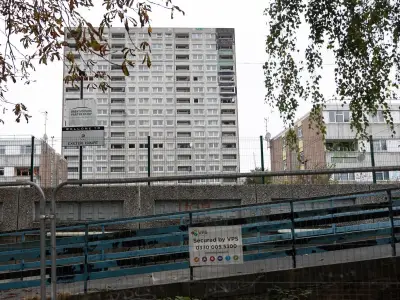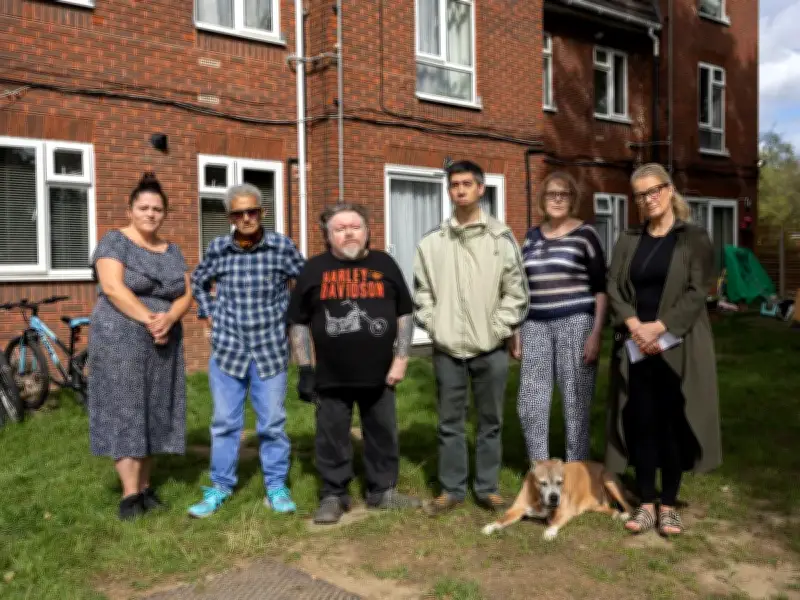
Residents of a West London housing block say they fear for their lives as the condition of their subsiding building worsens, with one man injured when his door fell in on him. Tenants at 31-49 Hanger View Way in West Acton, Ealing—a mix of renters and homeowners—initially raised concerns about subsidence in 2002, before the issue escalated in 2022 when large cracks appeared in flats. The block is managed by Peabody housing association.
Tenants have told the Local Democracy Reporting Service (LDRS) that in recent months the building has deteriorated further, with bricks coming loose and the structure appearing to shift dangerously. Peabody insists the building is safe to live in.
Man injured as door falls on him
Cameron Kermani moved into his ground-floor flat in 2020 after 30 years in council housing. He says he was not warned of the subsidence issues before moving in. Just a few weeks ago, his door fell out of the frame and landed on him. He said: “I [tried] to open the door, five o’clock in the morning, completely, the door completely came to my head from the frame, and I was so lucky the glass didn’t break.”
Cameron also has wall cracks throughout his property and is so scared of roof collapse in his bedroom that he has slept on the sofa in his living room for two years. While the LDRS was visiting the block, his neighbour, Michael, told him: “Your apartment is an accident waiting to happen, isn’t it? I mean, we feel like there is going to be a tragedy here before they actually get something done.”
Decanted tenant describes 'soul destroying' conditions
Michael (Mick) Brady has lived on the ground floor since 2006. In September 2017, he notified Peabody that wallpaper was tearing down and cracks were appearing in his flat. Over the next three years, severe water leaks, black mould, and building movement progressively worsened before he was decanted into a neighbouring flat for over a year in what was meant to be a six-to-eight-week repair job.
Mick moved back into his flat in 2023, but structural cracks appeared within a week. As a result, he has never unpacked his belongings in case he has to suddenly move again. He describes his living conditions as “like living in a squat”. Mick discovered written letters dating back to 2002 confirming that Peabody was made aware of the structural subsidence concerns over two decades ago. He said: “It's soul destroying. I can't even pull out any of my paintings or our mirrors or put anything on the walls.” He added that it's “also really scary”, saying: “I came out here one evening some years ago and smelled gas. The gas [company] came, cut the gas off for over a week. [It was from] where the building had moved, it fractured the gas pipes.”
Mother of chronically ill children fears collapse
Layla Fatima, a mother of two chronically ill children who also lives on the ground floor, described living in terror that structural movement in the walls will bring the block down. She said: “The stress is awful. I am terrified the building is going to collapse. My neighbour’s wall has massive structural cracks, and since we share the same wall, if it goes, it affects all of us.” Layla’s family were decanted for four months and moved into a safe property—however, they say the council never found them a permanent new home, and they have moved back into the flat despite the cracks.
Another tenant, Kevin Parish, has been attempting to sell his flat since 2025, but due to the structural issues he is struggling. He first started noticing cracks in 2019 and says Peabody’s engagement has been lacking. “We have problems with leaks, we have all sorts of issues, and I'm sick of living in a place where my landlord just doesn't do anything... And then in June last year, cracks started coming back again. I thought, oh no… with people coming around to do viewings. So I was telling them, 'You've got to come out and sort this out because I'm not going to be able to sell my place with all these cracks’.”
Peabody blames nearby tree, tenants cite foundations
Peabody has told residents that it believes a nearby tree is causing the problems. In 2022, the tree was chopped down, however issues remained. With bricks falling out of the building, cracks appearing in walls, and a door falling on a tenant, Peabody says it has now identified the issue—a different tree.
Tenants told the LDRS that they are concerned the building has inadequate foundations that were built too shallow, leaving what they have been told are empty voids beneath load-bearing sections. They say site investigation boreholes found this, with structural workers allegedly telling tenants nothing was holding the building up. The tenants allege that the borehole test site was improperly refilled with soft soil, worsening the issues. However, Peabody disputes this assessment.
A Peabody spokesperson said: “We’re sorry it’s taking so long to put things right. The building is safe to live in and we’re keeping a close eye on it. We’ve also looked into concerns about a previous borehole and how it was filled, and this isn’t causing the movement. We know a nearby tree is the cause and we’re working with the school, whose land it is on, to get it removed. While we work to get the tree removed, we’ll keep checking the building and dealing with repairs as they come up, including fixing cracks and problems with doors and windows. We’re continuing to talk to residents and keep them updated. We know this has been a long and frustrating wait, and we want to get the tree removed so we can get on with the permanent repairs.”
The tenants say they have also contacted councillors about the structural dangers and concerns, but claim the council argues it is out of their jurisdiction. The LDRS asked Ealing Council what it is doing to ensure their safety, and why vulnerable residents have not been rehoused. An Ealing Council spokesperson said: “We are concerned to hear residents remain dissatisfied with Peabody and would urge any tenants who have not had their formal complaint responded to, and resolved appropriately, to contact the Housing Ombudsman urgently so appropriate actions can be considered. Where those complaints raise wider or systemic concerns about Peabody’s services, we would expect the Housing Ombudsman and the Regulator of Social Housing to use their established arrangements to share information and intelligence so appropriate actions can be considered.”