London Assembly Advocates for Mid-Rise Housing as Solution to Capital's Crisis
The London Assembly has issued a compelling call to Mayor Sadiq Khan, urging a fundamental shift in housing strategy away from towering skyscrapers toward more human-scale mid-rise developments. This recommendation comes as London continues to struggle with a severe housing shortage, failing to meet the government's ambitious target of 88,000 new homes annually.
The Case for "Gentle Density"
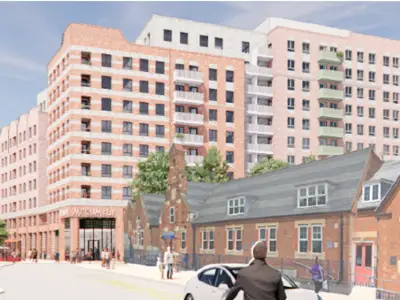
In a groundbreaking report released by the cross-party Planning and Regeneration Committee, Assembly Members argue that mid-rise buildings—typically five to nine storeys tall and including mansion blocks and stacked townhouses—should become the default approach for new residential construction in well-connected areas. The committee emphasizes that this "gentle density" model offers significant advantages over both low-rise sprawl and high-rise towers.
Committee Chair James Small-Edwards stated: "London faces a perfect storm of pressures slowing delivery, yet the answer is right in front of us. Mid-rise housing offers the liveable, human-scale density that residents want and that our city needs."

Current Challenges and International Comparisons
The report highlights several critical obstacles to housing delivery in London. Developers frequently opt for tall tower blocks due to the capital's exceptionally high land prices, making such projects more financially viable despite potential community drawbacks. Meanwhile, the current London Plan lacks sufficient clarity regarding building density and height guidelines.
International comparisons reveal London's unique housing profile. Remarkably, 88.3 percent of London's homes are houses, bungalows, or flats under five storeys tall. This contrasts sharply with Paris (41 percent), New York (48 percent), and Tokyo (62 percent), where mid-rise housing is far more prevalent throughout urban cores.
Environmental and Social Benefits
Assembly Members heard compelling evidence during their investigation that mid-rise developments provide "human-scale density that supports neighbourliness, family life and everyday amenities" while offering distinct "environmental advantages." The committee believes this approach can help rebuild trust with communities often alienated by massive tower block proposals.
The report references a Centre for Cities study noting that French and Japanese cities commonly feature mixed built forms with mid-rise housing integrated throughout urban cores. In contrast, British cities typically exhibit stark divisions between low-density suburban housing and concentrated high-rise developments.
Practical Recommendations and Implementation
The Assembly's recommendations include several concrete steps:
- Establishing mid-rise as the preferred development form in high-accessibility locations
- Implementing a modernized density matrix linking building height to transport accessibility
- Supporting boroughs in developing planning codes that enable high-quality mid-rise housing
- Incorporating effective design codes with quality safeguards in the next London Plan
The committee examined Croydon's recent experiment with gentle density, where guidelines were created for building small blocks of flats on underutilized spaces like garages and empty plots. While recognizing this as a potentially effective model, the report notes that insufficient "guardrails" in Croydon's design code led to resident dissatisfaction with neighborhood changes.
Mayor's Response and Future Directions
Mayor Sadiq Khan has previously implemented radical planning reforms to address the housing crisis, including reducing affordable housing quotas for developers and exploring construction on poor-quality green belt land. The Assembly's report now presents an alternative path focused on moderate intensification rather than either extreme low-density or high-rise development.
The committee's investigation concludes with a clear directive: "We believe mid-rise should become the default answer to housing development in London." This represents a significant challenge to current development patterns and could reshape London's skyline for generations if adopted in the next London Plan.