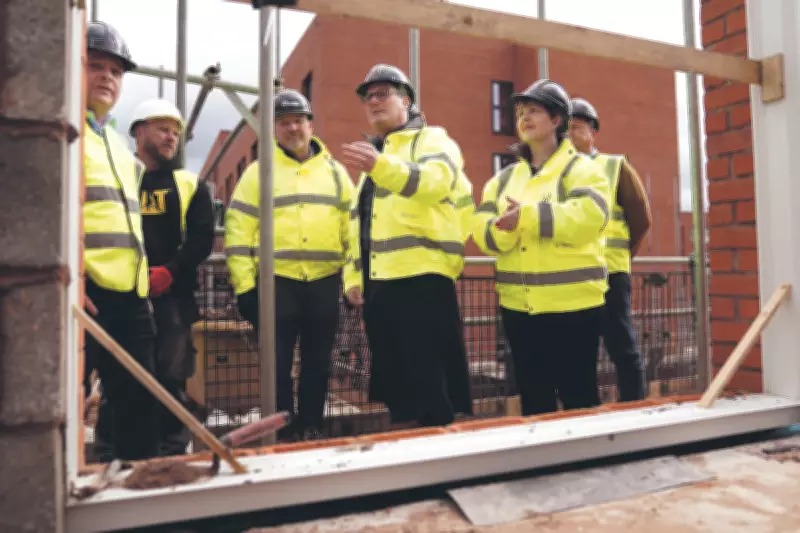
Labour's Ambitious Housing Pledge Faces Construction Industry Warning
The Labour government's commitment to build 1.5 million homes by the next general election is facing significant challenges as industry leaders warn that tax burdens and employment costs could derail the ambitious target. The Construction Plant-hire Association (CPA), representing over 2,000 firms providing essential machinery and expertise, has issued a stark warning that immediate sector support is crucial for success.
Budget Watchdog Forecasts Housing Stock Decline
In a concerning development, the Office for Budget Responsibility (OBR) has projected that net additions to the UK's housing stock will decrease from a 260,000 yearly average to just 220,000 in 2026-27. The Treasury watchdog noted that Labour's planning reforms have yet to "meaningfully materialise" in accelerating house building rates. Despite the 2029 election deadline for Labour's housing target, the OBR predicts that significant increases in construction won't occur until 2030.
London's Construction Crisis Deepens
The situation appears particularly dire in London, where the Centre for Policy Studies has warned of the capital's worst house building challenge since World War II. Construction began on only 4,170 new London homes in the last financial year, representing a dramatic 72 percent decline from the previous year. While London requires approximately 88,000 new homes annually to meet demand, consultancy firm Molior forecasts that only 4,550 will be built annually in 2027 and 2028.

Family-Owned Firms Sound Alarm on Tax Changes
Steven Mulholland, chief executive of the CPA, expressed support for Labour's "build, baby, build" approach but highlighted growing concerns among members. "Our sector backs the ambition to deliver the homes of tomorrow," Mulholland stated. "Plant-hire businesses supply the machinery and expertise behind every housing project in the country."
However, he emphasized that scaling up operations has become increasingly difficult as small and medium-sized enterprises face higher employer National Insurance contributions and rising net-zero regulatory costs. These pressures are expected to intensify with upcoming inheritance tax changes, including reforms to Business Property Relief scheduled for April implementation.
Inheritance Tax Reforms Threaten Equipment Investment
Following revisions to the 2024 Budget, any inheritance exceeding a £2.5 million threshold will now face an effective tax rate of 20 percent. Construction suppliers argue they will be disproportionately affected since their value typically resides in equipment and machinery rather than cash reserves. Industry surveys reveal alarming statistics:
- 80 percent of CPA members believe Business Property Relief changes will create asset transfer risks
- 76 percent anticipate reduced equipment investment as a direct consequence
- 79 percent cite government tax policy uncertainty as their primary concern
- 96 percent of plant-hire businesses are family-owned, making them particularly vulnerable
Mulholland emphasized the sector's precarious position: "More than three quarters of our members have already begun cutting back investment or are planning to do so. If Labour is serious about accelerating housebuilding, it must ensure policy does not make a bad situation worse."
Industry-Wide Challenges Mount
Separate analysis from construction firm McBains suggests that while infrastructure projects may drive some growth, housing and commercial sectors will continue to struggle with planning delays and labor shortages. The company's managing director identified minimum wage increases as a "particular concern" that discourages apprenticeship hiring at a time when the construction workforce has reached record lows.
The Ministry of Housing, Communities and Local Government has been approached for comment regarding these industry warnings and their potential impact on Labour's housing strategy. As pressure mounts from multiple fronts, the government faces increasing scrutiny over whether its ambitious targets can withstand the complex realities of construction economics and tax policy.