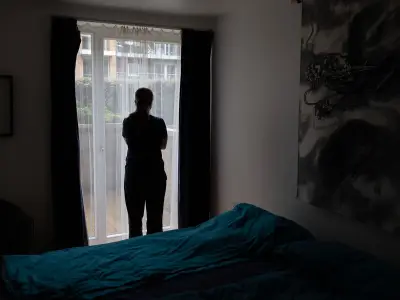
Tee Fabikun sits in an armchair in her cozy, homely flat, surrounded by papers, family photos, Nigerian handicrafts, and a forest of houseplants. She recalls her neighbors on the fifth floor of Lund Point, a tower block on the Carpenters estate in Stratford, east London. Next door lived a grumpy old man—or so she thought, until she saw him with his granddaughter in the lift. “There’s always two sides,” she says. Further along was a young couple who met in the building, possibly in that lift; they married, and she moved in with him. Then there was a Bangladeshi family with limited English; their daughter once knocked on Fabikun’s door with an exercise book, saying only “homework,” leading to regular tutoring. Fabikun knew nearly everyone in the 21-storey block.
But now, outside her flat, the landing is cold, echoey, and dirty, with peeling paint and steel security doors sealing off the other seven flats. Fabikun’s home is the only occupied one on the fifth floor. Across the entire building, only four of the 168 flats are still lived in.
Warren Lubin lives on the 20th floor, though one lift works thankfully. He describes the building as “a mess at the moment” and often comes down to Fabikun’s flat. They moved in around 1997 and have been friends since. From outside, Lund Point looks abandoned: rubbish-filled supermarket trolleys at the entrance, grubby and shabby cladding, broken windows, and netting over balconies to keep pigeons out—though they still get in, says Lubin. Rats too. Lubin has no netting; the council told him it no longer provides that. So pigeons nest on his balcony, with kestrels hunting the nestlings—he doesn’t mind the kestrels. He enjoys the 20-floor views: “The afternoon sun, the view westwards of London. Canary Wharf, the City, on a clear day all the way to the Wembley Arch.”

Lubin isn’t a fan of tower block living. He didn’t get to know many neighbors when he moved in, keeping to himself. “I don’t know why people think we want to live in towers, or that they make communities. They don’t,” he says. Later he got involved with residents’ organizations and steering groups, becoming a spokesperson for the estate. Fabikun, however, has always been happy in Lund Point. “I knew everyone. If you got into the lift with someone you didn’t know, by the time you got out you knew each other,” she says. She still feels safe: “It’s been my home for so many years, I love it.”
Chris Bailey of Action on Empty Homes calls the situation “a scandal, an example of everything that’s wrong with estate regeneration.” The Carpenters estate was built in 1967-68 by Newham council, with three tower blocks and low-rise housing totaling 710 homes. Little maintenance occurred between 1979 and 1997, and a £19bn backlog in council housing repairs was inherited by the incoming Blair government. From 2004, the council began a long-running regeneration program, with plans to refurbish, then demolish, the towers. The process of emptying them began.
In 2005, London won the 2012 Olympics, largely held in Stratford. In 2011, Newham council entered a deal with University College London (UCL) to build a campus on the site, requiring total demolition of the Carpenters estate. Eighty per cent of the footprint would go to UCL, 20% for rehousing residents. Residents formed Carpenters Against Regeneration Plans (CARP) to fight demolition. Prof Paul Watt of LSE describes it as “a form of state-led gentrification, displacing working-class tenants.” He notes that the negative reputation of estates often doesn’t reflect residents’ reality. Fabikun recalls: “It was a beautiful community. We were our brothers’ keepers.” She tells of a single mother with triplets supported by a rota of “grannies.”

During the 2012 Olympics, the BBC set up on Lund Point’s roof. By September 2012, over half of residents had been decanted. “It wasn’t good: friends got separated,” says Fabikun. Many younger families moved out. Fabikun, now 77, refused to leave: “I can’t buy anything in this area for that. They said, ‘Go to Southend.’ I don’t know anyone in Southend.” Lubin adds that decanting people with a right to return in 10-15 years means they’ll have new lives.
Watt says estate regeneration involves “managed decline”: services deteriorate, neighbors leave, and empty properties worsen. UCL pulled out of the deal, and Newham sought alternatives. In 2014, the Focus E15 group occupied a low-rise property on the estate after 29 homeless single mothers were told to relocate to Birmingham or Manchester. Hannah Caller, who helped organize the occupation, says: “It was outrageous… We shone a spotlight on the fact that they were trying to socially cleanse people from Newham.” Watt calls it “probably the single most catalysing incident” in London’s housing crisis.
Chris Bailey notes over a million empty homes in England, with 303,185 long-term empty—up 51.5% since 2016. In London, 47,287 are empty, up 138%. Nearly 60% of homeless families in England are Londoners. There are 34,635 empty council homes in England, nearly 11,000 in London. In Newham, 41,223 households are looking for homes. The government’s £39bn investment over 10 years falls short: Shelter says 90,000 social homes a year are needed; the government offers 18,000.
Bailey says the Carpenters is one of many examples where plans stalled due to breakdowns in funding or inaction. “It’s an awful lot of housing to keep intentionally empty when you’re… pissing away vast amounts of public money to private landlords.” A Newham council spokesperson said: “Estate regeneration schemes are long-term and complex… The programme has faced external shocks and pressures.”
In November, Lund Point residents were given hotel accommodation in a Stratford B&B after the building was deemed structurally unsafe. Lubin still stays in Lund Point most of the time; he hates the hotel. Fabikun goes to the hotel at night but returns daily to run the food bank. She was offered a flat across the high street but refused: “It had no toilet downstairs. I’m an old woman… you want me to fall and break my neck?”
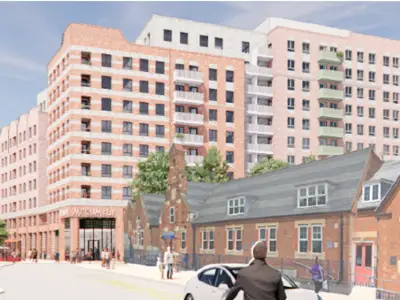
The estate feels tired and forgotten, especially compared to the surrounding transformation: the London Stadium, Westfield mall, Sadler’s Wells, and glass towers. A £1.5bn regeneration plan by Populo Living aims to create 2,300 new homes, 50% at affordable social rent. Two towers, including Lund Point, will be retrofitted. In 2021, 73% of remaining residents voted in favor. Lubin voted no: “I don’t like the numbers: 2,300 homes on 23 acres. You wouldn’t put that many cattle on 23 acres.” He doesn’t know where he’ll go or when. Populo says the project will run “well into the 2030s.” Bailey notes that many waiting residents won’t be around.
At night, the Carpenters estate is a dark contrast to the brightly lit towers around it. A fox dashes across the central square. Lights are on in one window—the house once occupied by Focus E15. James Riley Point, under renovation, has a single light on. Lund Point looms dark and silent. Walking back to the station, the words of the Specials come to mind: “This town is coming like a ghost town.”