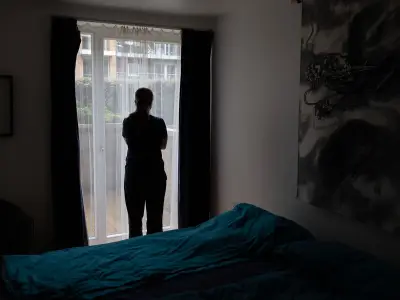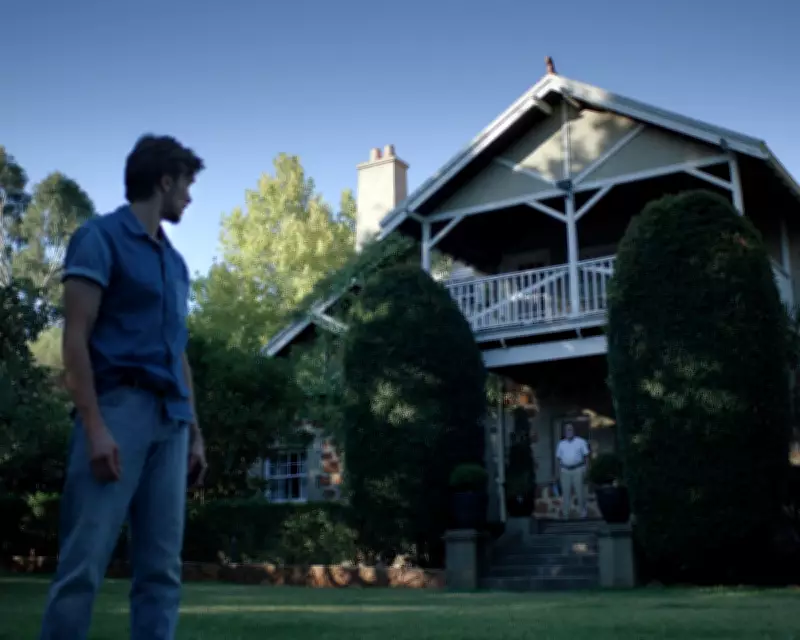
A still from the Australian film Birthright, which follows a young couple, Cory and Jasmine, who are forced to move in with Cory’s less-than-thrilled parents. Photograph: Madman Entertainment
The great Australian nightmare: how the housing crisis inspired a wave of brutal – and funny – pop culture. Soaring prices, rental stress and intergenerational inequality is fuelling new films, books and plays, including Birthright and Kill Your Boomers.
“I wanna go home,” sobs a heavily pregnant woman, sitting in a car stacked with her and her husband’s worldly possessions. “I want a home.” This isn’t a scene from one of the parks, campgrounds or parking lots around the country that have become an alarming symbol of Australia’s housing crisis. It’s from Birthright, a new Australian film about a millennial couple, Jasmine (Maria Angelico) and Cory (Travis Jeffery), who are facing parenthood and homelessness at the same time.

Cory has been left jobless after finishing his latest short-term contract, while Jasmine is on unpaid maternity leave from a university job – hardly a leap in the age of casualised labour. The end of a lease sends them packing to the sprawling empty nest of Cory’s less-than-thrilled baby boomer parents, Richard and Lyn. The result is less Packed to the Rafters, more Wake in Fright.
Director Zoe Pepper says the idea for Birthright came during the pandemic, as friends and family joined the many young Australians swallowing their pride to move back in with their parents. “They always intended only to stay for a little while … and then it would extend,” Pepper says. “I became really curious about the power dynamic playing out underneath that roof.” Pepper says its premise has only grown more relevant in the years since “avocado toast” discourse peaked. “In that last five years housing prices have nearly doubled … I do think Australia has created this uniquely, absolutely ridiculous situation where housing is almost like a Ponzi scheme.”
She isn’t alone. An ambient hum of real estate anxiety can be found on the screen, page and stage across Australia, from Melbourne’s Malthouse Theatre recently staging a refreshed Pride & Prejudice that was billed as a “love story in a housing crisis”, to Adelaide, where playwright James Watson’s The Housewarming – a showdown between gen Z haves and have-nots – just wrapped its first season.
Kill Your Boomers by Fiona Wright. Award-winning poet and writer Fiona Wright started working on her debut novel Kill Your Boomers even earlier, around 2018. “My life at the time was very much like Keira’s,” Wright says of her novel’s protagonist, a freelance writer who has turned to au pairing for yuppies. “We weren’t talking about a ‘housing crisis’ … it was really interesting to watch that conversation, that terminology, move further and further into the centre.” Like Pepper, Wright says the last few years have made that crisis even starker. “These aren’t just ‘young people problems’ any more,” Wright says. “It’s been really interesting to see friends I’ve known for a long time move into positions in their careers where, you know, we’re in charge. And we’re still going home to these shitty sharehouses that we live in with two strangers.” In the novel, Keira’s parents own a house in Dulwich Hill, and lecture her about “living within her means” – while they buy a new Tesla and stump up to send Keira’s niece to private school.
Cory and his pregnant wife Jasmine are forced to move into a home on the outskirts of the city owned by Cory’s parents Richard and Lyn in Birthright. Photograph: Madman Entertainment. In Birthright, the disconnect between generations is similarly pointed. Cory’s dad is convinced his arts graduate son has squibbed the same opportunities that he built a life – and property portfolio – from. “You work harder than anyone and the world will look after you,” he tells Cory after refusing to loan his expectant son $40,000. “He’s following the same recipe his dad laid out for him, but it just doesn’t work any more,” Pepper says of Cory’s predicament.

Chosen Family by Madeleine Grey. Like many Australians, Wright and Pepper’s characters come to believe the only path to get ahead, or even stay afloat, runs through their parents. The gamechanging power of inheritance isn’t uncommon in Australian millennial fiction: in Madeleine Gray’s 2025 novel Chosen Family, the lives of its characters hinge irrevocably on when a parent dies unexpectedly – and leaves behind a property worth half a million dollars. More recently, Ellena Savage’s The Ruiners opens with a young woman stuck in a grind of credit card debt and hospo shifts, until her estranged father bequeaths her $50,000. It’s not enough to buy a house in Australia – it’s literary fiction after all, not fantasy – so she buys the next most achievable thing: a crumbling, mould-ridden house on a distant Greek island, sight unseen.
Several Australian publishers told Guardian Australia they have not yet spotted an emerging broader trend of housing crisis fiction, but Lex Hirst at Pantera Press cited two upcoming nonfiction novels dealing with the housing crisis and inheritance inequality – adding that she thought, in fiction, “the push towards escapism will continue, as it tends to in uncertain times”.
The Ruiners by Ellena Savage. Much like the unemployed factory worker (Lee Byung-hun) in South Korean director Park Chan-wook’s No Other Choice, who turns to murder to keep a roof over his family’s head, Wright and Pepper’s characters aren’t content to wait for nature or the economy to take its course. With a title like Kill Your Boomers, it’s hardly a spoiler to say things get weird, as an anthropomorphised hole in Keira’s sharehouse kitchen – left unfixed by her landlord – eggs on her darker ambitions. “They had so much to lean on, Kiera, that’s why they could stand on their own feet,” the hole says. “And then they took all that scaffolding away.” Birthright takes a more slow-burning, chaotic route inspired by Who’s Afraid of Virginia Woolf? and Get Out, while driving home the depth and scale of Cory’s desperation.
Wright says the reactions from readers since her book came out have ranged from “Oh my god, hard relate”, to “She’s insufferable, can she just get a job?”. “And I think they’re both correct,” Wright says. After all, in the scheme of the housing crisis, both Keira and Cory are part of a relatively privileged cohort of potential heirs-in-waiting. Pepper certainly recognises the entitlement at the centre of Cory’s increasingly twisted family dynamic – and the reality that in many cases, wealthy parents are only too happy to open the bank of mum and dad to help their children. “It is terrifying how this distillation of class is going to become even more pronounced once millennials become the new boomers,” Pepper reflects. “It’s going to get turbo-charged.”
That disparity is exemplified by the character of Jasmine, whose less affluent background draws a line between her and her husband. When she remarks upon the quiet luxury all around his family home, Cory replies defensively that his parents are “not loaded – comfortable”. Such class unconsciousness makes Jasmine’s breakdown in the car hit harder than anything Cory and his parents throw at each other. For Pepper, at least, the darkly cathartic response during the film’s first run at festivals in New York, Sydney and Adelaide bodes well for its national release – if not the state of the crisis it satirises, both in Australia and abroad. “The worse the housing crisis, the harder the audience laugh,” she says. Birthright is in Australian cinemas now. Kill Your Boomers by Fiona Wright is out now (Hardie Grant, $34.99).