London's Canada Water Development Sees Affordable Housing Slashed to 9% After Mayor's Approval
City Hall has granted approval for a revised planning application for the massive Canada Water Masterplan in South London, resulting in a dramatic reduction of affordable housing units from the originally promised 35% to just 9% on site. This decision has ignited fierce opposition from local authorities and housing advocates who warn it establishes a dangerous precedent for future urban regeneration projects across the capital.
From 35% to 9%: The Erosion of Affordable Housing Commitments
The Canada Water Masterplan, originally approved by Southwark Council in May 2020, envisioned the construction of 2,815 homes with 35% designated as affordable housing, alongside 4.7 million square feet of retail, office, and leisure space. Developers British Land and AustralianSuper hailed the project as "London's first new town centre in 50 years," spanning a substantial 53-acre site.
However, by January 2025, British Land submitted a Section 73 application seeking amendments to the original consent, citing changes to building regulations and widespread sector challenges regarding costs and viability. This revised proposal increased the total number of homes to approximately 3,000, with potential for up to 4,184 units, while reducing the affordable housing offer from 35% to just 10% overall.

When Southwark Council missed its April 2025 deadline to decide on the amended plans, British Land escalated the matter to Mayor of London Sir Sadiq Khan, warning that further delays would jeopardize the scheme's substantial benefits. The developer's updated financial viability assessment indicated that only 3% affordable housing was feasible at that stage, though public funding could potentially increase this in later phases.
Mayoral Intervention and Public Funding Boost
Mayor Sadiq Khan chose to "call in" the application, concluding that the development would significantly contribute to London's housing delivery. The affordable housing figure subsequently increased to 9% after City Hall provided the £4 billion regeneration scheme with a grant, meaning up to 270 homes out of 3,000 will now be affordable.
During a public hearing at City Hall, Deputy Mayor for Planning, Regeneration and the Fire Service Jules Pipe ultimately approved the Section 73 application, allowing British Land and AustralianSuper to proceed with their revised plans. Pipe acknowledged that while the reduced affordable housing diminished public benefits, the grant funding represented a material consideration favoring approval.
"The design layout and massing of the scheme are well considered in the context of site constraints particularly for those arising from strategic views and heritage assets and would optimise development capacity," Pipe stated in his decision.
Fierce Opposition from Local Stakeholders
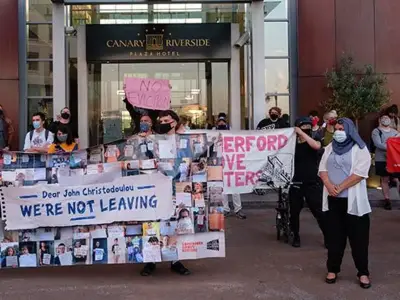
The revised proposals have faced substantial criticism from Southwark Council, local ward councillors for Rotherhithe, housing campaigners, and residents who have expressed profound disappointment with the diminished affordable housing provision.
Gemma Usher from Southwark Council's Strategic Team emphasized that the council administration believed "the public benefits of the scheme and in particular the low level of affordable housing provided do not justify the harms caused by the scheme arising from its increase in scale."
Jerry Flynn of the 35% Campaign highlighted the stark contrast between housing need and provision, noting that "93 per cent of households would qualify for affordable housing and that only 7 per cent of households can fully afford free market housing" according to the Southwark Plan. With nearly 23,000 households on the housing waiting list, Flynn criticized the "meagre 3 per cent" baseline offer that increased to 9% only through public funding.
"In other words, we are paying for the increase," Flynn asserted.

Community Concerns and Broken Promises
Rotherhithe ward councillors expressed deep concerns about the development's impact on local communities. Councillor Stephanie Cryan argued that the 9% affordable housing offer would "do nothing" to address the needs of local residents, noting that the immediate SE16 area has 2,785 households on the council waiting list, with 713 needing three or more bedrooms and 861 living in overcrowded homes.
"There is a real risk if the application is approved of Canada Water becoming an enclave of the wealthy... whilst those living in surrounding areas including long-established council estates believing that there is nothing of benefit to them," Cryan warned.
Fellow ward councillor Bethan Roberts echoed these concerns, stating that the application further erodes community trust in the scheme. "We've lost the cinema, we've lost affordable workspace, we're now slashing affordable housing provision, we've lost the police station - this litany of broken promises is something our residents cannot abide and won't stand for," Roberts declared.
Developer's Perspective and Future Plans
Michael Meadows, Head of Planning and Public Affairs at British Land, defended the revised plans, highlighting that the first phase had delivered 79 social rent homes and more than £10 million had been spent revitalizing Canada Dock, including a 170-meter boardwalk and 186 homes at The Founding. Additionally, £13 million has been allocated for new step-free access at Surrey Quays Station, with £2.6 million improving Canada Water Station.
"Granted planning permission today will enable the currently stalled Masterplan to progress, securing investment and ensuring much-needed housing is accelerated," Meadows stated. He emphasized that the revised Masterplan would deliver 150 social rent homes starting in 2027, equivalent to 20% policy-compliant affordable housing in the next development phase.
Meadows acknowledged potential for additional affordable housing in future phases but noted this would be subject to viability reviews. "We are ready to start building again to deliver 150 social rent homes in the next phases of development but we need an investable planning permission, one that reflects structural changes and the London market and supports house building," he explained.
Legal Concerns and Precedent Setting
Jed Holloway, a planning solicitor from the Southwark Law Centre, warned that approving the revised application would establish a dangerous precedent for all future schemes. Holloway also criticized British Land's introduction of co-living accommodation, which was not part of the originally consented scheme, arguing it would be unlawful to grant the application since Section 73 applications cannot change the existing description of development.
"We cannot continue to allow the costs of the housing crisis to fall on the public purse and local communities; wasting the biggest sites in the name of delivering private housing that demonstrably fails to meet local need," Holloway asserted.
Development Timeline and Community Impact
Local resident Michael Robertson expressed frustration with the current state of Canada Water, stating that "at the hands of the applicant, Canada Water has stagnated and the applicants have run the existing shopping centre into the ground. The local community hub has been a gargantuan flop and the shopping centre is now 65 per cent void as the applicants' controlled leases and controlled rents are untenable at national and local level."
British Land commenced construction of the first buildings in mid to late 2021, with the development proceeding phase-by-phase over a 10 to 15-year timeline that could extend completion to 2036. Each stage will require separate planning permission, maintaining ongoing scrutiny of the project's evolution and its impact on one of London's most significant regeneration areas.