The 14-Year-Old Who's Moved 26 Times: A Family's Struggle in the US Housing Crisis
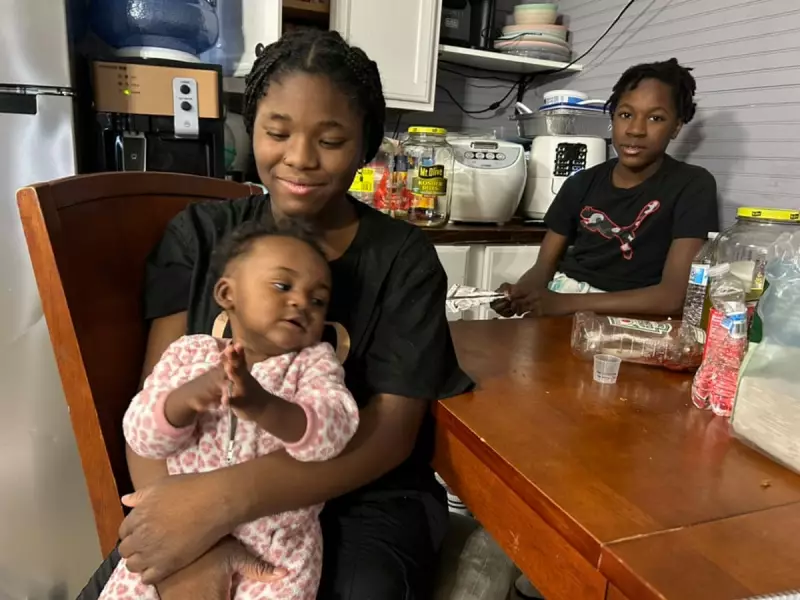
Na'Kaya Godfrey cradles her toddler sister, Kylie, in what is the family's latest temporary home, as her brother Junior watches nearby. At just fourteen years old, Na'Kaya spends her days playing with the baby and experimenting with makeup, but the relentless cycle of moving has plunged her into a state of deep anxiety. She often stays awake at night, unable to eat, waiting for her mother to return home. This portrait of instability is a stark illustration of how the American housing crisis is trapping families in a devastating cycle of displacement and stress.
A Life of Constant Displacement
After a long day at school, Na'Kaya and her twelve-year-old brother, Junior, return to a dark, empty house in Stone Mountain, Georgia. On a dreary winter afternoon, she switches on the space heaters that provide the only warmth in their unheated rental property. An inspirational sign on her dresser reads "Home, Sweet Home", but the words hold little meaning for a teenager who has never known permanence. When asked how many places she has lived, Na'Kaya guesses, "At least 25." Her mother, Jaimie, 35, clarifies the grim reality: this is their 26th home.
The Godfrey family's journey has been one of profound hardship. They have been forced to quickly vacate two houses, evicted from a third, and have resorted to couch-surfing with acquaintances. Their residences have included basements, gritty extended-stay hotels lining the interstate, and a grimy rooming house with a shared bathroom. They have slept in their car before it was repossessed, washed up at a QuikTrip gas station, and seen their worldly possessions dumped on the curb, losing the contents of three different storage units. Jaimie adds that Na'Kaya likely doesn't remember the homeless shelter they stayed in when she was a toddler.
"KK asks me: 'Why do we move so much? Do they not like us?'" Jaimie recounts. "I tell her: 'Mommy's just having a hard time.'" As a single parent with no family support, Jaimie has struggled to find jobs and side hustles that can cover soaring living costs, rent, and childcare. This economic battle is compounded by the impossible demands of juggling work, school, and childcare schedules.
The Heavy Toll on Children
The instability has taken a severe psychological toll on Na'Kaya and Junior. Na'Kaya often retreats to her room, decorated with pink unicorn sheets, donning headphones to listen to music or watch TikTok videos to calm her nerves until her mother returns from her late shift as a childcare teacher. Diagnosed with separation anxiety, she finds it difficult to eat when Jaimie is not home and often goes to bed hungry. She compulsively calls her mother every fifteen minutes, needing to hear her voice to feel secure.
"Mommy says I have to stop calling her, but I can't help it," Na'Kaya admits. "I just need to hear her voice and know she's safe." Feeling safe is fundamental to healthy child development, yet it is a sensation neither sibling has known in any of their many homes. They speak of a scary man in a rooming house, the fear of sleeping in a car, and unsettling noises that kept them awake during countless moves. Both suffer recurring nightmares where their family is under attack or something terrible happens to Jaimie, the one constant in their lives.
While Na'Kaya battles anxiety, Junior struggles with behavioural issues, disrupting class and fighting with other children. "I haven't really seen anything that makes me feel, like, safe," Junior confesses. "When I'm with my Mommy, Sissy and baby sister, I feel safe. That's the only time. When all of us are together."
The Hidden Crisis of Housing Insecurity
Children like Na'Kaya, Junior, and Kylie are often missing from headlines about the deepening housing affordability crisis in the United States. Yet, they are uniquely vulnerable as eviction rates spike in cities like Atlanta, rents and housing prices soar, and wages fail to keep pace with the cost of living. Because they are not in shelters or on the streets, the Godfrey children are not counted in official homelessness tallies, which reached an all-time high in 2024. Families with chronically unstable housing remain largely invisible, yet their lives are no less chaotic and traumatic.
Research shows that housing insecurity has serious, long-lasting consequences for children. Lack of a stable address or the experience of eviction can lead to high rates of school absenteeism and switching, triple the risk of behavioural problems, and lower cognitive test scores. Evicted children can lag in reading and math by as much as one year and are less likely to graduate from high school. Both Na'Kaya and Junior have been chronically absent and struggle academically; their grades drop and absences increase with each move. Jaimie worries that Na'Kaya still reads slowly, tracing words with her finger, and that Junior spends hours in in-school suspension. "Nobody likes me at school," he says glumly.
Infants without stable homes face greater risks of being underweight and suffering persistent health challenges, while preschoolers show major developmental delays at three times the rate of their housed peers. The stress of eviction can trigger depression and anxiety, even in children under nine. "You can see these children's not just present, but future being strangled," observes Brian Goldstone, journalist and author of There Is No Place for Us: Working and Homeless in America.
Running in Place Against Systemic Barriers
Jaimie Godfrey is no stranger to housing insecurity, having bounced between estranged family members as a child. Determined to provide more stability, she has fought to keep her children in the same schools despite their frequent moves. This commitment has created immense logistical challenges. Instead of participating in after-school activities, Na'Kaya and Junior have spent years waiting in back rooms of Jaimie's workplaces, sitting in car parks, or whiling away afternoons alone in hotel rooms. For nearly a year, they rose before dawn to catch a 5am bus to their old school, returning home long after dark.
"I feel like such a failure sometimes," Jaimie admits. "I've made mistakes, and there are days when the heaviness makes it hard to get out of bed. But the kids aren't mistakes. They're blessings. I just want something better for them than I had for myself."
In the face of the growing crisis, federal policy has shifted. The Trump administration has slashed rental and permanent housing assistance, overhauling homelessness policies to focus on mental health and drug addiction as "root causes"—a determination many housing experts dispute. The administration has also proposed stringent work requirements for "able-bodied adults" seeking housing aid.
Jaimie has been waiting for housing assistance since 2017. In Atlanta, as in many gentrifying cities where landlords can command higher rents than public subsidies cover, the voucher list has been effectively closed since 2018. Contrary to assumptions that those who are housing insecure are unemployed, Jaimie has always worked—managing a mobile phone store, working customer service at AutoZone, baking and selling sweet potato pies, running a pasta-delivery service, working at car auctions and construction sites, and taking odd jobs through staffing services. She has started GoFundMe campaigns and tried to become a TikTok influencer. Yet, at every turn, she has struggled.
Sherri McCoy, a church friend who runs the local non-profit Blessing Bags of Warmth, has been helping the Godfreys pay their $1,275 monthly rent and bringing food when Jaimie's food stamps run low. McCoy highlights the "impossible catch-22s" embedded in the system. For instance, to qualify for a childcare subsidy in Georgia, parents must first prove they are working 30 hours a week—something most cannot do without childcare. McCoy eventually helped Jaimie secure a $12-an-hour childcare job that allowed her to bring Kylie along.
"There are so many impossible catch-22s before you can get any help," McCoy explains. "It gets to a point that it's a catch-44." Although the Trump administration has recently promised to focus on housing affordability, experts like Goldstone argue its actions have worsened the situation for low-income families. "The reason we're seeing record-breaking homelessness is because of a basic mismatch between people's incomes and what it costs to have a place to live," Goldstone states. "That chasm is growing wider. And as it grows, we'll see more families losing their homes."
Children: The Hidden Face of Homelessness
Contrary to the administration's focus on adult addiction and vagrancy, children are the population in the United States most likely to become homeless, spend a night in a shelter, or be at risk of eviction. Black families and Black children face disproportionately higher risks of eviction, regardless of income. Black women like Jaimie Godfrey face eviction at twice the rate of white women. Studies indicate that nearly half of all eviction court cases involve single-mother households.
Research from New York University finds that housing conditions and demographics—not mental illness or substance abuse—are the primary reasons families end up in homeless shelters. Housing subsidies are the strongest predictor of housing stability. For homeless single-parent families without jobs, the biggest barriers to work are the lack of childcare, housing, and transportation.
"It's almost impossible to find your way out of poverty these days," says Kate Barrand, president and CEO of Horizons for Homeless Children. "The system is built to hold them down because embedded in our support system is this belief that if people are poor, it's their fault. You see these families, these single mothers who work harder than most everyone I know, and they're literally running in place."
Innovative Solutions and Funding Challenges
Atlanta is home to one of the few eviction-prevention programmes in the country specifically focused on children. Over the past decade, Standing With Our Neighbors, developed by the Atlanta Volunteer Lawyers Foundation, has embedded lawyers and social workers in nine schools in zones with the highest eviction rates. The programme works with parents, landlords, and courts to prevent families from being forced from their homes, though the Godfreys live outside these designated zones.
The foundation also provides emergency rental assistance and compels landlords to repair hazardous conditions like mould and sewage issues—problems that force families into "informal evictions." This happened to the Godfreys when a tree fell on their rental home and the landlord failed to repair the roof.
In 2024, the programme at Tuskegee Airmen Global Academy helped keep 123 students housed, about one-third of the student body. With increased stability came improved attendance and academic performance. The share of students rated as "developing or higher" increased from 46% to 67% in math, with similar gains in English and language arts—the highest in the school's history.
"It is very hard for a child who is homeless to focus in math class when we're talking about fractions and they don't know where they'll sleep that night," explains principal Melanie Sithole. The programme also boosted attendance at another Atlanta school, Hollis Innovation Academy, from 48% to 67% in one year.
Michael Lucas, executive director of the Atlanta Volunteer Lawyers Foundation, notes they had hoped to expand the programme to additional schools, including early childhood learning centres. Instead, they are preparing to scale back due to federal funding cuts by the Trump administration. "It's going to be harder," he acknowledges. "But we can't walk away."
The programme focused on underperforming schools with high turnover rates, finding these schools were in zones with the highest eviction rates—areas that mapped almost exactly onto Atlanta's majority-Black neighbourhoods. Some housing advocates argue that such programmes should be "racism-conscious," actively working to undo the harms of historical discriminatory policies like redlining.
Carl Gershenson, a sociologist and director of the Eviction Lab at Princeton, states, "Our data shows Black renters have higher eviction filing rates against them, so anti-eviction policies are going to have a disproportionately large benefit for Black renters."
An Uncertain Future
On a recent winter day, the Godfrey family was confined to their Stone Mountain home. Jaimie had just learned that the childcare centre where she worked was being evicted from its building and shutting down, leaving her jobless once more. Though sleep-deprived from years of worry, she accidentally overslept, causing the children to miss the school bus. With no car and no money for a ride-share, Na'Kaya and Junior stayed home, despite a recent warning letter about their chronic absenteeism and Jaimie's fears about their slipping grades.
The family spent the morning cleaning up rainwater that had leaked through the roof and setting peanut-butter traps for rats raiding the pantry. In the afternoon, after applying for work-from-home jobs, Jaimie spent $15 of her last $37 on chicken legs to ensure the children had a proper meal. Junior bathed his dog, his only friend, while Na'Kaya played with Kylie, hiding the baby's plastic balls in a hole in her dress to her sister's delight.
Later, Na'Kaya retreated to her room, adorned with blue twinkle lights that keep her awake but allow her to see Kylie's face when the baby wakes crying from a nightmare. Reluctant to discuss the family's many moves, Na'Kaya slowly slunk to the ground, crouched in a corner, drew her arms inside her "God Got Me" T-shirt, and stared blankly at the wall.
"I like all the subjects, and I don't mind doing the work," she says of school. "It's just hard when all this stuff is bunched up in my head. It makes it hard for me to think." Sometimes, to avoid biting her nails, she scribbles her feelings on paper, balls it up, and throws it away. "I write how I thought Atlanta was a good place for everyone," she shares. "But it pretty much don't seem like that."
The family's lease expires in March. They have no idea where they will go next, trapped in a cycle that shows no signs of breaking, emblematic of a national crisis leaving countless children and families running in place, their futures hanging in the balance.