Historic Newspaper Faces Crisis as Bezos Axes Over 300 Positions
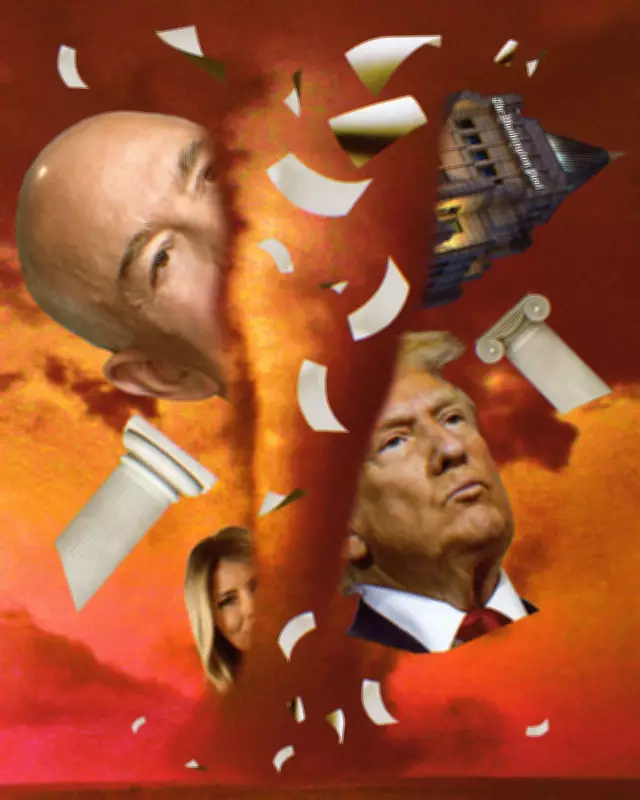
These are indeed historic times, with a metaphorical cyclone bearing down upon the established world order and the American system of government. It is precisely during such turbulent periods that journalism matters most, serving as a critical pillar of accountability and truth. The recent drastic actions at one of America's most storied newspapers have thrown this vital role into stark relief.
A Devastating Blow in a Warzone
The email arrived in Lizzie Johnson's inbox in Ukraine just before 4pm local time. For the Washington Post correspondent, it came at an exceptionally challenging moment. Russia had been relentlessly striking the country's power infrastructure, and just days earlier, she had been forced to work from her car without heat, power, or running water, resorting to writing in pencil because pen ink freezes too easily in the harsh conditions.
The subject line read: "Difficult news." The message coldly informed her that her position was being eliminated as part of organizational changes necessary to meet the "evolving needs of our business." Johnson's response, posted on social media platform X, may well become part of American media history: "I was just laid off by The Washington Post in the middle of a warzone. I have no words."

Unprecedented Workforce Reduction
Johnson was among more than 300 Washington Post employees—almost one-third of the newspaper's workforce—who lost their jobs in a single devastating move orchestrated by owner Jeff Bezos, the Amazon billionaire. This sweeping bloodletting eliminated the paper's entire sports department, decimated much of its culture and local reporting staff, and removed all journalists from critical international zones including Ukraine and the Middle East.
The layoffs have sparked renewed fears about the resilience of American democracy to withstand ongoing attacks from former President Donald Trump. Prominent voices from the Post's illustrious past expressed profound dismay. Don Graham, son of the paper's legendary Watergate-era owner Katharine Graham, broke his long silence since selling the publication to Bezos in 2013, stating simply: "It's a bad day."
Bob Woodward, whose reporting with Carl Bernstein exposed the Watergate scandal, lamented: "I am crushed." Marty Baron, the Post's former executive editor, described it as "among the darkest days in the history of one of the world's greatest news organizations," criticizing Bezos for "sickening efforts to curry favor with President Trump" that left an "ugly stain" on the newspaper's standing.
A Stark Contrast in Leadership
Robert McCartney, a 39-year veteran of the Post until his retirement five years ago, expressed astonishment at the stark contrast between Bezos's handling of the newspaper during Trump's first term and his conduct now. "We saw him as a savior. He pumped money into the Post, didn't meddle in the newsroom and stood up to Trump," McCartney recalled of the initial years of Bezos's ownership.
Fast forward to the present, and a very different approach has emerged. The timing appears particularly cruel given the Post's famous strapline introduced in 2017: "Democracy dies in darkness." That motto still runs proudly beneath the masthead, but after a week like this, America's democratic landscape appears notably darker.
Marcus Brauchli, the Post's executive editor until 2012, emphasized the terrible timing: "These are historic times, given the cyclone bearing down on the world order and American system of government. This is when journalism matters most. I mean, laying off reporters in Ukraine, now."
Questionable Priorities and Political Calculations
The financial rationale appears questionable given Bezos's immense wealth. As Peter Baker, chief White House correspondent for the New York Times, pointed out, Bezos could cover five years of the Post's reported $100 million annual losses with just one week of his earnings from other ventures. The optics of the announcement were particularly damaging, with the difficult task of informing staff delegated via Zoom to executive editor Matt Murray while Bezos was notably absent.

Meanwhile, Bezos was photographed beaming as he welcomed Trump's defense secretary, Pete Hegseth, to the Florida headquarters of his space company, Blue Origin. Will Lewis, Bezos's consigliere as publisher of the Post, also avoided facing staff during the layoffs, instead attending a red carpet NFL Super Bowl event in San Francisco the following day—though he abruptly resigned shortly afterward.
The layoffs occurred just five days after the launch of "Melania," a documentary about the former first lady bankrolled by Amazon Prime Video with a $75 million investment. Historian Simon Schama suggested this contrast in priorities would come to be seen as "the most glaring symptom of cultural collapse in a democracy hanging on to truth by the barest of threads."
A Pattern of Appeasement Emerges
Warning signs had been emerging for some time. In October 2024, Bezos yanked the Post's planned endorsement of Trump's Democratic rival Kamala Harris just eleven days before the presidential election, leading to a wave of public revulsion and the cancellation of at least 250,000 subscriptions. Soon after, the billionaire unilaterally imposed new strictures on the paper's opinion content, introducing what he called his "two pillars": personal liberties and free markets.
This ideological shift drove many top commentators to exit, including economics columnist Eduardo Porter, who now writes for the Guardian. Porter recalled: "This layering of dogma undermined critical thinking. It turned the Post into something more akin to a church, with tight constraints on thought."
McCartney suggested a possible motivation rooted in past conflicts: "It's very likely that the desire to appease Trump, to placate him, is playing a role in these decisions." He referenced 2019 when Amazon lost a $10 billion Pentagon cloud-computing contract during Trump's first term, with Amazon complaining in a lawsuit that this was retaliation for the Post's critical coverage of the administration.
Broader Media Landscape in Peril
This crisis at the Washington Post unfolds against an already parlous backdrop for American media. Since 2000, approximately 3,500 newspapers have closed, leaving one in four Americans living in "news deserts" without local journalism. The recent closure of the Pittsburgh Post-Gazette, founded in 1786, symbolizes this alarming trend.
Meanwhile, other historic newspapers have fallen into the hands of super-wealthy tech and venture capitalist owners who view journalism primarily as a monetizable asset. The Los Angeles Times, acquired in 2018 by biotech billionaire Patrick Soon-Shiong, has displayed similar symptoms of what might be termed "Trump Appeasement Syndrome," also refusing to endorse Harris before the 2024 election.
Trump's Systematic Assault on Media
This deteriorating media landscape creates fertile ground for misinformation to flourish—ground that Trump has cultivated relentlessly to his advantage. Long hostile toward what he calls the "fake news media," Trump has escalated his vendetta against truth-seekers, stripping public media channels NPR and PBS of more than $1 billion in federal funding, launching attacks on individual journalists and outlets exposing corruption, and sustaining a bullying campaign against corporate owners.
The transformation of CBS News serves as a particularly stark example. Following pressure from Trump that included a $10 billion lawsuit over a 60 Minutes interview, Paramount (which owned the network) settled for $16 million. After Paramount's merger with Skydance Media—which required federal approval—new CEO David Ellison appointed anti-woke commentator Bari Weiss as editor in chief of CBS News, despite her lack of television experience.
Weiss has since pulled a 60 Minutes segment on the Cecot mega-prison in El Salvador, to which the Trump administration had been deporting immigrants, and hired Trump loyalists and vaccine skeptics as contributors, sending shockwaves through the network's demoralized staff.
Democracy's Foundations Under Threat
The cumulative malaise descending over US media leaves the country's democratic institutions increasingly vulnerable. While media weakness cannot be exclusively blamed for Trump's excesses—with willing accomplices including certain universities, corporate law firms, and conservative activists controlling the Supreme Court—a weakened press certainly facilitates authoritarian tendencies.
The results are increasingly visible: Trump feels emboldened to berate respected journalists, peddle racist imagery, deploy paramilitary forces against protesters, and prepare for further assaults on electoral integrity. There exists a profound paradox in this situation: many democratic norms that Trump is systematically dismantling were established in the 1970s following the Watergate scandal—the very scandal exposed by two courageous reporters at a newspaper called the Washington Post.
As America navigates these historic times, the evisceration of one of its great journalistic institutions represents more than just business restructuring—it signals a dangerous weakening of the very mechanisms that sustain democratic accountability during periods of profound political crisis.