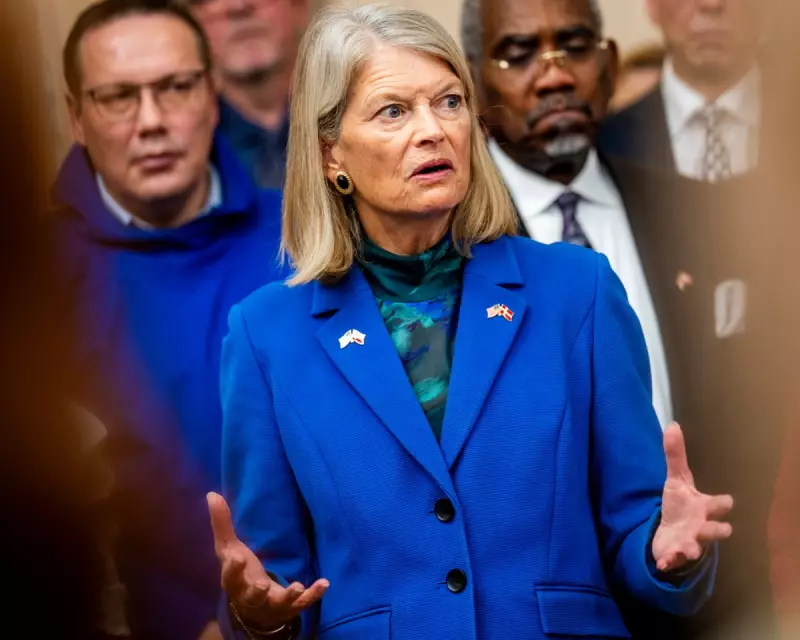
Republican Senator Lisa Murkowski addressed the press following discussions with Danish parliamentarians and a Greenlandic delegation in Copenhagen on January 16th. This diplomatic engagement occurred against a backdrop of heightened political tension, as former President Donald Trump's recent sabre-rattling over Greenland has sent shockwaves through his own party.
A Breach in Republican Unity
Donald Trump's fleeting but provocative suggestion of acquiring Greenland has catalysed the most pronounced Republican opposition witnessed during his political career. This episode arrives amidst a series of challenges to his authority, spanning military prerogatives, healthcare legislation, and the handling of sensitive legal files. While falling short of a full-scale insurrection, this dissent signals a growing unease within a vocal minority of the party.
With crucial midterm elections on the horizon, some Republicans are increasingly willing to publicly question a leader whose polling numbers are faltering. Political strategist Frank Luntz observed the paradox of Trump's influence, noting his legislative successes are now being weighed against their political cost. "The public and even people in his own party are starting to wonder whether it's too much," Luntz stated.

Historical Context of Dissent
Speculation about cracks in Trump's grip on the Republican party is not new, having been a recurring theme for years, often leading to premature conclusions. Historically, dissenting voices like Liz Cheney have faced marginalisation or felt compelled towards political retirement. Even the seismic events of the 2020 election defeat and the January 6th Capitol insurrection, which drew condemnation from loyalists like Lindsey Graham, failed to shatter the party's foundational support for Trump.
Subsequent electoral victories, including Trump's 2024 presidential win and Republican gains in Congress, seemed to vindicate this allegiance. For much of his tenure, the party granted him considerable latitude on issues like immigration and trade, leading critics to accuse Congress of enabling a monarchical presidency.
Emerging Fissures and Policy Breaks
Despite this history, clear fractures have emerged. In a notable break last November, four House Republicans—Marjorie Taylor Greene, Thomas Massie, Lauren Boebert, and Nancy Mace—defied Trump by supporting a move to release files related to Jeffrey Epstein. Trump's subsequent reversal on the issue, after it became clear the vote would pass, highlighted shifting dynamics.
Greene, once a staunch ally, later resigned and criticised Trump for betraying his base, a sentiment echoed in a recent profile where she described her initial belief in him as "naive." Further dissent was visible this month when over a dozen House Republicans supported a Democratic bill to extend healthcare subsidies, and the party has narrowly fended off attempts to curtail presidential war powers.
The Greenland Flashpoint
The Greenland episode, however, has proven particularly divisive. While many Republicans supported actions like the operation against Venezuela's Nicolás Maduro, Trump's bellicose rhetoric towards a NATO ally was seen by some as a step too far. Senators Thom Tillis and Lisa Murkowski engaged directly with Danish and Greenlandic officials, with Murkowski co-sponsoring legislation to block Pentagon funds from being used against NATO members' territory.
Former Senate leader Mitch McConnell warned that seizing Greenland would "shatter the trust of allies," while Congressman Don Bacon of Nebraska suggested such an action could lead to impeachment proceedings. Notably, many of these critics, including McConnell and Tillis, have announced their retirement, insulating them from potential political retaliation.
The Political Calculus Ahead of November
The relative silence from the broader Republican caucus speaks volumes. Tara Setmayer of the Seneca Project noted the emergence of "pockets" of questioning but questioned whether this would coalesce into a larger rebellion, especially in an election year where politicians are focused on survival. "They're going to continue to watch how the public reacts," she said, pointing to Trump's "alarming and erratic" behaviour becoming harder to defend.

Current polling underscores the challenge. An Emerson College poll shows 51% disapproval of Trump's job performance, with Democrats holding a lead on the generic congressional ballot. Bill Galston of the Brookings Institution suggests Republicans, anticipating a difficult November, may engage in subtle distancing rather than open breaks with the former president.
As Trump, constitutionally barred from another presidential run, sees his campaign merchandise stores closing and his influence potentially waning, the party faces a delicate balancing act. They must navigate public discontent while managing their relationship with a figure who remains deeply influential, yet increasingly seen as an electoral liability. The Greenland controversy has not sparked a rebellion, but it has illuminated the fault lines within the GOP as it heads into a pivotal electoral season.