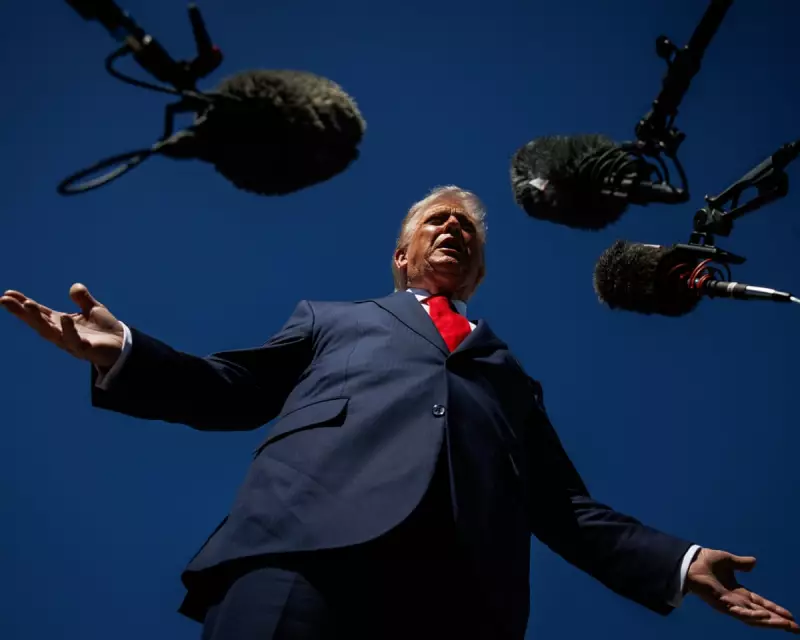
Donald Trump operates in a world of asymmetric warfare where conventional rules don't apply, giving him significant advantage over critics and political opponents. This dynamic has now ensnared one of Britain's most important institutions - the BBC - while revealing the former president's single greatest vulnerability.
The Asymmetry of Truth in Trump's World
The fundamental imbalance stems from Trump's relationship with factual accuracy. During his first White House term, the Washington Post documented 30,573 false or misleading statements - averaging 21 untruths daily. In a recent CBS 60 Minutes interview alone, he made 18 false claims according to CNN analysis, including incorrect assertions about grocery prices decreasing when they've actually risen and wildly exaggerating US aid to Ukraine.
This creates an impossible situation for those holding him accountable. While Trump faces minimal consequences for repeated falsehoods, his critics must maintain impeccable standards of accuracy. The expectation becomes: he can lie freely, but they cannot afford a single mistake.
BBC's Costly Error and Its Consequences
The BBC learned this lesson painfully when its Panorama programme examining Trump's record ahead of the 2024 election edited together two statements made 54 minutes apart from his January 6, 2021 speech, creating a misleading seamless call for violence. The corporation has since apologised for this journalistic failure.
This error provides ammunition Trump will undoubtedly exploit. White House press secretary already denounced the BBC as "100% fake news" and a "propagament machine" - language that will resurface whenever future BBC reporting challenges the administration. The incident highlights how institutions like the BBC must be bulletproof to maintain credibility in an increasingly polarised media landscape.
What makes this particularly damaging is Britain's reliance on the BBC as a bastion of shared facts. Unlike the United States, where red-state and blue-state realities diverge dramatically, the BBC helps maintain common ground. Without it, Britain risks following America's path where even Watergate-level evidence might fail to shift public opinion.
Epstein: Trump's Level Playing Field
Remarkably, there appears to be one area where Trump faces the same standards as everyone else: his connections to disgraced financier Jeffrey Epstein. Recent documents released by Democrats suggest Trump may have known more about Epstein's pattern of abuse than previously acknowledged.
This represents Trump's genuine vulnerability because the Maga base's attraction often stems from conspiracy theories about elite child abuse rings that Trump promised to expose. Evidence contradicting this narrative - showing friendship rather than opposition to Epstein - could fracture his core support in ways other scandals cannot.
The White House recognises this threat, currently working to prevent House of Representatives from voting for full release of justice department's Epstein files. Republican rebels aware of this issue's importance to their base may join Democrats in demanding transparency.
While Trump dismisses the revelations as another "hoax," the Epstein connection differs fundamentally from other controversies. This is the one battlefield where the asymmetry disappears, where Trump's usual tactics may prove ineffective against supporters who joined his movement specifically to combat the very abuses Epstein represents.
The ongoing situation demonstrates how traditional political warfare fails against an opponent unconstrained by conventional norms, while revealing the surprising vulnerability that could ultimately undermine his support where it matters most.