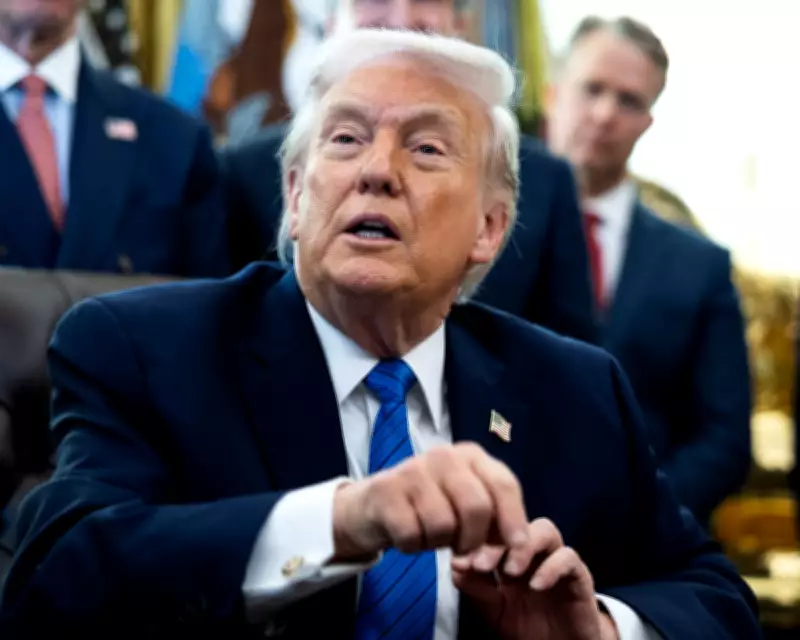
Former US President Donald Trump has publicly confirmed that high-level discussions are currently taking place between the United States and Cuban leadership, although he provided no specific details regarding the potential terms of any agreement. The announcement comes just days after Trump issued stark threats aimed at imposing a virtual oil blockade on Cuba, intensifying pressure on the communist-run island nation.
Negotiations Announced at Mar-a-Lago
Speaking to reporters at his Mar-a-Lago estate in Palm Beach, Florida, on Sunday, Trump stated, "Cuba is a failing nation. It has been for a long time but now it doesn't have Venezuela to prop it up. So we're talking to the people from Cuba, the highest people in Cuba, to see what happens." He added, "I think we're going to make a deal with Cuba." However, Trump notably refrained from elaborating on what such a deal might encompass, leaving the substance of the negotiations shrouded in uncertainty.
Escalating Economic Pressure
This development follows a series of aggressive moves by Trump's administration to ratchet up economic pressure on Cuba. On Thursday, Trump signed an executive order that threatens to impose additional tariffs on countries that sell oil to Cuba, a measure directly targeting the island's already strained energy supplies. The impact was immediate, with reports emerging on Friday of long queues forming at petrol stations across Havana as Cubans scrambled for fuel.

Trump had previously warned on Saturday, "It doesn't have to be a humanitarian crisis. I think they probably would come to us and want to make a deal ... They have a situation that's very bad for Cuba. They have no money. They have no oil. They lived off Venezuelan money and oil, and none of that's coming now." His rhetoric has been uncompromising, with earlier statements declaring, "NO MORE OIL OR MONEY FOR CUBA: ZERO!" and asserting that Cuba is "ready to fall."
Strategic Context and Regional Dynamics
The heightened tensions coincide with significant shifts in regional alliances, particularly following the ousting of Venezuelan leader Nicolás Maduro, who was a close ally of Havana and a crucial supplier of oil to Cuba. Trump and key figures like Secretary of State Marco Rubio, the Miami-born son of Cuban exiles, have openly expressed their desire for regime change in Havana, framing the current negotiations within this broader strategic objective.
In response, the Cuban government has accused Trump of deliberately seeking to strangle the island's economy, which is already grappling with severe challenges such as daily power cuts and worsening fuel shortages. The situation has raised concerns about a potential humanitarian crisis, with some international observers warning that the US's hardline approach could exacerbate the plight of ordinary Cubans.
As talks proceed behind closed doors, the international community watches closely to see whether these negotiations will lead to a diplomatic breakthrough or further escalate the longstanding tensions between the two nations. The outcome could have profound implications for US-Cuba relations and the geopolitical landscape of the Caribbean region.