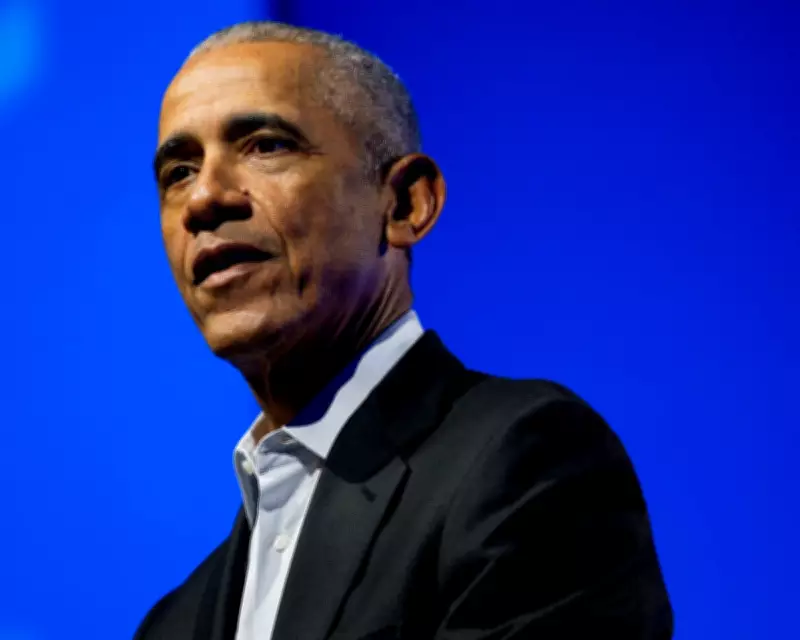
Obama Issues Clarification After Podcast Comments Spark Alien Frenzy
Former United States President Barack Obama has released a formal statement clarifying remarks he made during a podcast interview that sparked global speculation about extraterrestrial life. The statement, posted on Instagram, directly addresses comments Obama made during a rapid-fire question segment with podcast host Brian Tyler Cohen over the weekend.
The Podcast Comments That Started It All
During the speed round interview format, where guests provide brief answers to quick questions, Obama was asked directly: "Are aliens real?" The former president responded with: "They're real but I haven't seen them." He continued with additional commentary, stating: "They're not being kept at Area 51. There's no underground facility unless there's this enormous conspiracy and they hid it from the president of the United States."
These comments were immediately picked up by media outlets worldwide, with headlines proclaiming "Former US president Barack Obama says aliens are real" and "'They're real': Obama's shock alien claims." Major publications including Time Magazine covered the developing story, reporting on what appeared to be confirmation of extraterrestrial existence from a former world leader.

The Official Clarification
Following the media frenzy that ensued, Obama took to social media to provide context and clarification. "I was trying to stick with the spirit of the speed round, but since it's gotten attention let me clarify," Obama wrote in his Sunday evening statement.
He elaborated on his position: "Statistically, the universe is so vast that the odds are good there's life out there. But the distances between solar systems are so great that the chances we've been visited by aliens is low, and I saw no evidence during my presidency that extraterrestrials have made contact with us. Really!"
Area 51 Conspiracy Theories and Historical Context
The mention of Area 51 references one of America's most enduring conspiracy theories regarding extraterrestrial life. The highly classified air force facility in Nevada has long been rumored to house alien spacecraft and extraterrestrial beings recovered from crash sites.
In 2019, this fascination reached a peak when approximately 150 social media influencers gathered around the airstrip after 1.5 million people signed up to "storm" the site. The event ultimately ended anticlimactically, resulting in only a few arrests and transforming into what essentially became a music festival rather than a revolutionary investigation.
Declassified documents released in 2013 provided official insight into Area 51's actual purpose. The secret airstrip was revealed to have been used for aerial testing of United States government projects, including the U-2 and Oxcart aerial surveillance programs. Interestingly, these documents acknowledged that "high-altitude testing of the U-2 soon led to an unexpected side-effect – a tremendous increase in reports of unidentified flying objects (UFOs)."
The Broader Context of Extraterrestrial Discussion
Obama's comments and subsequent clarification come during a period of increased public and governmental interest in unidentified aerial phenomena. The discussion reflects ongoing debates about the existence of extraterrestrial life and the possibility of contact with other civilizations.
The former president's statement carefully balances scientific probability with governmental transparency, acknowledging the statistical likelihood of life elsewhere in the universe while firmly stating that no evidence of contact exists within official channels. This nuanced position reflects both the curiosity about cosmic possibilities and the responsibility of former leaders to provide accurate information about government knowledge and capabilities.
As discussions about extraterrestrial life continue to capture public imagination, statements from figures like Obama highlight the intersection between scientific inquiry, government transparency, and popular culture's fascination with the unknown. The episode demonstrates how quickly casual remarks can become international news and the importance of clear communication from public figures on topics that generate widespread public interest.