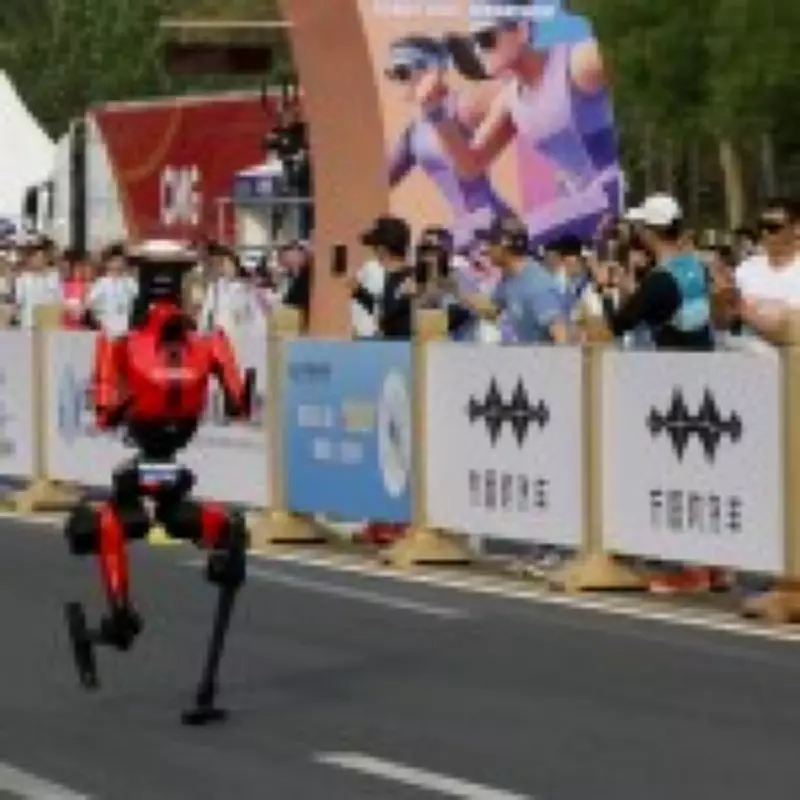
Humanoid Robot Lightning Sets New Half-Marathon World Record in Beijing
A bright-red humanoid robot named Lightning has shattered the world record for a half-marathon, completing the 21-kilometer (13-mile) distance in just 50 minutes and 26 seconds during a race in Beijing. This remarkable performance occurred despite the robot tripping into a barricade during the final stretch of the event.
Record-Breaking Performance Amidst Adversity
According to state-run China Daily, the 5'5" robot weighing 45kg managed to finish nearly seven minutes faster than the previous human record of 57 minutes held by Jacob Kiplimo. The incident with the barricade didn't prevent Lightning from claiming victory in the Beijing E-Town Half Marathon, where more than 300 robots participated on a separate track from 12,000 human runners.
State media outlet CCTV reported that approximately 40% of the robot competitors were fully autonomous, operating through sophisticated algorithms, while the remaining robots were controlled remotely by human operators. This distinction became crucial in determining the final standings.
Competition Rules and Robot Performance
Two other autonomous Lightning models secured silver and bronze medals with finish times of approximately 51 minutes and 53 minutes respectively. Interestingly, a fourth Lightning robot actually completed the race faster than all others with a time of 48 minutes and 19 seconds, but competition rules required multiplying remote-controlled robot times by 1.2, eliminating its chance at victory.
The race wasn't without its dramatic moments. Several robot models collapsed during the competition, including an H1 model from robotics firm Unitree that fell just moments before reaching the finish line. Unitree had previously claimed their robot could sprint at 10 meters per second, approaching the speed of world's fastest human Usain Bolt.
Trial Run Troubles and Social Media Reaction
Despite their impressive performance during the actual race, all top-winning robots had experienced difficulties during a trial run on April 12. One robot was filmed falling headfirst at the starting line, shattering into pieces and prompting a medical crew to lift its remains onto a stretcher in a scene that drew both amusement and commentary on social media.
Social media users reacted with both humor and philosophical questions about the event. One X user pondered, "Didn't humans invent the wheel precisely so machines could run faster?" while others commented on the ironic spectacle of emergency crews treating broken robots as if they were injured humans.
Technical Specifications and Industry Significance
Lightning represents the LRobotics D1 robot line, designed by studying the movements of elite human athletes. Engineers told Global Times that the robot's joints feature a liquid-cooling system similar to those found in modern smartphones. Chinese navigation platform Amap revealed their robotic athlete could navigate tracks using geolocation technology and could be commanded to perform tasks like buying coffee or picking up deliveries.
Beijing officials hailed the event as a "major step forward for the robotics industry" despite many robots tumbling and failing during the competition. China has embraced robotics technology in recent years, now employing more than two million robot workers—more than the rest of the world combined.
China's Growing Robotics Industry
The International Federation of Robotics reported that China installed 542,000 factory robots in 2024 alone, more than double the number from a decade earlier. These machines range from welding robots for automotive manufacturing to robotic claws for logistics and warehouse operations.
Beyond industrial applications, China has expanded into consumer robotics including robotaxis—self-driving cabs now common in cities like Wuhan and even appearing in London. However, these technologies aren't without challenges, as demonstrated earlier this month when dozens of passengers were trapped for hours in malfunctioning self-driving vehicles in Wuhan due to system faults.
The Beijing half-marathon represents both the impressive capabilities and current limitations of humanoid robotics, showcasing machines that can outperform humans in specific physical tasks while still struggling with basic navigation and stability challenges that humans navigate effortlessly.